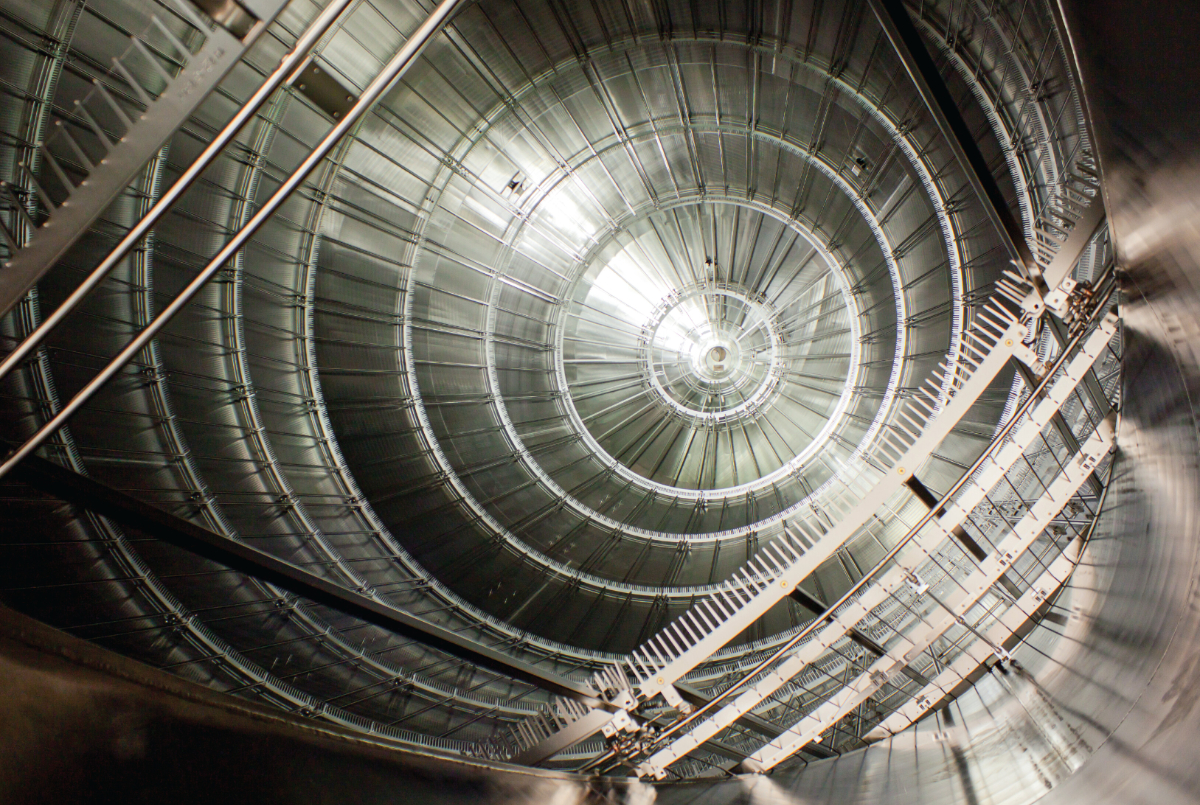
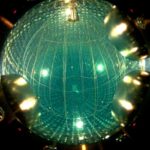
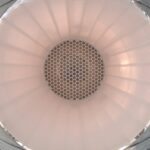
The 24-m-long main spectrometer of the KATRIN experiment is operated under ultrahigh vacuum. Credits: Michael Zacher/ KATRIN Collaboration
The KATRIN collaboration has succeeded in determining a new upper limit of 0.45 eV/c² for the neutrino mass. “The new result is a milestone on the way to the measurement goal of KATRIN,” says Kathrin Valerius, co-spokesperson of the KATRIN collaboration and professor at the Karlsruhe Institute of Technology.
Neutrinos play a key role both in the universe and in the world of fundamental particles, as they connect cosmic and subatomic scales: As remnants of the Big Bang, neutrinos still permeate our cosmos in large numbers – they are billions of times more abundant than atoms. As “cosmic architects”, they have helped shape the development of the universe. Their small but non-vanishing rest mass goes beyond the established standard model of elementary particle physics. It has not yet been possible to measure the neutrino mass directly in the laboratory.
The world-leading KArlsruhe TRItium Neutrino experiment (KATRIN) measures the neutrino mass using a direct and model-independent method. The KATRIN measurement is based on the work of W. Pauli and E. Fermi, who showed almost 100 years ago that precise beta decay spectroscopy can make the tiny neutrino mass visible. KATRIN analyzes the decay of the hydrogen isotope tritium into ³He in order to determine the neutrino mass from the energy distribution of the beta electrons. To do this, KATRIN needs a powerful tritium source operated at the Tritium Laboratory Karlsruhe (TLK). Measurement operations have been running since 2019 and will continue until the end of 2025.
Since 2002, leading European institutions have advanced early-stage training in astroparticle physics through the International Schools on Astroparticle Physics (ISAPP). This initiative fosters student mobility, knowledge exchange, and research collaboration, offering PhD students and early career researchers the chance to engage with experts. ISAPP organizes annual intensive schools in various locations, offering an immersive experience that enhances doctoral training while sparking innovation, discovery, and global collaboration.
Please find more information in the ISAPP newsletter: Issue 1, 2025
The APPEC Town Meeting will be held on-site in Zaragoza, Spain on 23-24 September 2025.
Town Meeting 2025: Preparation of the 2027-2036 Strategic Roadmap
As input for the preparation of the roadmap, a community survey took place over the last months. A briefing book including all Astroparticle Physics topics from the survey will be prepared by the APPEC Scientific Advisory Committee and released in summer.
During the Town Meeting we will further discuss each of these topics with respect to the European and international context, and the new developments in Astroparticle Physics and in the neighbouring fields that will shape the strategic recommendations of the next roadmap.
The 2-day meeting format includes plenary talks as well as round table discussions for each topic, to ensure a large participation of the community to shaping the future of Astroparticle Physics strategic orientations.
The discussions at the Town Meeting will serve as input for the European Astroparticle Physics Strategy 2027-2036.
The Astrophysics Centre of Multimessenger studies in Europe (ACME) project has opened the 1st Transnational Access call for its Centres of Expertise.
The deadline for the proposal submission is April 6th, 2025 at 17:00 CET.
The call aims to support research visits to European institutes that provide direct training and expert guidance in multi-messenger astronomy. The program covers a wide range of domains, including gravitational waves, neutrinos, cosmic rays, and photons across the entire electromagnetic spectrum, from very-high-energy gamma rays to X-rays, UV, optical, near-infrared, and radio bands. The goal is to enhance and expand expertise in the observational, data analysis, and theoretical aspects across the various ACME messengers and multi-wavelength domains.
Eligible candidates are scientists ( (PhD students, post-doc fellows, staff) from research institutes and universities in both EU and non-EU countries.
ACME objectives are to implement the APPEC and ASTRONET roadmaps’ recommendations and act as a pathfinder to broaden and improve access to the respective research infrastructures services and data.
The ACME project has received funding from the European Union’s Horizon Europe Research and Innovation programme under Grant Agreement No 101131928.
The muon neutrino detected by KM3NeT has an estimated energy of 220 PeV. Credit: KM3NeT
The KM3NeT Collaboration announces the detection from the abyss of the Mediterranean Sea of a cosmic neutrino with a record-breaking energy of about 220 PeV
An extraordinary event consistent with a neutrino with an estimated energy of about 220 PeV , was detected on February 13, 2023, by the ARCA detector of the kilometre cubic neutrino telescope (KM3NeT) in the deep sea. This event, named KM3-230213A, is the most energetic neutrino ever observed and provides the first evidence that neutrinos of such high energies are produced in the Universe. After long and meticulous work to analyse and interpret the experimental data, today, February 12, 2025, the international scientific collaboration of KM3NeT reports the details of this amazing discovery in an article published in Nature.
The detected event was identified as a single muon which crossed the entire detector, inducing signals in more than one third of the active sensors. The inclination of its trajectory combined with its enormous energy provides compelling evidence that the muon originated from a cosmic neutrino interacting in the vicinity of the detector.
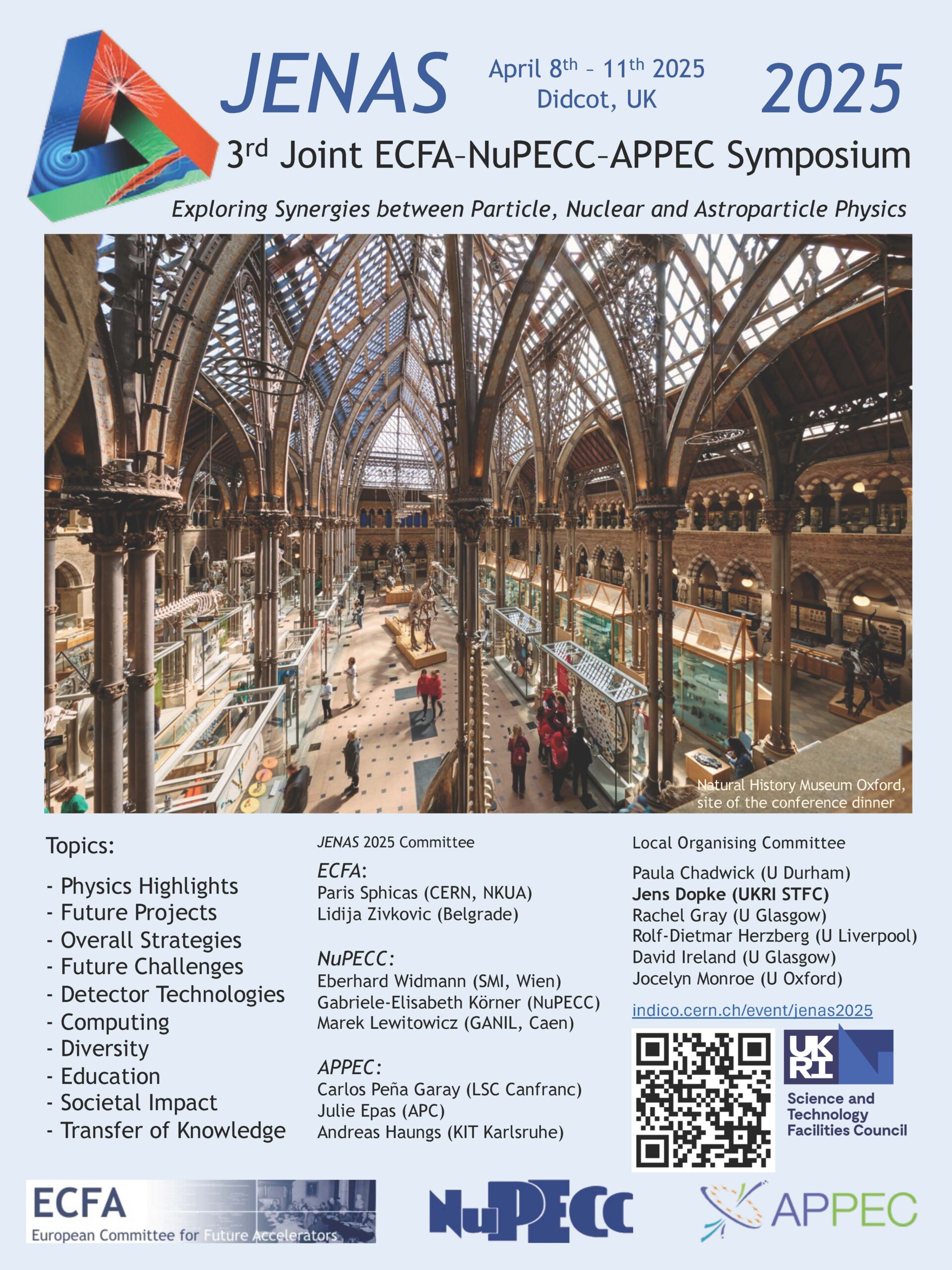
The 3rd Joint ECFA-NuPECC-APPEC Symposium (JENAS) will be held from April 8th to 11th, 2025 in Harwell Campus, Didcot, Oxfordshire, UK: https://indico.cern.ch/event/jenas2025/
The Symposium is a major joint meeting of the particle, nuclear and astroparticle physics scientific communities that takes place every three years with the goal of exploring synergies and highlighting recent achievements and challenges in the three scientific fields. The participants are scientists from the three communities, the funding agencies as well as large international projects and collaborations.
The many synergies between Particle, Nuclear and Astroparticle Physics are addressed in this 3rd Joint Symposium. Physics highlights, future projects and strategies as well as challenges in detector technology and computing are discussed, together with progress on seven approved joint activities.
an EU-funded project built by and for the astroparticle and the astronomy communities
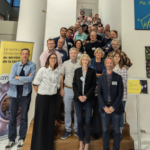
On the 16th and 17th of September was held in Paris the kick-off meeting for the Astrophysics Centre for Multimessenger studies in Europe – ACME. This HORIZON-INFRA-2023-SERV-01 EU-funded project coordinated by Centre national de la recherche scientifique CNRS aims to realize an ambitious coordinated European-wide optimization of the accessibility and cohesion between multiple leading astroparticle and astronomy research infrastructures, offering access to instruments, data and expertise, focused on the new science of multi-messenger astrophysics.
With 40 world-class collaborating institutions from 15 countries, ACME brings together the astroparticle and astronomy communities in a joint effort to forge a basis for strengthened long-term collaboration between these research infrastructures irrespective of location and level up access opportunities across Europe and beyond.
ACME objectives are to implement the Astroparticle Physics European Consortium’s (APPEC) and the Planning and Advisory Network for European Astronomy’s (ASTRONET) roadmaps’ recommendations and act as a pathfinder to broaden and improve access to the respective research infrastructures services and data, assess and evaluate new models for better coordination and provision of at-scale services, provide harmonized trans-national and virtual access, develop centres of expertise, improve science data products management, improve interoperable systems for rapid identification of astrophysical candidate events and alert distribution to optimize follow-up observations, provide training for a new and broader generation of scientists and engineers, open the astrophysics and astroparticle physics data sets to other disciplines and increase citizen engagement.
The ACME project coordinator Prof. Antoine Kouchner (APC – CNRS/Université Paris Cité), and co-coordinator Paolo D’Avanzo (INAF), represent each community to ensure balance and drive cross-domain collaboration.
“With ACME the astrophysics and astroparticle communities are coming even closer together. The bridge between the communities has already been strengthened during the preparation phase for the proposal. This augurs an even stronger collaboration and a productive dialogue to advance science” says Antoine Kouchner, Vice-President of International Relations at Université Paris Cité, Deputy Director at APC and Vice-Chair of APPEC.
Contact: Antoine KOUCHNER, Scientific Coordinator (CNRS/UPCité): kouchner@apc.in2p3.fr Paolo D’AVANZO, Scientific Co-coordinator (INAF): paolo.davanzo@inaf.it Julie EPAS, Project Manager (CNRS): epas@apc.in2p3.fr
Funded by the European Union. Views and opinions expressed are however those of the author(s) only and do not necessarily reflect those of the European Union or of the European Research Executive Agency (REA). Neither the European Union nor the granting authority can be held responsible for them.
This survey aims to engage with the European Astroparticle Physics community in order to collect useful information for the next APPEC roadmap. The data collected will be beneficial both for compiling statistics and gathering information. We therefore warmly invite you to participate individually, as a research group, or as a representative of a collaboration in the present survey.
Your opinion is valuable to us.
We ask that the survey be completed by the end of November 2024.
Borexino succeeded for the first time to measure the entire energy spectrum of neutrinos that the Sun produces exploiting techniques that allowed to obtain unprecedented levels of radiopurity, which as of today represent the state-of-the-art. Experiments currently underway or in preparation, such as those studying rare events (dark matter direct detection, neutrinoless double beta decay, reactor neutrinos) use technologies that largely derive from Borexino.
Borexino definitively helped answering Humanity’s age-old question about how the Sun and stars shine. This is a historic result that has been expected for more than eighty-five years when, in late 1930s, Hans Bethe and Carl Friedrich von Weizsäcker hypothesized what Borexino has now confirmed for the first time: stars are producing energy by the so-called pp-chain and CNO bi-cycle processes.
Inside view of the Borexino detector. Credits: Borexino
Alongside hypothetical dark matter particles, neutrinos from the sun have long been predicted to be observables in detectors built to search for dark matter nuclear recoil signals with large time projection chambers filled with liquid Xenon. Observing this feeble signal, with energy barely detectable, requires excellent detector performance and sophisticated signal-to-background discrimination. This has been demonstrated by XENONnT operating at the Gran Sasso Laboratory in Italy.
A slight sign of 8B signal is also reported at the same meeting by the PandaX-4T a similar detector operated at the Jingping underground laboratory in China.