On the slopes of the Mt. Elbrus, the 16th International Baksan School on Astroparticle Physics was held, organized jointly by the Institute for Nuclear Research (INR) of RAS and the Joint Institute for Nuclear Research (JINR) with the participation of the Astroparticle Physics European Consortium (APPEC) and the Russian Foundation for basicResearch (RFBR). After a 15-year break, the world-famous series of schools held near the Baksan Neutrino Observatory of the INR RAS was revived.
Among the participants of the School, there were 58 postgraduates, senior students, and young scientists from 9 countries of three parts of the world. Participation of European students became possible thanks to APPEC support; many Russian listeners were supported by JINR and the INR RAS, and the RFBR grant gave an opportunity to cover the business trip expenses of invited lecturers. “At the School, I saw a well-balanced composition of the deepened theoretical basis, the modern state of science and the view on future astrophysical experiments, and all this was presented by great lecturers. A large number of fairly good questions asked by participants, and their vivid interaction confirms the great success of the School that should definitely be held again in the same format,” as quoted by Thomas Berghöfer (DESY, Germany), who also delivered the lecture “Ultimate Low Light-Level Sensor Development”.
A more comprehensive report can be found in their press release and on the webpage which also provides additional material.
The Dawn V meeting to assess and develop world-wide coordination for the next generation of ground-based gravitational-wave observatories will be held at the Virgo/EGO Observatory from 26-27 May 2019 in Cascina, Italy. It follows the GWADW meeting in Elba, Italy, and the PAX VI meeting (starting immediately after Dawn, in Cascina)
With the observation of the first gravitational-wave event from a binary neutron star, GW170817, during Advanced LIGO and Virgo’s second observation run, multimessenger astronomy with gravitational waves has started. The current generation of gravitational-wave detectors now serves a wide community including fundamental physics, astrophysics, astronomy, cosmology and nuclear physics. The observations to date and their widespread impact on science make the argument for future facilities quite compelling.
The one and one-half day program of this meeting will have a focus on the recently completed Gravitational-Wave International Committee study of third generation detectors (3G), and seeking the next significant steps for the community to realize the future network. Of particular interest is the proper coordination between the European effort proposing to build an observatory detailed by the ‘Einstein Telescope’ design study, and the U.S. proposal of a similar class observatory, named ‘Cosmic Explorer’.
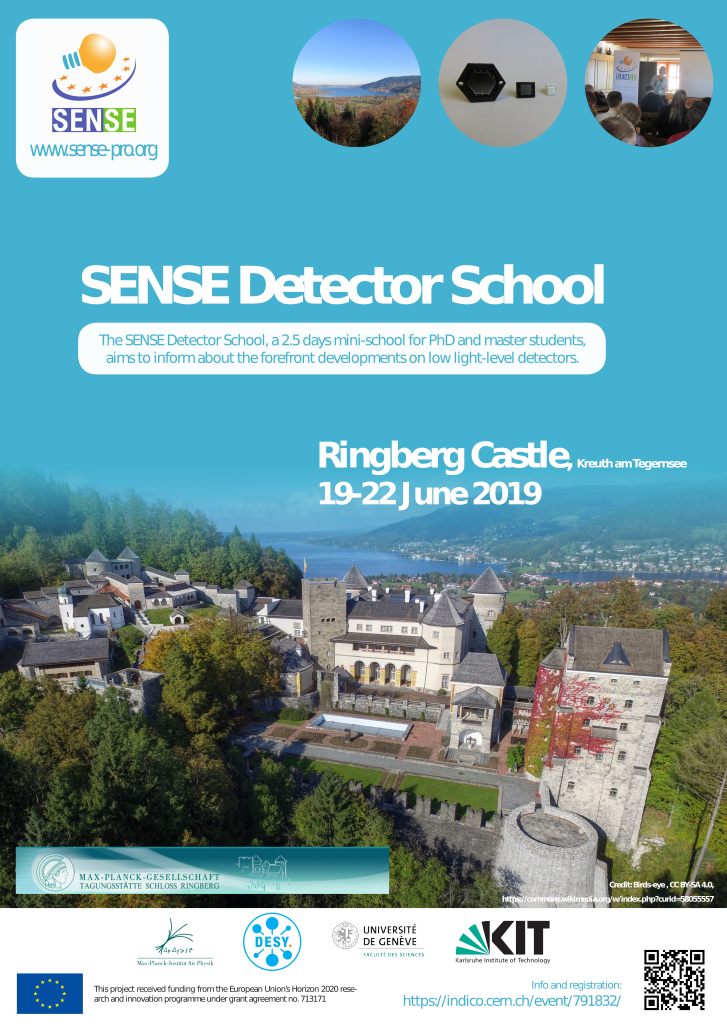
We are happy to announce the SENSE Detector School at the Ringberg Castle in Kreuth am Tegernsee in Bavaria, Germany, from 19 – 22 June 2019. The 2.5 days mini-school for PhD and master students aims to inform about the forefront developments on low light-level detectors.
The speciality of the school is the small group of students with a continuous possibility to discuss with the teachers.
The participation of 25 students is sponsored by SENSE. You can apply for the school until 3 May 2019 with a letter of motivation. The nomination of participants will be announced on 10 May 2019. We aim to achieve a balanced mix of working topics as well as gender and nationalities.If required, childcare can also be organised.
As soon as the timetable has been finalised, a decision will be made on a possible contribution from the students.
The 36th ICRC will be held in beautiful Madison, Wisconsin, USA from July 24th – August 1st.
The International Cosmic Ray Conference, or ICRC, is a physics conference organized biennially by the Commission C4 (Astroparticle Physics) of the International Union of Pure and Applied Sciences (IUPAP) since 1947, where physicists from the world present the results of their research in Astroparticle Physics. The meeting covers cosmic-ray physics, neutrino physics, gamma-ray astonomy, dark matter, particle astrophysics, and detector techniques in these fields.
Rear-side view of a suspended mirror. Image credit: EGO/Virgo Collaboration/Perciballi.
The Virgo and LIGO detectors are ready to start the new Observing run called O3, lasting a whole year. The hunt for gravitational waves is set to start on April 1st when the European Virgo detector, based in Italy at the European Gravitational Observatory (EGO), and the LIGO twin detectors, located in the state of Washington and Louisiana (USA), will start to take data becoming together the most sensitive gravitational wave observatory to date.
During a one-year period the LIGO and Virgo Collaborations will register science data continuously, and the three detectors will operate as a global observatory. Since August 2017, the end of the second observation run O2, the two collaborations have intensively worked on their interferometers to improve the sensitivity and reliability. Scientists have also improved their offline and online data analysis and developed further the procedures for releasing Open Public Alerts: these will within minutes notify the physics and astronomy community when a potential gravitational-wave event is observed.
The scientific output of observation run O3 is expected to be tremendous and it will potentially reveal new exciting signals coming from new sources.
The Helmholtz Association is funding an international graduate school for multi-messenger astronomy, which is organised by DESY, the Humboldt University Berlin, the University of Potsdam and the Israeli Weizmann Institute of Science.
Multimessenger astronomy, the exploration of the Universe using a multitude of cosmic messengers, has led to several groundbreaking discoveries during the last few years, many of which built on significant contributions from the partner institutions.
With a new generation of instruments, advanced methods of exploiting their data, as well as extensive theoretical modeling, members of this research school have unique research opportunities in this emerging field.
The partner institutions are involved in several leading observatories, e.g. the Cherenkov Telescope Array, the IceCube neutrino observatory or the Zwicky Transient Facility, to which the students will have access.
Last week the International Workshop on Neutrino Telescopes took place in Venice, Italy. The focus of the workshop was Multimessenger Physics. Matching the topic of the conference the chair of the APPEC General Assembly Teresa Montaruli gave a talk on Multimessenger Physics and the APPEC strategy.
In the end a round table, moderated by T. Montaruli, with F. Halzen and C. Rubbia on Perspectives and Challenges of Multimessenger Astrophysics took place. F. Halzen discussed Multimessenger in connection to particle physics and the future of neutrino astronomy was discussed by A. Karle. The question was raised how APPEC will support the R&D: by increasing synergy of Gravitational Waves, Dark Matter and Neutrino Double Beta Decay experiments and involving CERN, Technology Fora and ECFA Panel.
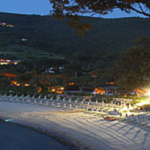
The GWADW2019 – From Advanced Interferometers to Third Generation Observatories – will take place from 19-25 May 2019 at Hotel Hermitage, La Biodola, Isola d’Elba.
After the detection of a Binary Neutron Star (BNS) merger, following earlier Binary Black Hole (BBH) merger detections, Gravitational Wave Detection Astronomy is now entering a new phase with a year long observational period beginning early 2019. Multimessenger Astronomy is coming with new questions that can be only partially answered with present instruments, even taken to their limit performance.
In the medium term Gravitational wave astronomy is calling for third generation observatories, surveying with high statistics source populations while recording also fainter, remote or low rate sources. The design of third generation observatories is entering a detailed phase while the construction of the best possible instruments in the current sites is starting. All this requires detailed studies and experimentation to master the difficult challenges being faced, learning from present instruments and exploring new frontiers.
This workshop is the main place where new ideas as well as research and development for future gravitational wave detectors are discussed, covering all instrumental aspects of gravitational wave detection.
The 22nd International Conference on General Relativity and Gravitation and the 13th Edoardo Amaldi Conference on Gravitational Waves will take place from July 7-12, 2019 in Valencia, Spain.
GR22 is the latest in the series of triennial international conferences held under the auspices of the International Society on General Relativity and Gravitation. This conference series constitutes the principal international meetings for scientists working in all areas of relativity and gravitation. The Amaldi conferences are held under the auspices of the Gravitational Wave International Committee. Since 1997, they have been held every two years and are regarded as the most important international conferences for the gravitational-wave detection community. In Valencia, GR22 and Amaldi13 are organized as a joint event. The organization is coordinated by Drs. José Antonio Font and José Navarro-Salas, from the University of Valencia (UV) / Instituto de Física Corpuscular (UV-CSIC), on behalf of a large national committee. Organisational support is provided by the Fundación Universidad Empresa UV – ADEIT.
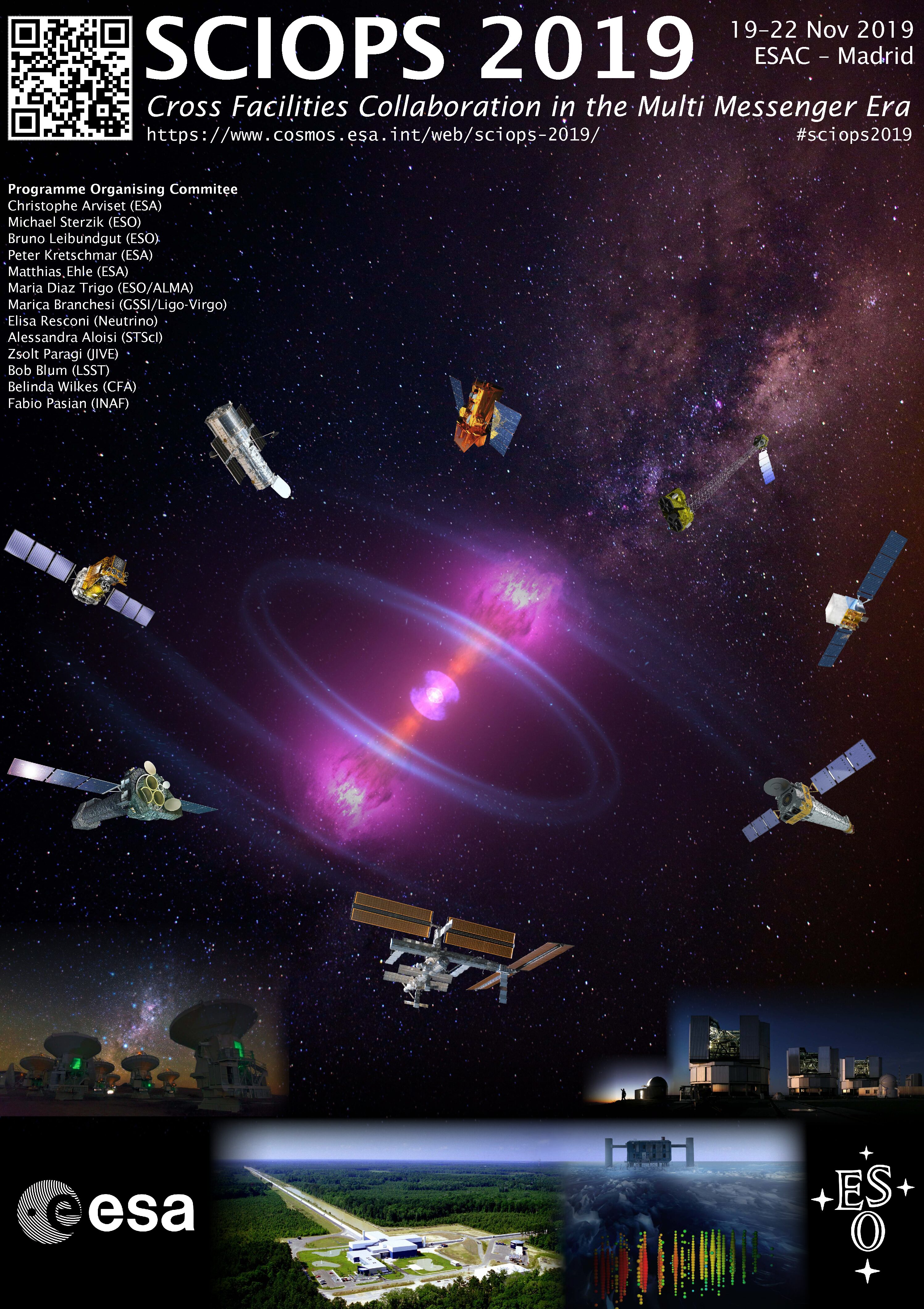
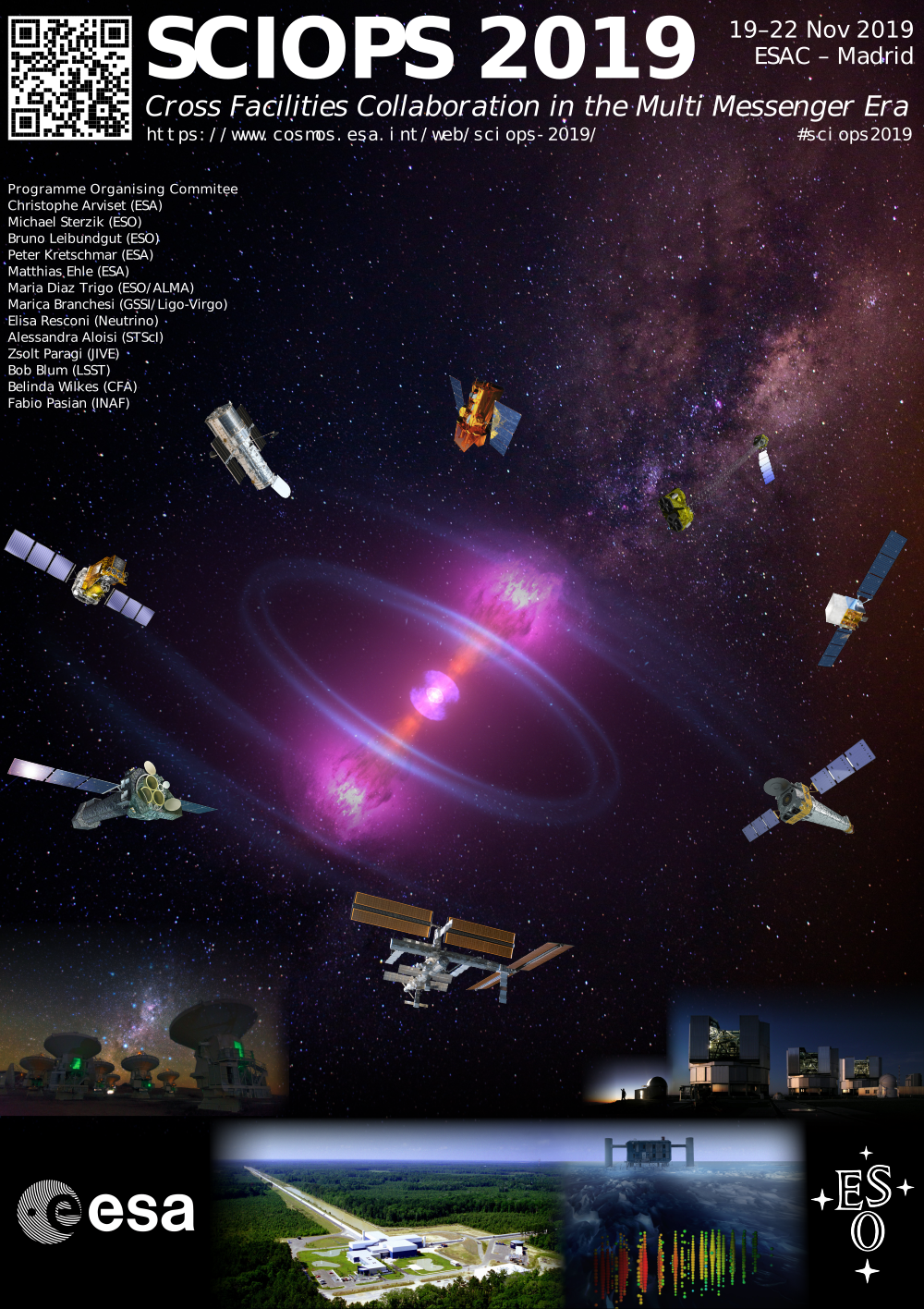
The ESA/ESO SCIOPS workshop 2019 on “Cross Facilities Collaboration in the Multi Messenger Era” will be held from 19-22 November 2019 at the European Space Astronomy Centre (ESAC), ESA, Villanueva de la Cañada, Madrid, Spain.
With the observations of electromagnetic counterparts to gravitational wave events and to high-energy neutrinos, astrophysics has entered the multi-messenger era. New powerful survey facilities at different wavelengths are becoming reality and will hugely increase the number of potentially interesting targets in the next few years. A growing network of observatories is being made ready to follow up on exciting events. But the sheer number of expected follow-up targets and the complexities of collaboration and coordination among wide groups of researchers and different observatories poses many challenges to the existing means and ways of working.
At the same time, technology continues to make rapid advances, allowing for unprecedented interconnectivity, fast and interactive visualisation and new methods of machine-supported analysis for huge data sets. As the everyday experience of dealing with technology and information evolves, so do requirements on the organisations providing data to the scientific community and the general public.
This 4th ESA-ESO collaborative workshop will focus on the experiences gained in the last years in multi-mission, multi-wavelength and multi-messenger collaboration, on the challenges for the coming years and on ideas and approaches to tackle these challenges.




 On the slopes of the Mt. Elbrus, the 16th International Baksan School on Astroparticle Physics was held, organized jointly by the Institute for Nuclear Research (INR) of RAS and the Joint Institute for Nuclear Research (JINR) with the participation of the Astroparticle Physics European Consortium (APPEC) and the Russian Foundation for basicResearch (RFBR). After a 15-year break, the world-famous series of schools held near the Baksan Neutrino Observatory of the INR RAS was revived.