The European Strategy for Particle Physics provides a clear prioritisation of European ambitions in advancing the particle physics science. The Strategy is due to be updated by May 2020 to guide the direction of the field to the mid-2020s and beyond.
To optimally inform all participants in the process, the Secretariat of the European Strategy Group (ESG) called upon the particle physics community across universities, laboratories and national institutes to submit written input by 18 December 2018 to prepare the discussions on the Strategy Update which will take place in 2019.
All of the proposals will be analysed at a public scientific symposium that will be held in Granada, Spain in May 2019. The contributions and discussions will help shape the long-term priorities of particle physics in Europe. These priorities will be formalised at the beginning of 2020 in the update of the European Strategy for Particle Physics.
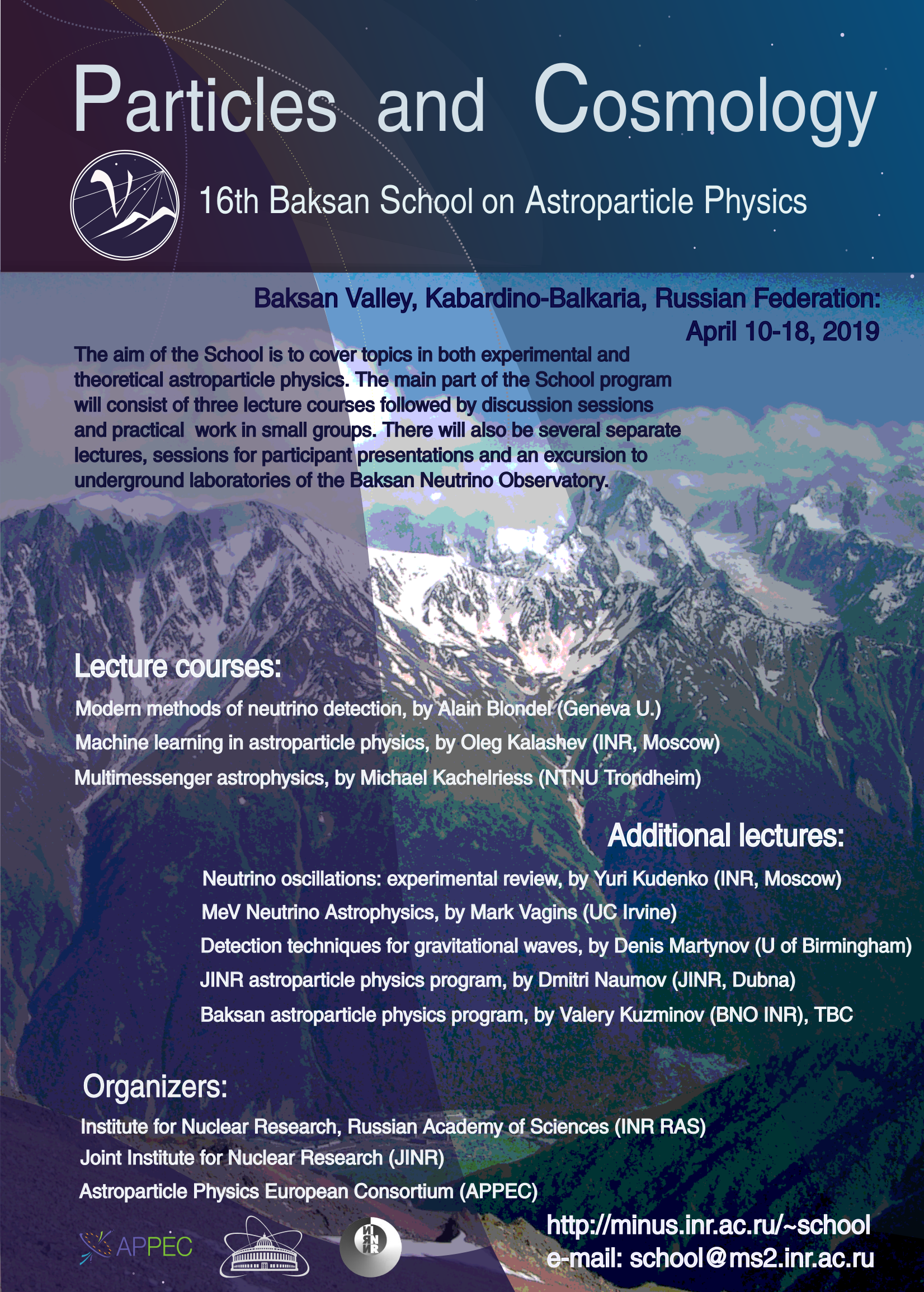
The aim of the School is to cover topics in both experimental and theoretical astroparticle physics. The program of the school will include three main lecture courses followed by tutorials, practical and discussion sessions, together with several separate lectures, special session for participants presentations and excursion to underground laboratories of the Baksan Neutrino Observatory. The School is addressed to advanced masters students, graduate students and postdocs working in astroparticle physics.
The key features of the school are:
* Three 6-lecture courses by leading experts (neutrino detection, machine learning, multimessenger astrophysics), supplemented by tutorials, practical work, more lectures and participants’ talks.
* Excursion to Baksan Neutrino Observatory underground labs (4800 mwe).
* Location in a national park close to Mt. Elbrus (5642), one of the “Seven Summits” of the World, with possibilities for skiing and hiking during long mid-day breaks.
* Low registration fee (325 EUR including full-board lodging, airport transfer, banquet and excursion) and fellowships covering the fee.
APPEC is organizing the Workshop on Observatory Synergies for Astroparticle Physics and Geoscience with the geoscientists of GEO-8 and the co-sponsoring of the Academia Europaea. The workshop will be held at the Institut de Physique du Globe de Paris (IPGP) on February, 11-12 2019 (afternoon to morning).
It will provide a venue for discussing the development of relatively recent and highly promising applications of astroparticle physics in the geosciences, including gravitational, muon, and neutrino imaging, innovative fiber-based monitoring systems, data collection in extreme environment, etc.
Furthermore, this workshop represents the ideal occasion for improving exchange and cooperation with geoscientists.
Details and the workshop program can be found here:
Rationale. The recent convergence between Geoscience and Astroparticle Physics. In the last years there appeared many areas of natural synergy between Geosciences and Astroparticle Physics. Earth and Astroparticle sciences share a mutual scientific culture based on common objects of study, methods and approaches. They both deal with complex natural systems at much larger scales than the human scale, need deployments of large sensor networks in sometimes very hostile environments (sea, desert, underground, space), use long series of precise observations acquired over a range of time scales. They develop models relying on the state of the art in fundamental physics, chemistry, earth sciences, biology, numerical and computer sciences. They finally use big data analysis and transfer and worldwide networking. In particular, some of the synergies concern:
Imaging (gravitational, acoustic, muon, neutrino)
Data collection in extreme environment
New technological means for parameter monitoring
Contribution to the understanding and forecasting of natural hazards
Aim and structure of the workshop. The main aim of the proposed workshop is to explore the possible common grounds and combine the scientific expertise of both fields, involving key PIs of the respective fields together, in order to promote original interdisciplinary research and education projects. The structure of the workshop will be as follows: There will be a series of short presentations by key PI’s on the possible synergies and the cases developed up to now, followed by a discussion and a closing meeting with organisations collaborating in APPEC and GEO-8, as well as other Geosciences and Astrophysics agencies. Common lines of action, regarding co-funding or common applications to European calls, and international collaborations will be explored. The workshop will also examine opportunities for future coordination during the last part of the H2020 (2018-2020) and the forthcoming Horizon Europe programs.
Organizing Committee:
Michel Diament (Institut de Physique du Globe de Paris)
Philippe Jousset (Helmholtz Centre GFZ)
Stavros Katsanevas (Director of EGO – European Gravitational Observatory)
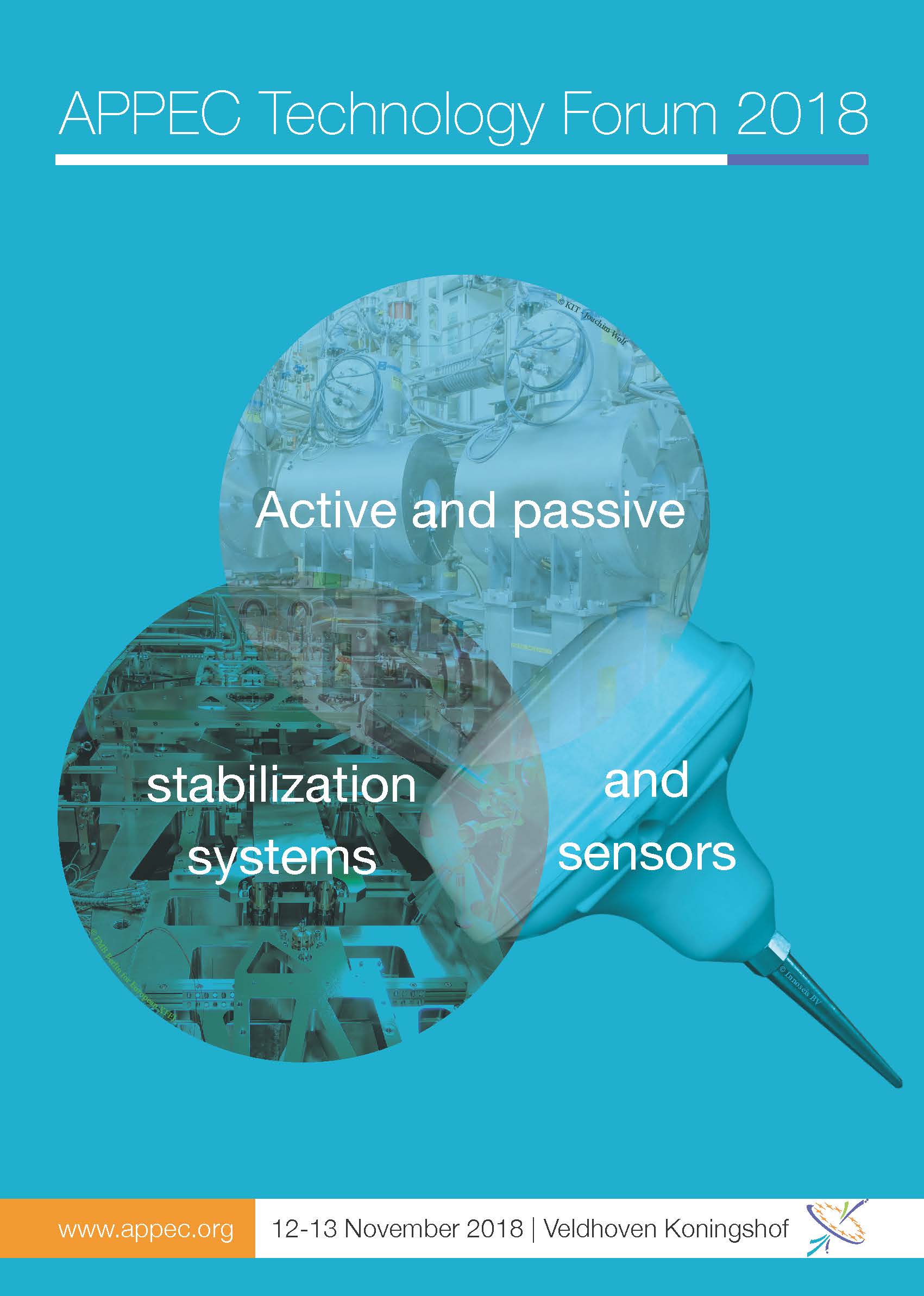
Topic: Active and passive stabilization systems and sensors
The Astroparticle Physics European Consortium APPEC is inviting technology experts from industry and academia to the APPEC Technology Forum 2018 (ATF 2018) on Nov 12-13 2018 in Veldhoven, near Eindhoven in The Netherlands.
For the sixth year, ATF 2018 will provide the necessary framework for discussions among all the stakeholders fostering new R&D activities, improving existing technology and supporting current and emerging intra- and extra-field collaborations.
With the intention of laying the foundations for future cooperation involving industry and academia, this year the ATF 2018 will concentrate on the development of holders and positioning systems for high-stability setups, where vibrations can be detected with special sensors and then suppressed, extending to other forms of active and passive stabilization needed in many scientific experiments. This technology can have a wide range of applications, for example, where mirrors, magnets and detectors have to be precisely positioned, or temperature and pressure have to be accurately stabilised.
The fields of application are also numerous, ranging from astroparticle, particle and detector physics to geology, quantum mechanics and many other disciplines. The potential for innovative applications is large and we are convinced there will be the opportunity for an effective exchange of ideas and experiences among the participants.
ATF 2018 is taking place immediately before the Precision Fair 2018, at the same location which will provide even more opportunities for knowledge transfer and collaboration. The Fair is focused on development and production of high-tech components, modules and systems, aimed at meeting the ever increasing demands on shape, size and accuracy of fast precision positioning. Two sessions on the first day of the Fair will be dedicated to the achievements and future demands of precision technology in Big Science Projects.
Participants from CERN, the KATRIN experiment and Einstein Telescope (ET) community have already confirmed they will present their high-precision technology at the Forum. Register here to attend: https://indico.desy.de/indico/event/20154/registration/
The workshop ‘Dawn IV: Global strategies for gravitational wave astronomy’ took place August 30-31, 2018 in Amsterdam, the Netherlands. About a hundred physicists and astronomers attended to plan a global approach for third generation (3G) ground-based gravitational wave detectors.
The depth and breadth of the science case for 3G gravitational wave observatories was presented, including the impact on the broad scientific community as a result of the important contributions that 3G can make to fields, ranging from fundamental physics, astrophysics, astronomy, cosmology and cosmography, through to nuclear science. Examples included the capability of detecting gravitational waves from all coalescing binaries in the Universe; the importance of new and independent access to the history of the equation of state parameter of Dark Energy to cosmology; the capability for precision tests of gravity under extreme circumstances; and access to the Dark Ages and perhaps signals of the early universe.
A global strategy was discussed, where every new phase must be associated with a new scientific target. Realising design sensitivities and proceeding towards the foreseen A+ and AdV+ upgrades of LIGO and Virgo, respectively will allow the gravitational wave community to produce increasingly better data on merging black holes and/or neutron stars. This provides access to important observables as the equation of state of neutron stars, allows precision tests of theories of gravity such as General Relativity, and will enable mapping the cosmology of the local universe. At the same time these upgrades de-risk the key technology for 3G. The next step will be to realise Einstein Telescope (ET): as long as there is no certainty of other 3G instruments, ET will be the best way forward as it will, for the first time, provide access to the entire universe in gravitational waves. Cosmic Explorer and a third 3G detector in Asia or Australia will provide the best complement to multi-messenger astronomy.
In the journey towards 3G science on a global scale it is important to consider the viewpoint of different continents and countries. For the Einstein Telescope the scientists closely work with APPEC to prepare the submission of a proposal to ESFRI. The results from the past three years have firmly established gravitational-waves as a cornerstone of astronomy. Excitement from scientists and the general public world-wide as well as the Nobel Prize in Physics in 2017 has further fuelled the exploration of the next generation of terrestrial gravitational detectors; the third generation.
Dawn IV was a fruitful event that provided a platform for important strategic discussions amongst the global gravitational-wave community about how to build the most scientifically advanced and successful future detector network possible.
This Halloween, get ready to visit the dark side – but there is no need to be afraid, as it is actually a global celebration of science.
Dark Matter Day returns for a second year giving people all over the world the opportunity to celebrate Halloween in a different way. A series of Dark Matter Day events, which highlight the global search for the elusive dark matter, will be held in person and online throughout the day on October 31.
Did you know that everything we see in the universe accounts for only 5 percent of all matter? The rest is a mysterious and as-yet-undetectable substance known as dark matter that, together with dark energy, makes up about 95 percent of the mass and energy in our universe. Dark matter is everywhere, and yet so far we know very little about it, even though there is overwhelming evidence that it exists.
Universities, laboratories, and institutions around the world have announced Dark Matter Day-themed events explaining what we do know about dark matter, but also talking about how much we have yet to learn.
Find out more, or take part in Dark Matter Day events near you or online, around the world.
From deep under the North Sea, to the outskirts of Rome and the Canadian shores of the Pacific, the winning images from the 2018 Global Physics Photowalk competition capture the beauty, precision and international nature of humankind’s search to understand the Universe.
Selected from thousands of images submitted by hundreds of amateur and professional photographers around the world, the Global Physics Photowalk provided a rare glimpse into the people, engineering and technology behind some of the world’s most inspiring, amazing and sometimes oddest science.
The 18 participating laboratories, including Europe’s INFN, STFC and CERN, study science topics ranging from exploring the origins of the Universe to better understanding how our planet’s climate works, and from improving human and animal health to helping deliver secure and sustainable food and energy supplies for the future.
Each lab held their own local competition, and has now entered their top three images into the global competition. From those images, a public online vote chose the top three, while a panel of expert photographers and scientists also chose their three favourites.
Dr Vanessa Mexner is a science communicator at Nikhef, the National Institute for Subatomic Physics in the Netherlands. She represented the Interactions Collaboration on the judging panel and described the competition as inspiring and amazing.
She said: “The pictures capture the beauty of science and the people behind this in such an amazing way. Through all these wonderful pictures, we can offer a broad audience a unique glimpse into the people, the engineering and technology, the science – so a big ‘thank you’ to all the photographers who took part in the global competition.”
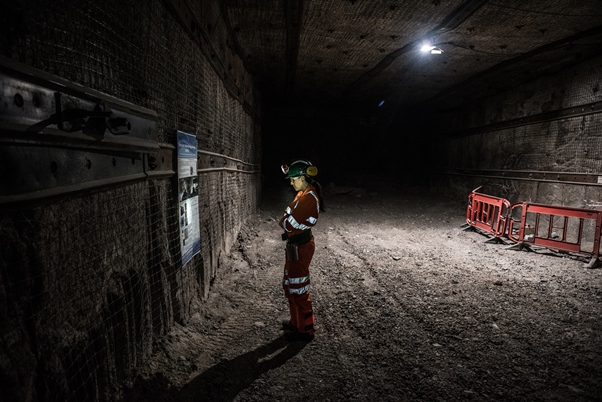
Professional photographer Enrico Sacchetti was a member of the international judges’ panel. Commenting on Simon Wright’s winning image he said: “The lighting is what attracts you to this silent but powerful image. It’s great seeing her completely at ease in this lonely environment.”
Shining a light on dark matter at STFC’s Boulby Underground Laboratory – 2018 Global Photowalk judges winner (Credit: STFC/Simon Wright)
Panel member Ale de la Puente, a Mexican artist and designer, also praised the winning image: “Alone where the unknown still lies, there is light, darkness, and a shadow cast that intriguingly take us deep back to the tunnel, beyond the excellence of technique the metaphor of pushing the horizon far away from light and our view is compelling.”
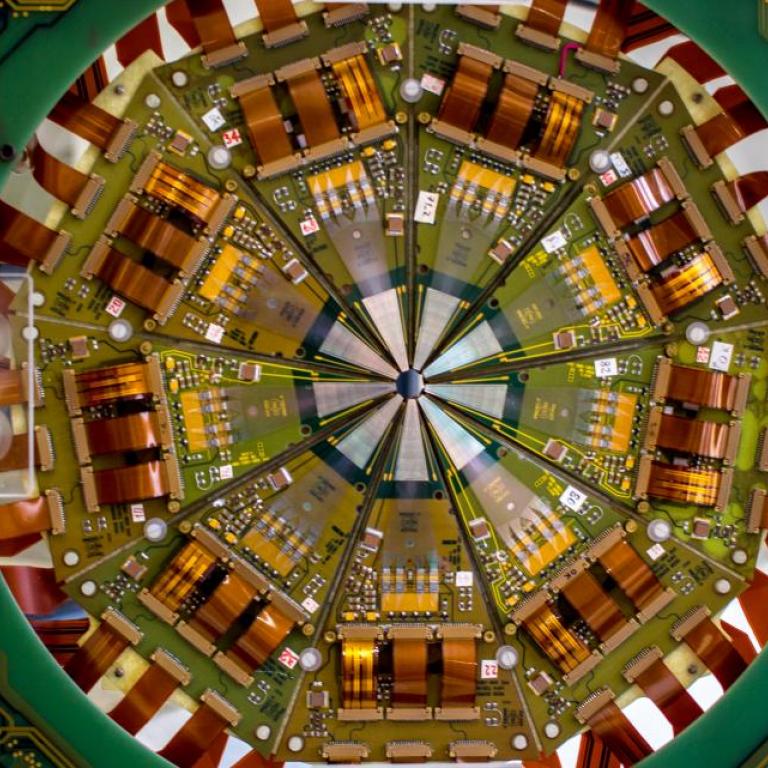
Enrico and Ale also praised Stefano Ruzzini’s image of a silicon-strip particle detector taken at the Frascati National Laboratories of the Italian Institute for Nuclear Physics:
Ale said: “Not only the colors, the symmetry, and quality of the image, but the mysterious beauty of a contemporary technology mandala, reminds the endless search for knowledge.”
Enrico said: “The almost perfect symmetry is fantastic. I’m attracted by the strong colours but I’m especially attracted by the complete lack of any reference to scale!”
Find out more about the competition and see all of the winning photos on the Interactions website.
The largest liquid-argon neutrino detector in the world has just recorded its first particle tracks, signaling the start of a new chapter in the story of the international Deep Underground Neutrino Experiment (DUNE).
DUNE’s scientific mission is dedicated to unlocking the mysteries of neutrinos, the most abundant (and most mysterious) matter particles in the universe. Neutrinos are all around us, but we know very little about them. Scientists on the DUNE collaboration think that neutrinos may help answer one of the most pressing questions in physics: why we live in a universe dominated by matter. In other words, why we are here at all.
The enormous ProtoDUNE detector – the size of a three-story house and the shape of a gigantic cube – was built at CERN, the European Laboratory for Particle Physics, as the first of two prototypes for what will be a much, much larger detector for the DUNE project, hosted by the U.S. Department of Energy’s Fermi National Accelerator Laboratory in the United States. When the first DUNE detector modules record data in 2026, they will each be 20 times larger than these prototypes.
The first ProtoDUNE detector took two years to build and eight weeks to fill with 800 tons of liquid argon, which needs to be kept at temperatures below -184 degrees Celsius (-300 degrees Fahrenheit). The detector records traces of particles in that argon, from both cosmic rays and a beam created at CERN’s accelerator complex. Now that the first tracks have been seen, scientists will operate the detector over the next several months to test the technology in depth.
“Only two years ago we completed the new building at CERN to house two large-scale prototype detectors that form the building blocks for DUNE,” said Marzio Nessi, head of the Neutrino Platform at CERN. “Now we have the first detector taking beautiful data, and the second detector, which uses a different approach to liquid-argon technology, will be online in a few months.”
To bridge the gap between basic research and real market needs, ATTRACT is calling for researchers, entrepreneurs and companies to bring forward breakthrough projectson pioneering imaging and sensor technologies.
The call opens on 1st August 2018 and applicants have up to three months to submit their ideas (deadline 31st October, 2018 23:59 hrs CET).
The ATTRACT Project will fund 170 breakthrough technology concepts in the domain of detection and imaging technologies across Europe. The projects will be awarded €17 million in funding – €100,000 each in seed funding to carry out their idea.
Observations made with ESO’s Very Large Telescope have for the first time revealed the effects predicted by Einstein’s general relativity on the motion of a star passing through the extreme gravitational field near the supermassive black hole in the centre of the Milky Way. This long-sought result represents the climax of a 26-year-long observation campaign using ESO’s telescopes in Chile.
Obscured by thick clouds of absorbing dust, the closest supermassive black hole to the Earth lies 26 000 light-years away at the centre of the Milky Way. This gravitational monster, which has a mass four million times that of the Sun, is surrounded by a small group of stars orbiting around it at high speed. This extreme environment — the strongest gravitational field in our galaxy — makes it the perfect place to explore gravitational physics, and particularly to test Einstein’s general theory of relativity.
New infrared observations from the exquisitely sensitive GRAVITY[1], SINFONI and NACO instruments on ESO’s Very Large Telescope (VLT) have now allowed astronomers to follow one of these stars, called S2, as it passed very close to the black hole during May 2018. At the closest point this star was at a distance of less than 20 billion kilometres from the black hole and moving at a speed in excess of 25 million kilometres per hour — almost three percent of the speed of light.
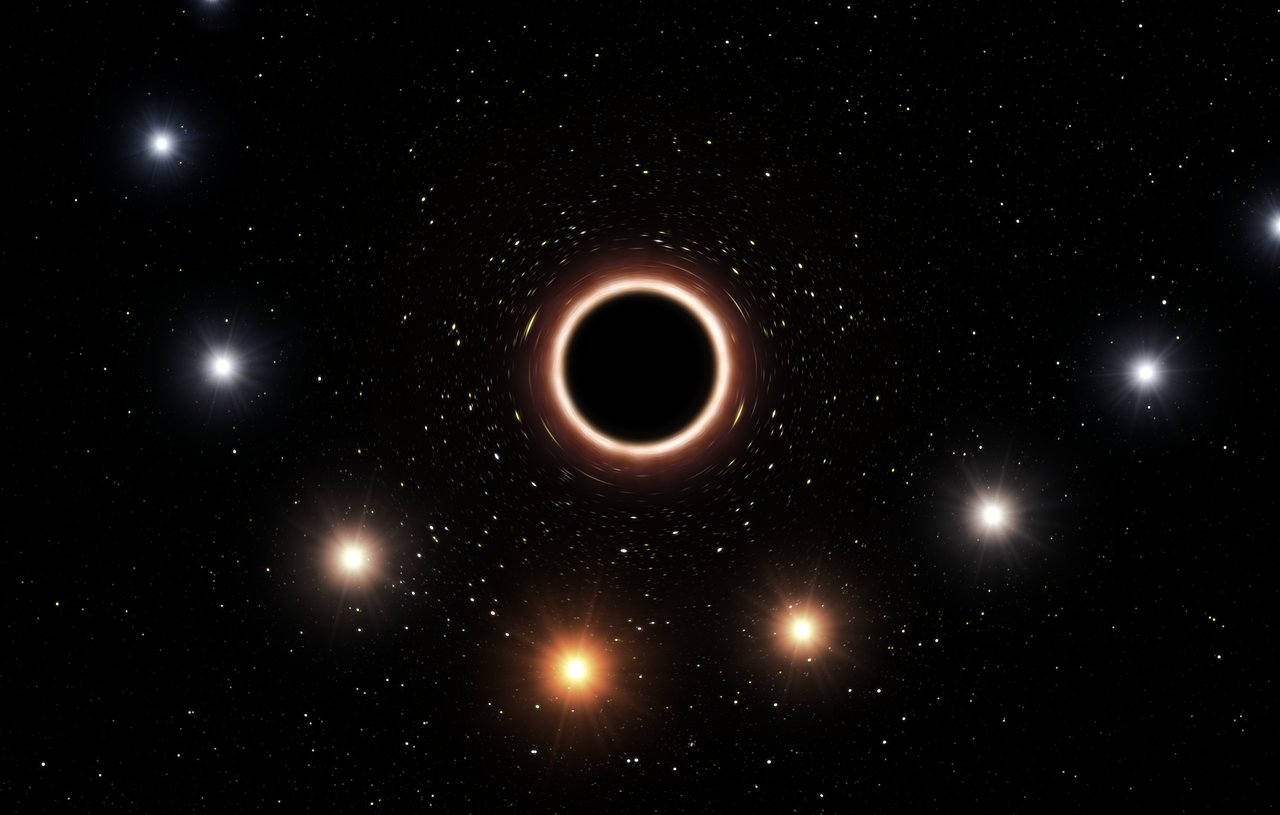
This artist’s impression shows the path of the star S2 as it passes very close to the supermassive black hole at the centre of the Milky Way. As it gets close to the black hole the very strong gravitational field causes the colour of the star to shift slightly to the red, an effect of Einstein’s general thery of relativity. In this graphic the colour effect and size of the objects have been exaggerated for clarity.
The team compared the position and velocity measurements from GRAVITY and SINFONI respectively, along with previous observations of S2 using other instruments, with the predictions of Newtonian gravity, general relativity and other theories of gravity. The new results are inconsistent with Newtonian predictions and in excellent agreement with the predictions of general relativity.




 The European Strategy for Particle Physics provides a clear prioritisation of European ambitions in advancing the particle physics science. The Strategy is due to be updated by May 2020 to guide the direction of the field to the mid-2020s and beyond.
 APPEC is organizing the Workshop on Observatory Synergies for Astroparticle Physics and Geoscience with the geoscientists of