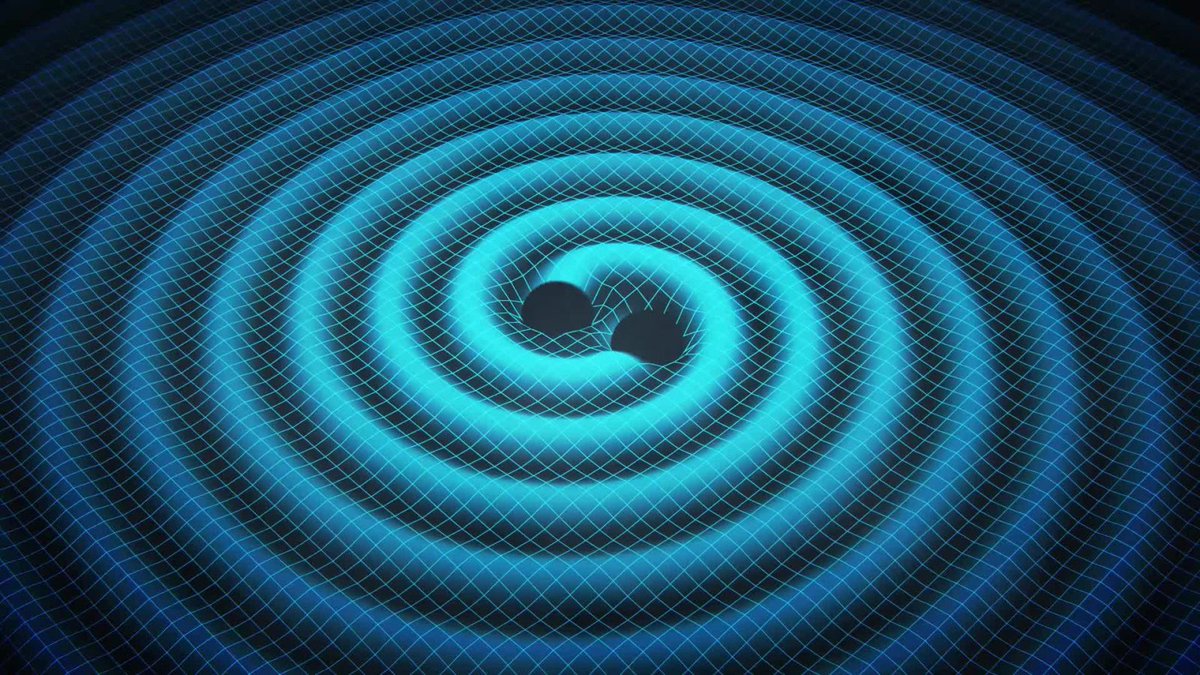
The LIGO Scientific Collaboration and the Virgo collaboration have identified a second gravitational wave event in data from the Advanced LIGO detectors. The event was detected early on the morning of 26 December 2015, following on from the first direct detection of a gravitational wave in September.
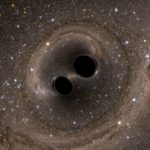
The December gravitational waves were produced during the final moments of the merger of two black holes around 1.4 billion years ago. The black holes, 14 and 8 times the mass of the sun, merged to produce a single, more massive spinning black hole that is 21 times the mass of the sun.
“It is very significant that these black holes were much less massive than those observed in the first detection,” said Gabriela Gonzalez, LIGO Scientific Collaboration (LSC) spokesperson and professor of physics and astronomy at Louisiana State University. “Because of their lighter masses compared to the first detection, they spent more time—about one second—in the sensitive band of the detectors. It is a promising start to mapping the populations of black holes in our universe.”
During the merger, a quantity of energy roughly equivalent to the mass of the sun was converted into gravitational waves. The detected signal comes from the last 27 orbits of the black holes before their merger. Based on the arrival time of the signals—with the Livingston detector measuring the waves 1.1 milliseconds before the Hanford detector—the position of the source in the sky can be roughly determined.
“In the near future, Virgo, the European interferometer, will join a growing network of gravitational wave detectors, which work together with ground-based telescopes that follow-up on the signals,” said Fulvio Ricci, the Virgo Collaboration spokesperson. “The three interferometers together will permit a far better localization in the sky of the signals.”
The detection of another gravitational wave events demonstrates that the era of gravitational wave astronomy has begun. Advanced LIGO’s next data-taking run will begin in the autumn, with further improvements in detector sensitivity. The Virgo detector is expected to start its observations during the second half of the new observing run.
The governing body of the Cherenkov Telescope Array Observatory gGmbH (CTAO gGmbH) has selected Bologna as the host site of the CTA Headquarters. The CTA Council further selected Berlin – Zeuthen for the Science Data Management Centre (SDMC) from five site candidates.
The Council, composed of shareholders from nine countries (Austria, Czech Republic, France, Germany, Italy, Japan, Spain, Switzerland and the United Kingdom) in consultation with associate members (Netherlands, South Africa and Sweden), announced the decision in Munich following the consideration of all of the proposals.
“We are grateful for all of the proposals put forward by the applicants. While each of the candidate sites were suitable options, the Council is confident that Bologna and Zeuthen will be well-equipped to support CTA’s long-term operations,” said Ulrich Straumann, Managing Director of the CTAO gGmbH.
An international conference on imaging techniques in subatomic physics, astrophysics, medicine, biology and industry. The conference is organised by KTH Royal Institute of Technology and sponsored by the Royal Swedish Academy of Sciences KVA through its Nobel Institute for Physics.
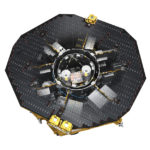
ESA’s LISA Pathfinder mission has demonstrated the technology needed to build a space-based gravitational wave observatory.
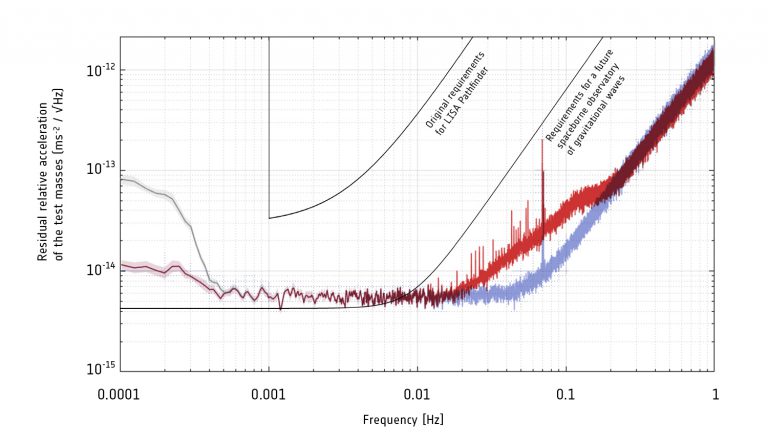
Results from only two months of science operations show that the two cubes at the heart of the spacecraft are falling freely through space under the influence of gravity alone, unperturbed by other external forces, to a precision more than five times better than originally required.
In a paper published in Physical Review Letters, the LISA Pathfinder team show that the test masses are almost motionless with respect to each other, with a relative acceleration lower than ten millionths of a billionth of Earth’s gravity.
The demonstration of the mission’s key technologies opens the door to the development of a large space observatory capable of detecting gravitational waves emanating from a wide range of exotic objects in the Universe.
In the top central part of the graph, the wedge-shaped area indicates the original requirements of LISA Pathfinder. Below it, the more stringent requirements for a future spaceborne observatory of gravitational waves are also indicated.
SXS, the Simulating eXtreme Spacetimes (SXS) project
More than 1000 scientists and engineers involved in the detection of gravitational waves have been awarded a special Breakthrough Prize in Fundamental Physics. The award of $3 million will be shared between LIGO founders Ronald WP Drever, Kip S Thorne, and Rainer Weiss, and 1005 others in the LIGO-Virgo Collaboration as well as seven additional scientists recognised for their contributions to the success of LIGO.
Edward Witten, the chair of the Selection Committee said: “This amazing achievement lets us observe for the first time some of the remarkable workings of Einstein’s theory. Theoretical ideas about black holes which were close to being science fiction when I was a student are now reality.”
Yuri Milner described the group’s achievement as “a perfect science story.”
The prizes can be shared by any number of scientists. All of the authors of the paper announcing the direct detection of the GW150914 event are included. The seven scientists in addition are Luc Blanchet, CNRS; Thibault Damour, IHES; Lawrence Kidder, Cornell University; Frans Pretorius, Princeton University; Mark Scheel, Caltech; Saul A. Teukolsky, Cornell University; Rochus E. Vogt, Caltech.
APPEC chair Frank Linde said: “The first direct detection of gravitational waves was extremely exciting, and has sparked more and more interest in the field. I am very pleased that this international group of pioneers has been honoured with a Breakthrough Prize, and it is a good reminder of the cooperation and collaboration needed to make great strides in science. And: an excellent example for the Nobel committee to follow…”
The Special Breakthrough Prize can be awarded by the selection committee at any time “in recognition of an extraordinary scientific achievement”, in addition to the annual prizes in fundamental physics, mathematics, and life sciences. Nominations for the annual awards are open until the end of May, and the awards will be presented in the autumn.
Previous winners of the special prize in fundamental physics include seven leaders of the Large Hadron Collider teams, while last year’s annual award in fundamental physics went to five experiments working on neutrino oscillation. The prizes are funded by a grant from the Milner Global Foundation. Read the full press release here.
Location: Dublin Institute for Advanced Studies (DIAS), Dublin
Date: 12/04/2016 – 14/04/2016, all day
The Dublin Institute for Advanced Studies (DIAS), with the support of an interdisciplinary grant from the Irish Research Council (WEXD – When Experts Disagree), will hold a specialist workshop from Tuesday 12th to Thursday 14th April 2016 examining some disputed areas of high-energy astrophysics. A novel and interesting aspect of the meeting is that it will also be attended by some experimental philosophers interested in expert disagreement.
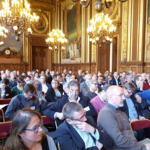
The APPEC Town Meeting held in Paris on 6 and 7 April saw the astroparticle physics community gather and share information in preparation for the new APPEC Roadmap.
The roadmap to be published this year will update its predecessors from 2011 and 2008. Speaking as the meeting began, Antonio Masiero, chair of the APPEC Scientific Advisory Committee pointed out that the observation of the Higgs boson, the Planck map of the Cosmic Microwave Background, and the recent direct detection of gravitational waves had all taken place since the last roadmap, and had offered support to the standard model. However, there are still some points of contention between the standard model and observed facts.
Read reports from the meeting in our newsletters from day one and day two.
The Astroparticle Physics European Consortium invites you to a town meeting at the Grand Amphithéatre de Sorbonne in Paris on the 6 and 7 April 2016 to discuss an update of the 2011 APPEC Astroparticle Physics roadmap, to be published in September 2016.
In 2014, APPEC decided to launch an update of the 2011 Roadmap, transforming it to a “resource aware” roadmap. The intention was to gauge the financial impact of the beginnings of operation of the large global scale observatories put forward in the previous roadmap and to examine the possibilities of international coordination of future global initiatives. The APPEC Scientific Advisory Committee examined the field and prepared a set of recommendations. Based on these recommendations, the APPEC General Assembly drafted a set of “considerations” to be published by end of February 2016 and be debated in an open dialogue with the community, through the web page but primarily at the town meeting of 6-7 April. Based on this debate the final recommendations of APPEC will appear by September 2016.
During the 6-7 April meeting, there will be presentations and discussions around the nine subdomains of astroparticle physics separated in four larger topics (Early Universe, Dark Universe, Neutrinos and High Energy Universe). At the end of the first day, Nobel laureate 2015 T. Kajita will give a general public talk on neutrino physics. The town meeting will close with a round table discussion, including presentations comments and discussions with non-European international agencies.
The European Comission recently announced the results of the last year Horizon 2020 call in the domain of Future Emerging Technologies (FET-Open). In this highly competitive call the SENSE proposal, submitted by a team of three APPEC related partners (University of Geneva, MPI for Physics in Munich, and DESY as coordinator), was among the 13 selected projects.
The SENSE project will be funded as a Coordination and Support Action with the aim of coordinating the research and development efforts in academia and industry in low light level sensoring. This initiative has emerged from the series of Technology Forums organized within the frame of ASPERA and APPEC. SENSE is a three years project. Starting in September 2016, R&D experts will be invited to prepare an R&D roadmap towards the ultimate low light level sensors. SENSE will then coordinate, monitor and evaluate the R&D efforts of research groups and industry in advancing low light level sensors and liaise with strategically important European initiatives and research groups and companies worldwide.
To foster cooperation and knowledge transfer SENSE will build up an internet-based Technology Exchange Plattform. Training events and material shall be prepared to especially engage young researchers.
A kick-off event is planned for September 2016. Further information will be distributed by the APPEC newsletter.
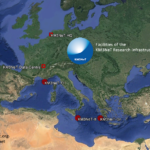
The European Strategy Forum on Research Infrastructures – ESFRI – has presented its new roadmap with six new research infrastructures including KM3NeT 2.0. The roadmap also includes the Cherenkov Telescope Array as a continuing project.
In addition to regular updating of the roadmap, and following through on those projects, ESFRI is tasked with supporting a coherent and strategy-led approach to policy making on research infrastructures in Europe and facilitating multilateral initiatives leading to a better use and development of research infrastructures acting as an incubator for pan-European and global research infrastructures.
To be eligible for the roadmap a research infrastructure should have at least three countries with funding commitment and political support.
“Full steam ahead for KM3NeT 2.0. The ESFRI review was maybe not easy, but certainly beneficial.” said Maarten de Jong, spokesperson of the KM3NeT Collaboration, during his talk at the launch event, in which he explained the scientific goals of the research infrastructure and highlighted the recent progress.
Responding to KM3Net 2.0’s inclusion, S. Harissopulos, director of the Institute of Nuclear and Particle Physics of NCSR “Demokritos” said: “The Greek Minister of Research encouraged us to actively participate in KM3NeT 2.0.”
Michel Spiro, chairperson of the KM3NeT Scientific and Technical Advisory Committee added: “This is a new step towards neutrino astronomy and further deciphering the Universe and neutrino mysteries.”
Antonio Masiero, the chairperson of the KM3NeT Resources Review Board, chairperson of the APPEC Scientific Advisory Committee and vice-president of INFN notes, “This is excellent news, KM3NeT continues to be considered by EU as an important project and an innovative research infrastructure at the continental level. This vote of confidence will be instrumental as KM3NeT rapidly moves forward on the realisation of the envisaged research facility.”
APPEC Chair Frank Linde said: “As APPEC Chair, I am incredibly pleased and proud to see both CTA and KM3NeT 2.0 selected as ESFRI Projects; I quote: ‘… selected for scientific excellence and maturity …’. Their timely realization is amongst APPEC’s top priorities and will allow us to probe deeper in the mysteries of the extreme Universe. KM3NeT 2.0 has a good chance to resolve the neutrino mass hierarchy and with some luck CTA and/or KM3NeT could pinpoint spots in the Universe where Dark Matter annihilates itself!”