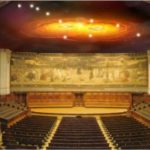
The Astroparticle Physics European Consortium invites you to a town meeting at the Grand Amphithéatre de Sorbonne in Paris on the 6 and 7 April 2016 to discuss an update of the 2011 APPEC Astroparticle Physics roadmap, to be published in September 2016.
In 2014, APPEC decided to launch an update of the 2011 Roadmap, transforming it to a “resource aware” roadmap. The intention was to gauge the financial impact of the beginnings of operation of the large global scale observatories put forward in the previous roadmap and to examine the possibilities of international coordination of future global initiatives. The APPEC Scientific Advisory Committee examined the field and prepared a set of recommendations. Based on these recommendations, the APPEC General Assembly drafted a set of “considerations” to be published by end of February 2016 and be debated in an open dialogue with the community, through the web page but primarily at the town meeting of 6-7 April. Based on this debate the final recommendations of APPEC will appear by September 2016.
During the 6-7 April meeting, there will be presentations and discussions around the nine subdomains of astroparticle physics separated in four larger topics (Early Universe, Dark Universe, Neutrinos and High Energy Universe). At the end of the first day, Nobel laureate 2015 T. Kajita will give a general public talk on neutrino physics. The town meeting will close with a round table discussion, including presentations comments and discussions with non-European international agencies.
The European Comission recently announced the results of the last year Horizon 2020 call in the domain of Future Emerging Technologies (FET-Open). In this highly competitive call the SENSE proposal, submitted by a team of three APPEC related partners (University of Geneva, MPI for Physics in Munich, and DESY as coordinator), was among the 13 selected projects.
The SENSE project will be funded as a Coordination and Support Action with the aim of coordinating the research and development efforts in academia and industry in low light level sensoring. This initiative has emerged from the series of Technology Forums organized within the frame of ASPERA and APPEC. SENSE is a three years project. Starting in September 2016, R&D experts will be invited to prepare an R&D roadmap towards the ultimate low light level sensors. SENSE will then coordinate, monitor and evaluate the R&D efforts of research groups and industry in advancing low light level sensors and liaise with strategically important European initiatives and research groups and companies worldwide.
To foster cooperation and knowledge transfer SENSE will build up an internet-based Technology Exchange Plattform. Training events and material shall be prepared to especially engage young researchers.
A kick-off event is planned for September 2016. Further information will be distributed by the APPEC newsletter.
The European Strategy Forum on Research Infrastructures – ESFRI – has presented its new roadmap with six new research infrastructures including KM3NeT 2.0. The roadmap also includes the Cherenkov Telescope Array as a continuing project.
In addition to regular updating of the roadmap, and following through on those projects, ESFRI is tasked with supporting a coherent and strategy-led approach to policy making on research infrastructures in Europe and facilitating multilateral initiatives leading to a better use and development of research infrastructures acting as an incubator for pan-European and global research infrastructures.
To be eligible for the roadmap a research infrastructure should have at least three countries with funding commitment and political support.
“Full steam ahead for KM3NeT 2.0. The ESFRI review was maybe not easy, but certainly beneficial.” said Maarten de Jong, spokesperson of the KM3NeT Collaboration, during his talk at the launch event, in which he explained the scientific goals of the research infrastructure and highlighted the recent progress.
Responding to KM3Net 2.0’s inclusion, S. Harissopulos, director of the Institute of Nuclear and Particle Physics of NCSR “Demokritos” said: “The Greek Minister of Research encouraged us to actively participate in KM3NeT 2.0.”
Michel Spiro, chairperson of the KM3NeT Scientific and Technical Advisory Committee added: “This is a new step towards neutrino astronomy and further deciphering the Universe and neutrino mysteries.”
Antonio Masiero, the chairperson of the KM3NeT Resources Review Board, chairperson of the APPEC Scientific Advisory Committee and vice-president of INFN notes, “This is excellent news, KM3NeT continues to be considered by EU as an important project and an innovative research infrastructure at the continental level. This vote of confidence will be instrumental as KM3NeT rapidly moves forward on the realisation of the envisaged research facility.”
APPEC Chair Frank Linde said: “As APPEC Chair, I am incredibly pleased and proud to see both CTA and KM3NeT 2.0 selected as ESFRI Projects; I quote: ‘… selected for scientific excellence and maturity …’. Their timely realization is amongst APPEC’s top priorities and will allow us to probe deeper in the mysteries of the extreme Universe. KM3NeT 2.0 has a good chance to resolve the neutrino mass hierarchy and with some luck CTA and/or KM3NeT could pinpoint spots in the Universe where Dark Matter annihilates itself!”
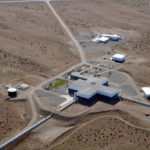
One century after Einstein’s prediction, half a century of constant cutting edge technological innovations and the tenacity of a world-wide community hunting for gravitational -waves have paid off: the first gravitational wave passing through Earth was detected on September 14, 2015 at 09:50:45 UTC! The announcement was made by the LIGO Scientific Collaboration and the Virgo Collaboration using data from the two LIGO detectors. The results have been accepted for publication in the journal Physical Review Letters.
APPEC Chair Frank Linde said: “It is with tremendous pleasure that I congratulate the LIGO-Virgo Collaboration on this monumental achievement. For sure this will prove to be a turning point in astronomy and cosmology as well as in fundamental studies of the poorest known fundamental force in Nature: Gravity. Collectively we just acquired a new tool: gravitational waves – the power of which we are all very eager to explore.
“Personally, I can hardly believe the extraordinary beauty and the wealth of information hidden in the 0.2 second long ‘ripples’ recorded by the two laser interferometers located in Hanford (WA) and Livingston (LA). Each one alone recorded the tell-tale signal of the coalescence of two massive objects (most likely black holes) as well as the subsequent ring-down signature of the merged black hole. Corrected for propagation delay (few milliseconds) and relative detector orientation, the two signals are perfectly consistent and a huge treasure trove for our scientists as already witnessed by the released publications and, I am sure, by the flood of publications to appear in the coming months.
“Regarding APPEC, Astroparticle Physics European Consortium, this first detection of a gravitational wave could not come at a better time since we have just scheduled a Town Meeting in the Grand Amphithéatre de Sorbonne in Paris on 6-7 April 2016 to discuss our new European Roadmap of Astroparticle Physics This discovery puts discussions on next generation gravitational-wave detectors like the Einstein Telescope centre stage! But today is for the LIGO-Virgo teams to enjoy, and we look forward to seeing how the world responds to their wonderful news.”
Scientists from the KM3NeT Collaboration have publicly announced KM3NeT 2.0, their ambition for the immediate future to further exploit the clear waters of the deep Mediterranean Sea for the detection of cosmic and atmospheric neutrinos. The published Letter of Intent details the science performance as well as the technical design of the KM3NeT 2.0 infrastructure.
The two major scientific goals of KM3NeT 2.0 are the discovery of astrophysical sources of neutrinos in the Universe with the KM3NeT/ARCA detector and the measurement of the neutrino mass hierarchy using atmospheric neutrinos with the KM3NeT/ORCA detector.
The KM3NeT scientists estimate that with the ARCA detector installed at the KM3NeT-It site south of Sicily, Italy, the observation of the cosmic neutrino flux reported by the IceCube Collaboration will be possible within one year of operation. With the ORCA detector installed at the KM3NeT-Fr site south of Toulon, France, they expect to determine neutrino mass hierarchy with at least 3-sigma significance after three years of operation.
The Astroparticle Physics European Consortium invites you to a town meeting at the Grand Amphithéatre de Sorbonne in Paris on the 6 and 7 April 2016 to discuss an update of the 2011 APPEC Astroparticle Physics roadmap, to be published in September 2016.
In 2014, APPEC decided to launch an update of the 2011 Roadmap, transforming it to a “resource aware” roadmap. The intention was to gauge the financial impact of the beginnings of operation of the large global scale observatories put forward in the previous roadmap and to examine the possibilities of international coordination of future global initiatives. The APPEC Scientific Advisory Committee examined the field and prepared a set of recommendations. Based on these recommendations, the APPEC General Assembly drafted a set of “considerations” to be published by end of February 2016 and be debated in an open dialogue with the community, through the web page but primarily at the town meeting of 6-7 April. Based on this debate the final recommendations of APPEC will appear by September 2016.
During the 6-7 April meeting, there will be presentations and discussions around the nine subdomains of astroparticle physics separated in four larger topics (Early Universe, Dark Universe, Neutrinos and High Energy Universe). At the end of the first day, Nobel laureate 2015 T. Kajita will give a general public talk on neutrino physics. The town meeting will close with a round table discussion, including presentations comments and discussions with non-European international agencies.
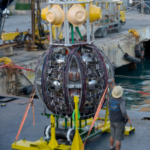
On the morning of 3 December, the installation of KM3NeT began, as the first vertical neutrino detection string was put in place in the depths of the Mediterranean Sea south of Sicily, and began delivering data. Hundreds of detection strings will be used to build the next generation neutrino telescope, each one carrying 18 light sensor modules to register the faint flashes of Cherenkov light that signal the interaction of neutrinos with the seawater surrounding the telescope.
Marco Circella, the technical coordinator of KM3NeT explained “The large depth of sea water shields the telescope from particles created by cosmic rays in the atmosphere above the telescope. Constructing such a large infrastructure at these depths is a tremendous technical challenge. Making the underwater connections requires custom-designed electrical and fibre optic connectors. The crew of the Ambrosius Tide are experts in performing such delicate submarine operations.”
The string was successfully powered on from the shore, and data started to arrive. Rosanna Cocimano, who coordinates the power systems for KM3NeT outlined the process: “An electro-optical network of cables distributes the high-voltage power from the shore station to the sensor modules in the deep sea. The measured light signals are digitised by the sensor modules and the resulting data returned to the shore station via optical fibres.”
Maarten de Jong, director of KM3NeT said: “This important step in the verification of the design and the technology will allow the KM3NeT Collaboration to proceed with confidence toward the mass production of detection strings and their installation at the sites in the Mediterranean Sea off-shore from Italy and France. A new era in neutrino astronomy has begun.”
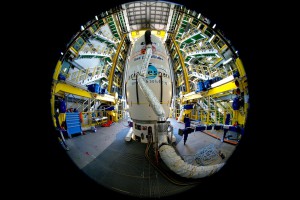
LISA Pathfinder is designed to demonstrate that free particles follow geodesics in space-time. It will do this by tracking two test masses in free fall using very precise laser interferometry. The spacecraft faced the challenge of keeping the test masses safe during the launch, whilst then being able to keep them in space with no external forces acting on them.
The distance between the test masses on board the spacecraft is too small to detect gravitational waves, but it is designed to show the technologies needed for a future mission that would be large enough to make the effects of a low-frequency gravitational wave measurable.
The mission carries the LISA Technology Package including inertial sensors, interferometric readout, payload computer and diagnostic system – provided by European companies, research institutes, and the European Space Agency; and the Disturbance Reduction System which is testing technology for NASA and consists of a processor running drag-free control software, and micro-Newton colloidal thrusters.
LISA Pathfinder ready for launch
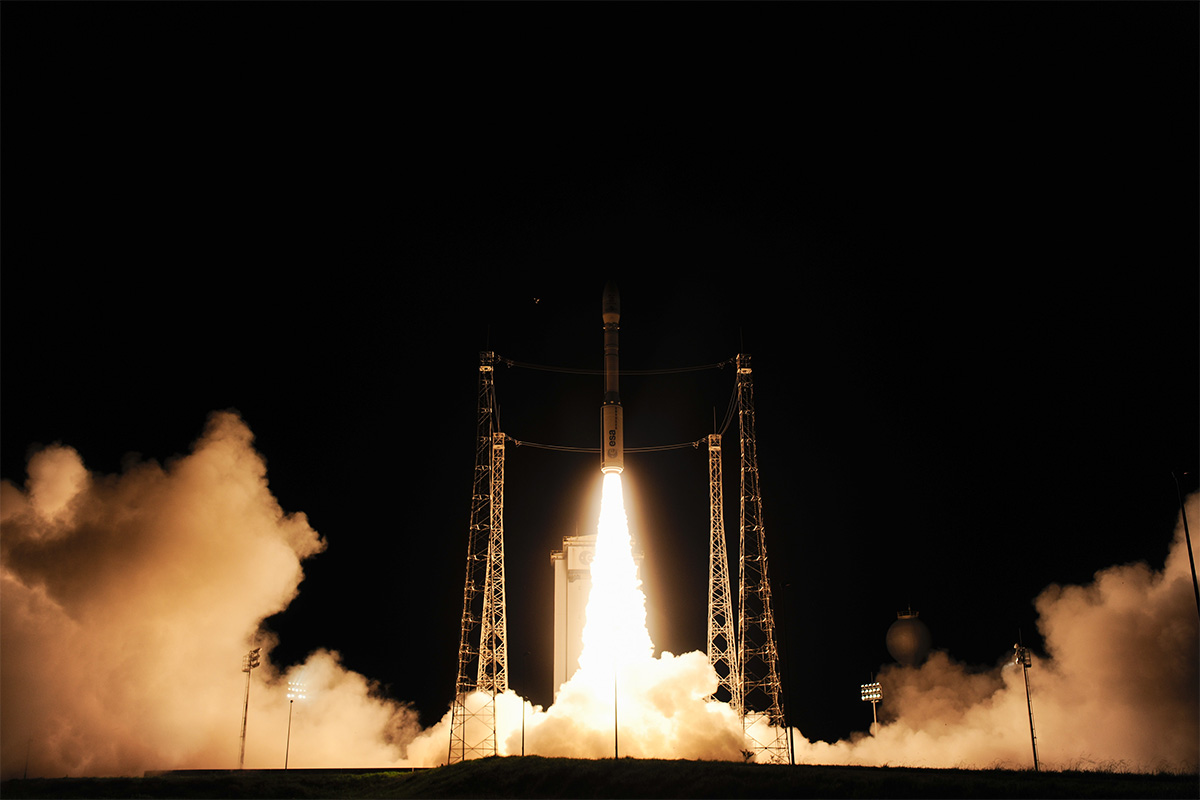
The spacecraft was launched aboard a Vega rocket to a parking orbit around Earth. It will use its own propulsion module to travel on to the first Sun-Earth Lagrange point, L1. The journey and calibration phases will take a total of about three months. The European Space Agency intends to fly a large mission dedicated to the gravitational Universe as the third large mission of the current Cosmic Vision programme. The expected launch is in 2034.
The GCT prototype is first CTA telescope prototype equipped with an operational camera. It uses high-speed digitisation and triggering technology capable of recording images at a rate of one billion frames per second and sensitive enough to resolve single photons. To detect the short flashes of light produced by gamma rays as they hit the Earth’s atmosphere, the telescope’s camera has to be about a million times faster than a DSLR camera.
The telescope uses the Schwarzschild-Couder dual-mirror optical design, giving it good image quality over a large field of view and making it lighter than a single-mirror system.
The GCT is one of CTA’s small size telescopes (SSTs) and will cover the high end of the CTA energy range, between about 5 and 300 TeV (tera-electronvolts). Around 70 SSTs are needed to make sure the array is sufficiently sensitive at these enormous energies. Other small size telescopes are being prototyped and tested in Italy and Poland.
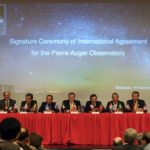
The AugerPrime symposium held on 15-16 November 2015 saw the signing of a new international agreement for the operation of the Pierre Auger Observatory for the exploration of cosmic rays until 2025. Collaborators and science funding agency representatives gathered in Argentina to sign the agreement, which will allow for new scintillation detectors to be added to the 1660 existing detectors, as well as faster and more powerful electronics.
Astrid Chantelauze, science outreach manager of the Helmholtz Alliance for Astroparticle Physics and Marie-Noëlle Rolland, freelance graphic designer, created a blog for their attendance at AugerPrime.