Get prepared together! September 29/30, 2015 – Zagreb, Croatia
In September 2015 the Horizon 2020 work programs for the period 2017-2018 will be released by the European Commission. APPEC invites all interested astroparticle physicists, colleagues from neighboring scientific fields and companies interested in F&E cooperations to a community workshop.
After the APPEC Horizon 2020 workshops in November 2013 (Zeuthen) and February 2014 (Paris) with this third workshop APPEC wants to achieve the following:
Analyse and discuss the experience of the first two years of Horizon 2020 and give advice on how to prepare successful proposals in future calls.
Inform about the upcoming funding opportunities and support the community in preparing their proposals for the calls.
Prepare with the community astroparticle infrastructure related activities and collaborative actions to be discussed with the European Commission as topics of future work programs (2019 and beyond).
The program of the workshop will be composed by experts’ presentations on the various funding instruments – including individual grants – and open discussions. Furthermore, astroparticle groups can ask for dedicated sessions to setup and plan their strategy for collaborative projects.
Special emphasis shall be put on proposals for calls in the Future Emerging Technology (FET) and the Leadership in Enabling and Industrial Technologies programs of Horizon 2020; representatives of companies interested in common R&D projects are welcome to participate in the workshop. The Spreading Excellence and Widening Participation program (“Teaming and Twinning”) as well as the Research Infrastructures program with focus on e-infrastructures and big data shall be covered.
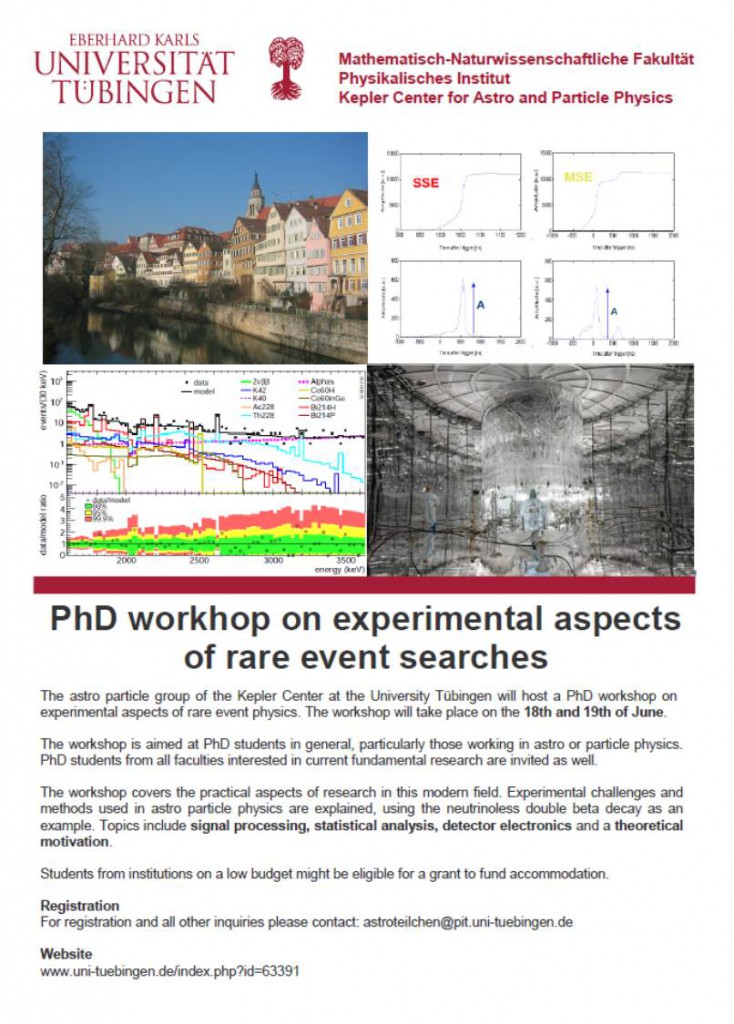
PhD Workshop on Experimental Aspects of Rare Event Searches
June 18-19, University of Tübingen
The astro particle group of the Kepler Center at the University of Tübingen will host a PhD workshop on experimental aspects of rare event physics. The workshop will take place on 18 and 19 June.
The workshop is aimed at PhD students in general, particularly those working in astro or particle physics. PhD students from all faculties interested in current fundamental research are invited as well.
The workshop covers the practical aspects of research in this modern field. Experimental challenges and methods used in astro particle physics are explained, using the neutrinoless double beta decay as an example. Topics include signal processing, statistical analysis, detector electronics and a theoretical motivation.
Students from institutions on a low budget might be eligible for a grant to fund accommodation.
September 29-30, 2015 Forschungszentrum Jülich, Germany
The first annual meeting of the programme “Matter and Universe” of the project oriented funding (PoF) research field Matter will take place at the research center Jülich.
The meeting at the Research Center Jülich brings together the different programme communities with activities in elementary particle physics, hadron physics, nuclear physics and astroparticle physics in order to strengthen the co-operation across the different programme topics.
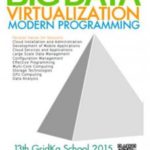
The international GridKa School is one of the leading summer schools for advanced computing techniques. The school’s aims is to bring participants in contact with experts from science and technology leaders in on-hand tutorials and talks sharing their vast experiences and knowledge. The targetvaudience are different groups like grid and cloud beginners, advanced users as well as administrators, graduate and PhD students. Organized by the Karlsruhe Institute of Technology (KIT), GridKa School is hosted by Steinbuch Centre for Computing (SCC).
This year GridKa School covers a broad range of topics. With virtualization becoming more and more in many aspects of the information technologies, one range of subjects are lightweight containers as well as virtualization of networks, file systems or whole data center infrastructures [ELK, Cloud HPC, IPv6, LXC/Docker, Puppet, SDN/OpenDaylight, SDDC]. For an efficient use of resources another focus is on efficient programming techniques and parallel programming on modern CPUs and GPUs [Concurrent C++, CUDA, FastFlow, Programming Templates, AngularJS]. On large scale data analysis, GridKa School offers this year contributions on various database architectures, analysis frameworks and analysis tools [CEPH, MongoDB, (no)SQL DBs, Python/Pandas, R, Spark/Hadoop]. To teach not only theoretical but also practical experiences, experienced professionals cover topics in plenary talks as well as in on-hands tutorials.
Aiming to bring beginners and experienced data analysts and admins together, GridKa has special fees for students and members of academia.
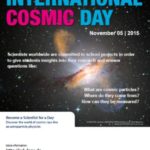
The International Cosmic Day enables students to get in contact with astroparticle physicists to get a first insight into their research, experimental methods and everyday work.
Some basic questions which will be adressed are: What are cosmic particles? Where do they come from? How can they be measured?
The relatively young research field of astroparticle physics has been developing dynamically over the last years (some experiments are: ANTARES, Auger, BAIKAL, Fermi, HAWC, H.E.S.S., IceCube, MAGIC, Telescope Array, VERITAS ). It connects particle physics (describing the interactions of elementary particles) with astrophysics (describing up to the biggest structures in the universe) and with cosmology (studying the history of the universe). One of the very interesting topics in astroparticle physics is trying to understand the acceleration mechanisms of cosmic ray particles to very high energies, much higher than accelerators on Earth can reach.
The universe is a big place. Cosmic rays drift around and get energy boosts from multiple sources. Some particles attain enormous energies. When they strike the upper atmosphere, they initiate Extended Air Showers. These events create thousands of particles that simultaneously reach a small section of Earth’s surface. More energetic primaries affect larger sections of the surface.
On the International Cosmic Day we will focus on two questions which will be addressed by student experiments:
Coincident air shower measurements: Can you find out how often nearby detectors simultaneously “light up” with cosmic rays? If they do, is it a randomness or a measurement of one of these showers?
Zenith angle distribution of air shower particles: Can you find out if the number of air shower particles arriving from the horizon is the same as from above? If it is not, what could cause this effect?
The 4th International Cosmic Day on November 5, 2015 is organized by DESY, together with Netzwerk Teilchenwelt, IPPOG, QuarkNet and Fermilab and will enable students in many different countries around the world to get to do their own experiments at nearby universities, research institutions or even in their classrooms.
We invite students to:
Perform their own cosmic particle experiment
Analyze and present their data on a common website
Compare their own results with the results of others
Work like in an international research collaboration
The Workshop runs over one year, including two meetings in Les Houches in the month of June, and exchanges and collaborations before and after the meetings. The meetings in Les Houches will consist of two sessions:
Session I: 1-10 June 2015 with emphasis on SM-related issues
Session II: 10-19 June 2015 with emphasis on New-Physics searches