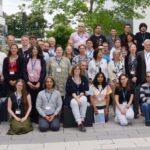
Scientists met at KIT to work on the next-generation dark matter detector.
Credits: Joachim Wolf/ KIT
Scientists from the leading dark matter experiments came together in June at the Karlsruhe Institute of Technology, joining forces to design and build a future dark matter detector within the XLZD consortium. The XENON and LUX-ZEPLIN collaborations currently each operate some of the most sensitive experiments ever built to detect rare particle interactions, such as those expected from dark matter or neutrinos. The DARWIN collaboration, uniting XENON and new members, is planning a next-generation observatory for rare-event searches based on the liquid-xenon technique. These collaborations came together to jointly work on the next-generation experiment, which is expected to take data later in this decade.
At the meeting in Karlsruhe, the scientists discussed how this experiment can be realized together. The project is expected to make dramatic advances for our understanding of dark matter, the dominant form of matter in the universe. The same experiment will also advance our understanding of how our Sun creates its energy through the study of neutrinos that directly come from the core of our star. Further discoveries may be made through the study of rare nuclear decays. “I am thrilled about the enormous potential of this detector” says Prof. Laura Baudis from the University of Zurich. “With one
experiment, we will simultaneously learn about dark matter, neutrinos, our Sun, nuclear physics, particle physics, and even cosmology”. Prof. Hugh Lippincott from the University of Santa Barbara added: “Here we have the best teams in the search for dark matter joining forces, to get to the bottom of this cosmic riddle. We are motivated to do the science, and this meeting has made it clear that we also have the necessary expertise to build this observatory in the coming years.”
A recent whitepaper outlining the science case was signed by over 600 scientists from 150 institutions in 28 countries, underlining the international scope and support of the project. “We had signed a Memorandum of Understanding already in 2021”, says Prof. Kathrin Valerius from KIT, “and this meeting was a great success. It allowed us to further solidify our joint scientific work that we had so far only been able to do remotely over the past year.”
The XII symposium of the Einstein Telescope (ET) took place in Budapest, at the Hungarian Academy of Sciences, on the 7th – 8th of June. The ET scientific community met in Budapest for a crucial step in the long Einstein Telescope journey: the formal establishment of the ET Collaboration.
More than 400 scientists, out of more than 1200 members of the Collaboration, participated in the meeting in person or remotely. The ET members discussed the status of the experiment, the technical challenges, the scientific case, and the scientific and technical progresses made by each of the ET boards. The ET Project Directorate presented the perspective from the funding agencies. Finally, the approved INFRA-DEV Horizon EU project, for supporting the preparation phase of the experiment, and the INFRA-TECH Horizon EU proposal, recently submitted to Brussels for supporting technological R&D activities, were introduced to the whole Collaboration.
During the meeting in Budapest, the ET Collaboration Board (CB) was constituted, temporary chaired by Dr. H. Lueck (AEI), composed of the representatives from each of the 79 research units from 13 countries. During the first CB meeting, the ET Collaboration discussed the recently created ET bylaws that will govern the future of the experiment and initiated procedures to set up the required Collaboration committees. In addition, interim ET Spokesperson (Michele Punturo, INFN) and Deputy Spokesperson (Harald Lueck) figures were identified.
With the birth of the ET Collaboration, this symposium marks a milestone on the long journey of the Einstein Telescope endeavour.
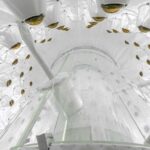
XENONnT researchers assemblying one of the two PMT arrays (front) and working on the TPC (back)
Credit: XENONnT Collaboration
XENONnT detector at LNGS.
Credit: XENONnT Collaboration
On July 22nd during the IDM 2022 Conference (https://indico.cern.ch/event/922783/) held in Vienna, the XENONnT Collaboration announced its first results on Electron Recoils events.
The XENONnT detector at the Gran Sasso Laboratory in Italy replaces the previous one, XENON1T. XENONnT aimed not only to enlarge the detector mass (5.9 t active volume from 2 t) but improve significantly the background identification and rejection exploiting new techniques and an active neutron veto. Details on the detector can be found here: XENON Collaboration, JCAP 11 (2020) 031.
XENONnT took the first science data over 97.1 days, from July 6 to November 10, 2021.
The Electron Recoils (ER) events measurement has allowed XENONnT to probe the excess observed by XENON1T at 2.3 keV (ER energy). XENONnT has reached an unprecedented low level of radon of order 2 μBq/kg. The low background achieved allows XENONnT to use rare signal, such as the double-electron capture on 124Xe, as validation tool. The first data has allowed XENONnT to probe that the detector is performing well, to cancel the excess at low energy, which was due to 3H, and to probe the neutrino magnetic moment with unprecedented sensitivity to 6.3×10⁻¹² μB.
On July 7th the LUX-ZEPLIN (LZ) Collaboration has released their first results on searching for Weakly Interacting Massive Particles (WIMPs), a candidate for dark matter. LZ is a detector installed at about 1500 m below ground in the SURF underground laboratory in South Dakota in the US (https://www.sanfordlab.org). The LZ is an international Collaboration with 287 members from different continents. LZ represents the continuation of a research program which begun with the LUX experiment. LZ is replacing LUX with a more advanced and sensitive detector.
The new results are derived from 65 days of exposure and establish a new record in searching for WIMPs. This is a tiny fraction of the 1000 days foreseen for the LZ project. WIMPs are a well-known candidate for dark matter. Dark matter accounts for 85% of all matter, therefore unveiling the nature of dark matter is a major challenge for science these days.
LZ is 7 ton active liquid xenon TPC, 1.5 m in diameter and height, viewed by 494 3-inch photosensors. The assembly of the TPC has been carried out in a radon-free clean room on ground at SURF before moving it underground inside the cryostat.
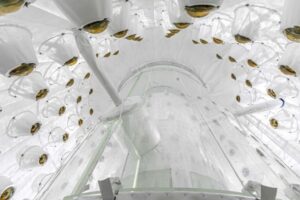
For the first time LZ has exploited in its outer detector an active neutron veto consisting in 17 ton of Gd-loaded liquid scintillator. The TPC and neutron veto are inside a water tank instrumented with 120 8-inch photosensors, which works as an active muon veto.
LZ data are consistent with the background-only hypothesis above the small tested WIMP mass of 9 GeV/c2. In the spin-independent scenario the WIMP-nucleon cross section is probed at the unprecedented level of 5.9×10-48 cm2 for a WIMP mass of 30 GeV/c2. In spite of this null result, LZ shows a crucial progress in hunting for dark matter and demonstrate the excellent performance of the detector waiting for more to come.
A paper describing the results can be found here. A recording of the presentation can be viewed on YouTube here. The slides from the presentation as well as supplemental material referenced in the paper can be found here.
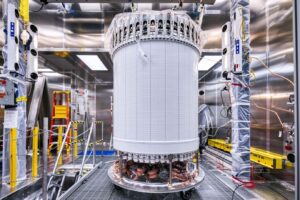
The LZ central detector in the radon-free clean room at SURF after assembly. Photo by Matthew Kapust (https://www.sanfordlab.org)
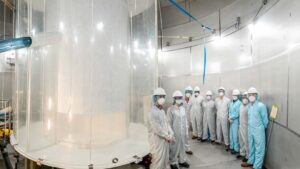
Members of the LZ collaboration in the water tank after the outer detector installation.
Photo by Matthew Kapust (https://www.sanfordlab.org)
LZ Outer Detector. Photo by Matthew Kapust (https://www.sanfordlab.org)
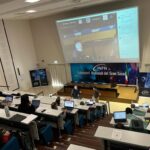
The workshop on European Underground Laboratories took place at LNGS. Credits: Antonio Giampaoli/ LNGS
A Workshop on EU Underground Laboratories was held at LNGS on 28-29 April. The Workshop was jointly organized by LNGS and APPEC (https://agenda.infn.it/event/30742/).
The purpose of the Workshop was to facilitate and promote an executive network between Underground Laboratories in Europe to better face next generation experiments.
Contributions from LNGS (Italy), LSC (Spain), LSM and LSBB (France), CLAB (Finland), Boulby (UK), HADES (Belgium), ChETEC-INFRA (Germany), Romania and Poland were reported during the Workshop.
A final round table with lab directors established a willingness to initiate regular meetings to assess the present state of infrastructure in order to identify common interests and future collaborations.
The aim of this ECFA-NuPECC-APPEC working group is to find ways to improve the recognition of individual achievements in large collaborations. The working group was installed in July 2019 in Ghent. It continues previous work by ECFA, which among other activities performed a community-wide survey in 2018. Meetings with the collaborations were held separately for the three communities in two rounds, first in June-July 2020 and then in Oct-Nov 2020. A questionnaire was prepared and sent to the participating collaborations from all three communities in late 2020 and has been evaluated. A report summarizing the results has been prepared, circulated in the community and presented at the JENAS meeting in May 2022 in Madrid. Based on the feedback, a final version has been prepared that can be downloaded here.
Background: a composition of the center of the milky way (custom composition of three different wavelengths images)and a deep star map by NASA’s scientific visualization studio
Earth: textures are from NASA blue marble, 3D rendering from Simon Barke
LISA constellation: Simon Barke
Credts: NASA/JPL-Caltech/NASAEA/ESA/CXC/STScl/GSFCSVS/S.Barke (CC BY 4.0)
LISA, the future gravitational wave observatory in space, has passed major milestones and is expected to fly in the mid-2030s. Recent developments of LISA include the review of technologies and planning according to ESA´s standard development logic, and the U.S. National Academy of Sciences’ Decadal Review. LISA has successfully mastered both milestones:
Mission Formulation Review and begin of Phase B1
LISA, the Laser Interferometer Space Antenna, has reached an important milestone: it has passed the comprehensive “Mission Formulation Review” (MFR) and entered the next phase of development, Phase B1. The MFR review team, consisting of experts from ESA, NASA, the scientific community and industry, identified no showstoppers and confirmed that LISA has successfully reached a maturity sufficient to proceed to the next stage. The MFR is a prerequisite for mission development to continue. In an ESA mission lifetime cycle, the MFR is the formal end of Phase A (mission feasibility). Building upon the foundations laid in Phase A, the team now focuses on developing the requirements guidelines for the mission.
“LISA is well underway. In Phase B1 we do more detailed design work to establish the complete set of mission requirements and the verifications approach”, says Prof Karsten Danzmann, Lead of the LISA Consortium.
Martin Gehler, LISA Study Manager at the European Space Agency, adds: “The review was a major success for all stakeholders and the fruit of vigorous work on Consortium, NASA, and ESA side over the last years.”
Transitioning into Phase B1 finally lifts the mission out of concept studies and marks a major milestone for all of the scientists and engineers involved. With an implementation duration of around 10 years, LISA is expected to fly in the mid-2030s and, following a year-long cruise to its final, low-disturbance destination, can start to fulfil its mission to observe gravitational waves from space and enable new scientific discoveries.
US National Academy of Sciences highlights LISA as a New Window on the Dynamic Universe
The US National Academy of Sciences has noted the important presence in the NASA Program of Record for the implementation and execution of the LISA Mission, led by the European Space Agency. In the Astrophysics Decadal Survey, a panel of experts evaluated and prioritized research activities in astronomy and astrophysics in the coming decade. The survey noted the “tremendous promise” of the future gravitational wave space mission LISA because of the expectation that observations of gravitational waves in space will make “astronomical measurements that will change paradigms.”
LISA International Symposium
The online LISA International Symposium took place from July 25-29 and was organized by the Institute for Gravitational Research of the University of Glasgow. Updates on all areas of the project were presented during this meeting and recors of the talks are available here:
LISA Through observations of gravitational waves, LISA will offer an unprecedented and unique view of the Universe, quite different from any other space telescope and any ground-based gravitational-wave detector. LISA will deliver pioneering scientific results enabling insights not available through electromagnetic observations.
Combining LISA observations with those of other ground- and space-based facilities will also allow scientists to make enormous advances in multi-messenger astronomy.
LISA will observe gravitational waves in a lower frequency band than those detectable by LIGO and Virgo, allowing us to observe much larger systems at earlier times in the Universe’s history.
The LISA instrument will consist of three spacecraft in a triangular configuration with 2.5 million kilometer arms, moving in an Earth-like orbit around the Sun. Gravitational waves from sources throughout the Universe will produce slight oscillations in the arm lengths (smaller than the diameter of an atom). LISA will capture these motions and thus measure the gravitational waves by using laser links to monitor the
displacements of test masses free-falling inside the spacecraft. The LISA satellites are being built by ESA, ESA member nations, and NASA.
LISA´s hardware got its first and very successful test in space with the LISA Pathfinder (LPF) mission, led by ESA with NASA participation. This included a thorough test of crucial components of LISA´s technology. LPF demonstrated that it’s possible to place and maintain test masses in free-fall to an astonishing level of precision, and that the exquisite metrology needed for LISA meets the requirements.
The LISA Consortium is a large international collaboration that combines the resources and expertise from scientists in many countries all over the world. Together with ESA as the lead agency and NASA as an international partner, the LISA Consortium is working to bring the LISA mission to fruition.
Round table discussions during the Town Meeting.
Credits: AAPEC/ Ashley Jones
On the 9th and 10th of June about 100 Astroparticle Physicists met in Berlin to discuss the Midterm review of the European Astroparticle Physics Strategy 2017-2026. The aim of the Town Meeting was to receive a final feedback from the community on the implementation process of the Astroparticle Physics Strategy with respect to the international context, and the new developments in Astroparticle Physics and neighbouring fields that could lead to further evolution of the strategic recommendations.
As input to the Town Meeting, written community feedback was obtained over the last months and together with the oral feedback from the Town Meeting, the APPEC Scientific Advisory Committee will release a draft Strategy Update document by fall for final community feedback. The Strategy Update is expected to be released by APPEC before the end of the year.
The first day of the town meeting was dedicated to discussions in small groups. According to their stated interests, the participants were put into mixed discussion groups with 4-6 participants and 14 different topics were discussed in eight rounds. In addition, there was the opportunity to discuss further topics during the “Open microphone speeches”.
After initial skepticism, this concept was subsequently highly praised and contributed a great deal to the successful outcome of the meeting. Especially after the long Corona break, without face-to-face meetings, the need for informal and personal discussions was very high and sufficient time was made available for these, which was gratefully appreciated by the participants.
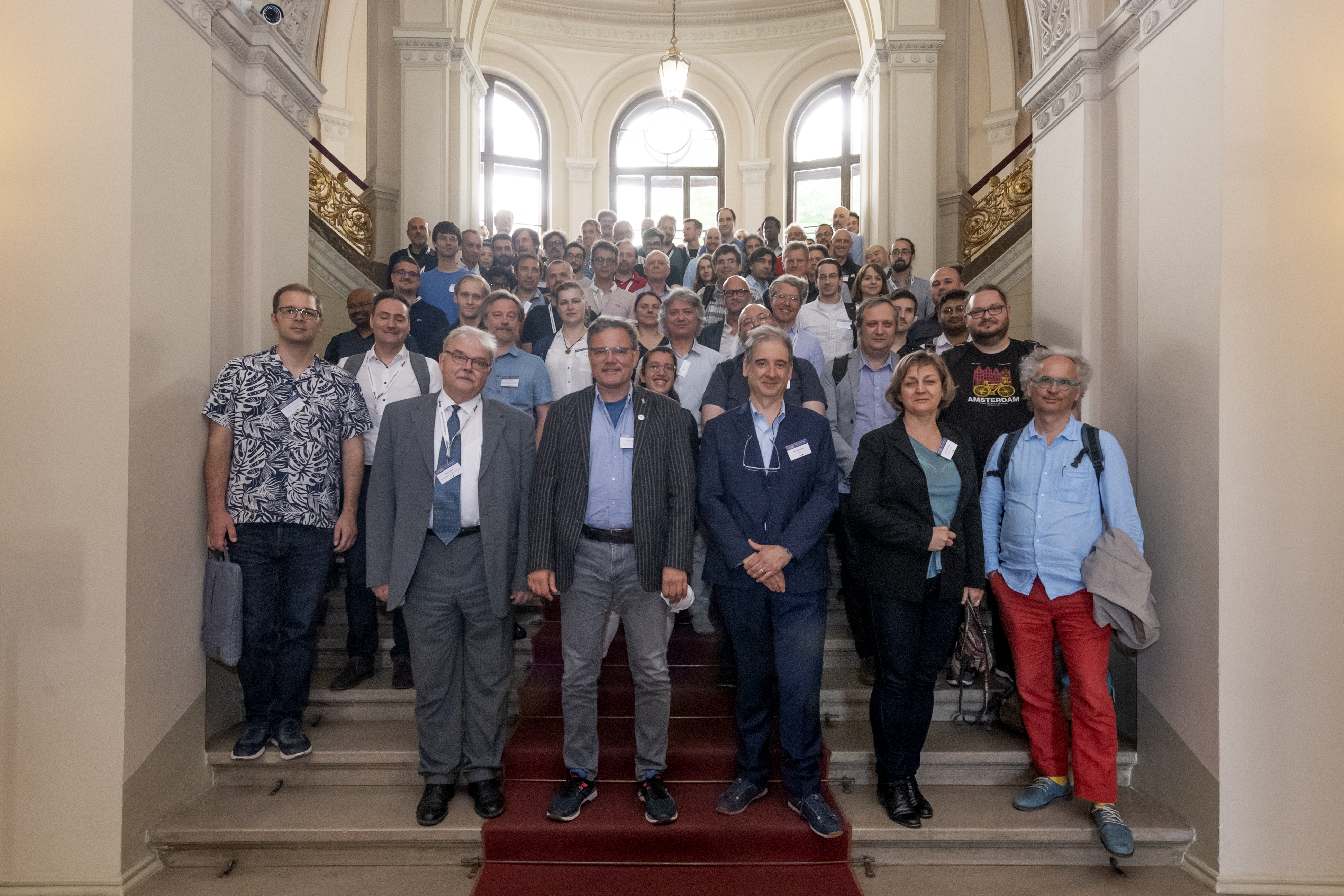
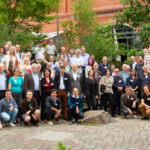
Group picture
Credits: APPEC/ Ashley Jones
In the late afternoon and evening of the first day the outcomes of the discussions were collected by the table hosts together with the topical summary speaker who presented the results on Friday morning. From all the summary talks, it was the task for the APPEC SAC Chair to identify the most important topics and how to incorporate them into the midterm review and finally the update document. This was presented in a final presentation on Friday afternoon.
Christian Spiering has worked in Russia for more than four years in the 1970s and has collaborated with Russian researchers for almost fifty years. Russia with its language, its literature and its people became a kind of second cultural home for him. In the early APPEC/ASPERA period he chaired several roadmap processes and he initiated the Global Neutrino Network, a network in which neutrino astronomers from different countries and from several experiments work together. Russia’s attack on Ukraine has currently made such collaborations impossible. This war affects in first order the Ukrainian people and Ukrainian scientists but also has a huge impact on science in Europe as a whole and in particular on collaborations with Russian scientists. These aspects will be discussed in the following interview.
You have always worked closely with Russian scientists. How has this collaboration changed since the start of the war in Ukraine?
Before answering your question, let me make a general remark: I admit that I belonged to those who have tried to understand and to explain Russian policy, even to some degree Putin’s policy, and who see themselves disproved since February 24. I am also aware that with respect to the emergence of this conflict, there is no simple black and white. Historians will weigh the arguments of all sides against each other, including also those about chances missed by Western and Ukrainian policy. But whatever mistakes may have been made from all sides: nothing, really nothing justifies a war, and nothing justifies the support of the aggression against Ukraine.
Now to your question.
Let me give you a simple example: I am chairing the Technical Advisory Board of Baikal GVD and I am a member of its strategic Advisory Committee. Just in February we had sessions of these two committees and wrote detailed recommendations, including the advice to broaden the basis of the experiment by inviting more international collaboration partners. Now, a bit more than a month later, we neither could perform such sessions, nor would we write recommendations. The advice to invite more international partners at present would sound bizarre, to say the least.
Within the Global Neutrino Network, Baikal GVD is also part of transnational multi-messenger activities which – regrettably for all sides – will suffer from the present situation.
Another case is the TAIGA experiment in Siberia, with strong intellectual and hardware contributions from Germany. For the time being, Germans will not travel to Russia and participate in detector upgrade and operation. Parallel analyses in Germany and Russia are continuing, but when and how this could lead to a jointpublication is open. Another example is the FACT Cherenkov telescope in La Palma which was foreseen to be transported to the TAIGA site; if and when this could happen is currently written in the stars. On another note will be experiments like LEGEND, CUPID and others which used to (or have planned to) obtain purified materials from Russia. They might have to look for other, likely more expensive suppliers.
Are there still opportunities to work together with Russian colleagues?
For the moment all cooperation with Russian institutions has been frozen. I believe that – if artists and sportsmen cancel their participation in joint events – scientists should also send a strong signal against this completely unjustified and brutal war. There is no question that contacts will be resumed at some point after the end of the war, or at least after a ceasefire. This will certainly start with small projects shaped by individuals. However, I personally would find it difficult to come back to common work, such as if nothing had happened, with someone who has openly supported the invasion of Ukraine.
How do you assess the situation for science and scientists in Russia?
Russian scientists will be, or are already, the first to suffer with respect to their work. This starts with the possibilities to participate in international projects in the West, to be accepted as speakers on conferences, with problems to sign with their Russian affiliation on joint publications, and continues with the availability of high-tech components for experiments in Russia, like, e.g., the Baikal Gigaton Volume Detector or the TAIGA observatory.
On a completely different note is the exodus of excellent scientists, among them those of whom Putin says he “spits them out like a mosquito that has got into his mouth” (a formulation which reminds me of the darkest times in Germany as well as in Soviet Union). Historical situations are difficult to compare, but somehow this could become a version of the exodus of brilliant minds from Germany in the 1930s.
On the one hand, there is a declaration, signed by several thousand Russian scientists, against the war; on the other hand, Russian universities have issued a statement in which they express their full support for Putin’s politics. How can we deal with these different attitudes?
I have the deepest respect to the signatories of the letter against the war – for their clear inner compass and for their courage. For me, the rectors of the Universities who signed the second letter range on a similar level as all the Duma members, ministers and governors who have silently carried out the illegal orders of the government and therefore bear a considerable share of the blame for the current situation. Note, however, that some rectors did not sign this nasty document and that the names of some of them seem to have been inserted without their own knowledge. Also, a non-negligible number of faculty members and students signed a letter against that of their rectors – with consequences for them which likely will become fully visible only after the war.
I have no clear idea how to deal with that. The general principle should be to support the signatories of the anti-war letters wherever possible, and avoid the cooperation with the intentional signatories of the rector’s letter if any possible. How to translate this into action in concrete situations will have to be seen. For the duration of the war, a proper selectivity seems impossible, so I would vote for freezing any official cooperation until the weapons are silent and a ceasefire is reached, however fragile it may be.
Whatever we do, we should keep in mind, that Russian science does not only consist of Universities and Research Institutes, but is made up of thousands of unexpectedly isolated researchers, a large proportion of whom condemn war, even though they may disagree with us about its causes. I will keep the contacts to my Russian friends, and I fervently hope for a time when we see each other in person and can work together again.
Many collaborations and scientific institutions are currently discussing how to combine good scientific practice and the sanctions against Russia and how to deal, for example, with joint publications. What is your opinion on this?
I think that withdrawing already submitted publications is not a good way. Work on publications in preparation, however, might easily be paused – this kind of “freezing” does not violate good scientific practice. Let’s be honest: for more than 99.9% of all possible publications, at this very moment a clear sign against the war is more important than their delay by a few months (I hope that this time scale does not turn out to be an illusion).
In any case, I would wish that the APPEC countries find a coordinated answer to this question.
Do you expect an increasing number of Russian refugees, including scientists? How should we as a scientific community deal with these?
Journalists, writers, artists and scientists are probably the most exposed and vulnerable groups. The European governments should create a support program so that our Universities and research institutes are enabled to create positions for exiled Russians and to integrate them in our research landscape. Given the excellent scientific quality of many of the Russian opponents to the war, this would certainly turn out as a clear benefit for astroparticle and particle physics in western countries.
You yourself live in Berlin, where many Ukrainian refugees are currently arriving. How do you personally experience this situation?
Together with a few others, I am taking care of eight Ukrainian women with their 13 children. At the beginning, they were accommodated in a hostel, but without meals. So, we prepared breakfast and dinner for them for a fortnight. Meanwhile we could accommodate them in four flats and are helping them with all the confusing formalities – financial support, health insurance, language lessons, etc. Most of them want to go back to Ukraine as soon as the war is over.
A Russian-speaking colleague of mine, also retired, took a job as a full-time teacher of Ukrainian kids. In general, there is great support from volunteers, and even the cumbersome Berlin bureaucracy is – slowly but steadily – getting into gear.
This interview took place on 2 April 2022.
Further information
Database of positions and accommodation for Ukrainian students and researchers: Science for Ukraine
Christian Spiering (born 1948) studied Physics at Humboldt University Berlin. 1974-78 he worked at JINR Dubna. Having started his carrier with hadron-nucleus interactions, he moved to a neutrino experiment at Protvino/USSR, and 1988 to neutrino astrophysics – starting with the neutrino telescope in Lake Baikal, later AMANDA at the South Pole, and ending up with IceCube. Being engaged in “two worlds”, he initiated the Global Neutrino Network in 2014. He worked also in the Tunka/TAIGA air shower experiments in Siberia. Christian served as AMANDA European Spokesperson and later IceCube spokesperson. From 2006 to 2012 he chaired the APPEC Peer Review Committee. He was awarded the Markov Price of the Russian Academy of Sciences and the O’Ceallaigh-Medail of the Dublin Institute for Advanced Studies. He is author of two popular-scientific books, quite recently “Neutrino astronomy – looking to hidden worlds”.
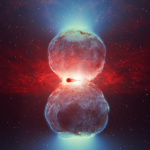
Artist’s impression of the white dwarf and red giant binary system following the nova outburst. (Credits: DESY/H.E.S.S., Science Communication Lab)
In a publication in Science, the H.E.S.S. collaboration has for the first time described the time sequence of the acceleration process in a nova.
Novae are a source of high-energy particles and photons and RS Ophiuchi (RS Oph) is a recurrent nova system comprising a white dwarf and a companion red giant star. RS Ophiuchi exploded on August 8, 2021 and the H.E.S.S. telescopes were turned to the constellation in the night after the first sightings and promptly detected the explosion. The observations continued for more than one month, resulting in an exquisitely covered light-curve of the event.
The paper ‘Time-resolved hadronic particle acceleration in the recurrent nova RS Ophiuchi’ describes the spectral and temporal properties of the gamma-ray emission. They reveal that it takes longer to reach maximum brightness at the highest energies compared to less energetic light and offers insights that allow a more profound understanding of such explosions.