On 8 November ETpathfinder was opened in Maastricht in a festive ceremony by the demissionary Minister of Education, Culture and Science of the Netherlands Ingrid van Engelshoven. ET pathfinder serves as a testbed to develop new technologies for future gravitational wave detectors, in particular the Einstein Telescope (ET).
The ETpathfinder is built at Maastricht University involving several European institutions as explained by Stefan Hild, project leader of ETpathfinder: “We started ETpathfinder with 15 partners from the Netherlands, Belgium and Germany. Universities and research institutes from France, the UK and Spain have since started to contribute as well. It is great to see all this international expertise come together here in our facility.”
The facility is a huge cleanroom where various kinds of laser interferometers can be set up over the next 20 to 30 years. Despite several towers which contain all kinds of equipment there are ‘arms’ consisting of vacuum tubes of 20 meters long. Although they are too short to actually measure gravitational waves they are sufficient for the development and testing of different kinds of technologies and their interplay. This includes for example new cooling techniques, mirror coatings and lasers, which will be developed together with high-tech companies. The resulting innovations are expected to find other uses in industry as well.
The construction of ETpathfinder in Maastricht strengthens the border region’s position as a candidate location for the the Einstein Telescope and is an important asset to science in Netherland as stated by van Engelshoven: “We strengthen both the development of large-scale scientific infrastructure and the ambition to conduct fundamental research. I am pleased that I was able to contribute to this instrument together with the other partners.”
Left: Professor Stefan Hild, project leader of ETpathfinder and ‘demissionary’ minister Van Engelshoven (OCW).
Right: With a push of the button, Ingrid van Engelshoven officially opened ETpathfinder from inside the cleanroom.
Credits: Philip Driessen, Maastricht University.
A 3D render of ETpathfinder. Credits Marco Kraan, Nikhef
The European Astroparticle Physics Strategy 2017-2026 was adopted by the APPEC General Assembly in 2016. Since then, there have been many developments both in the Astroparticle Physics research field and in the wider world.
In the coming time, APPEC undertakes a mid-term update of the European Astroparticle Physics Strategy, with the aim to establish such an update in fall 2022.
The (European) Astroparticle Physics Community will be closely involved in this update. To this end, a Town Meeting is being prepared for 9 and 10 June 2022 in Berlin, at which occasion all relevant aspects of the strategy will be discussed.
In preparation of this discussion, the APPEC Scientific Advisory Committee (SAC) is preparing a mid-term strategy review document to be serving as framework for the organisation of the Town Meeting and to serve as input for the discussions themselves.
A first draft of the mid-term review is now available here. This document is a DRAFT and not the final document. It serves for the APPEC SAC to receive feedback from the community concerning the accurateness and completeness of the document. Please note, that developments are going fast and that some notions in the report may have been outdated before the ink dried up.
We invite you to give feedback to this document through a form provided on this page. There the form is accessible through the “Feedback” button on the left, or the “Fill out the survey” link at the bottom of the page. Feedback can be given as National Community, Collboration or Individual. Please check the appropriate box.
Feedback can only be provided as plain text. Of course, hyperlinks can be quoted in this text to properly document your response. Multiple feedback submissions are possible, but one comprehensive feedback text will be appreciated.
We explicitly solicit to suggest a burning question that is not yet addressed in the draft mid-term review and that you think should really be discussed during the Town Meeting.
Deadline for your feedback is Friday 21 January 2022.
Your feedback will be used to compile the final APPEC SAC mid-term strategy report that will be released well in time for the Town Meeting on 9-10 June 2022. For transparency, your feedback will become available publicly after when the final SAC mid-term review will be submitted to the community as input for the Town Meeting.
The input from the Town Meeting will serve as input for the Strategy Update document that the APPEC SAC will prepare for submission to the APPEC GA after the 2022 summer holidays. The GA will then release it as the European Astroparticle Physics Strategy 2022-2026 Update.
The European Astroparticle Physics Strategy 2022-2026 Update will also serve as an input to the process to establish the new European Astroparticle Physics Strategy after 2026.
From Sep. 29th until Oct. 1st the LNGS Laboratories hosted an international, hybrid workshop on Neutrinoless Double Beta decay focussed on a common strategy of European and North American agencies on that topic, see https://agenda.infn.it/event/27143/ .
The main projects and experiments included in the APPEC roadmap and the DOE Portfolio Review, the corresponding science, on-going R&D activities for even more ambitious future projects, as well as the capabilities of the relevant Underground Laboratories have been discussed at this workshop. Four major projects have been discussed in depth: CUPID, nEXO, LEGEND and NEXT. CUPID, LEGEND and nEXO were part of the DOE Portfolio Review, while CUPID, LEGEND and NEXT are parts of the APPEC Roadmap on Neutrino-less Double Beta Decay.
After three days of fruitful and deep discussion, the representatives of several European and North American funding agencies, Ministerial representatives and Laboratory Directors have met in a closed session. They unanimously agreed that the strong scientific motivation and the need to cross-check any potential signal with different isotopes justifies the effort to support three experiments, CUPID at Gran Sasso, and LEGEND and nEXO, where one should be located in North America and one in Europe.
The NEXT experiment is highly valued and considered as a future development, but the general consensus is that it then needs to be discussed further once its scalability to large detector masses has been demonstrated.
All participants are aware that this ambitious programme will require additional funding beyond that already secured. Therefore, discussions between the agencies and the scientific community will continue.
The IUPAP neutrino panel had the mandate to promote international cooperation in the development of an experimental program to study the properties of neutrinos and to promote international collaboration in the development of future neutrino experiments to establish the properties of neutrinos.
A main objective of the panel was to carry out a review of the present status of neutrino physics and the requirements and R&D that are necessary for the research field to fulfill its near- to long-term potential. The final report in the form of a science-driven white paper is now available:
Interview with Akira Ohnishi, Laura Fabietti, Philip von Doetinchem, and Alexander Kalweit on the JENAA-EoI on Nuclear Physics at the LHC
Akira Ohnishi, Philip von Doetinchem, Laura Fabbietti and Alexander Philipp Kalweit formed an initiative on Nuclear Physics at the LHC in response to the JENAA call for EoI.
This topic is of interest to all three communities, particle, astroparticle and nuclear physics. Hyperon-nucleon and hyperon-hyperon interactions can be studied with high precision, and these results are fundamental for the study of the equation of state of neutron stars. For the search for dark matter in cosmic rays, the physics of the formation of light antinuclei, like antideuterons and antihelium nuclei, plays an important role and is thus of particular interest for the astroparticle physics community.
In this interview they tell us more about the aims and activities of this initiative.
How are the four of you connected with the three JENAA communities?
Philip: I am an astroparticle physics researcher with a focus on cosmic antinuclei detection for the purpose of using them as messengers for new physics light antinuclei. These subjects are closely connected with each other, and can be studied in the terrestrial experiment, LHC-ALICE. Laura and Alexander: We are both working in the ALICE experiment at CERN and we are excited about the fact that measurements at the LHC have a direct impact on astrophysical questions. Akira: I am a theoretical nuclear physicist and have communicated with Laura on the hyperon-nucleon interactions, and I am also interested in the neutron star matter equation of state.
How did you come up with the idea of a common EoI?
Akira: The ALICE members (Laura and Alexander) organized an interdisciplinary unit including Philip and myself. One of the papers on hyperon-nucleon interactions is published in Nature, and we find that our subjects are attracting broad interest. Philip: Looking at the current status of particle astrophysics it is clear that the interpretation of the cosmic-ray data itself will benefit strongly from improving nuclear production and interaction cross sections. Therefore, a collaborative effort across different disciplines is essential to make the most out of existing and future data.
What are the aims of your initiative?
Philip: The goal is to bring the different communities closer together and to develop a common strategy to address big open questions, like the nature of dark matter, existence of antimatter, and to understand the equation of state of neutron stars. Akira: I am working on the theoretical studies of connecting the hadron-hadron interactions and the hadron-hadron correlation functions. At present, we evaluate the hadron-hadron correlation functions from “reliable” ab initio interactions, such as the lattice QCD and chiral EFT interactions. By comparing with data, I hope that various hadron-hadron interactions would be elucidated by the studies both from theory and experiment.
The kick-off Meeting for your initiative took place almost one year ago. How did you proceed after this?
Akira: I have joined the ALICE collaboration as an associate member. Two papers from the ALICE collaboration including me are in preparation. I also submitted two papers (not from ALICE) on the correlation functions. One is the hadron-deuteron correlation function and the other is the femtoscopic study of NΞ – ΛΛ coupled channel potential. One of the great advances in the ALICE papers (in prep.) including me is the extension of the scope to hadrons with a charm quark. As the first work, we are preparing a paper on D– p correlation function paper. Since there have been no experimental works on the charmed-hadron interaction with nucleons, I think that this is a breakthrough. I have contributed to the paper on providing predictions from some of the theoretical interactions. Philip and Laura: Our groups started collaborating on a new cosmic antideuteron study that specifically focuses on integrating all new collider data for antideuteron production and interaction in the Galaxy in a consistent way.
What are the next steps?
Philip: It is planned to organize a strategy meeting in 2022 to develop a concrete vision of what this initiative wants to accomplish in the next 5, 10, 20 years. We are currently just opening the door to cosmic antinuclei physics and it will be a significant effort from the current status to a precision understanding of sources and propagation of cosmic antinuclei. The impact of these studies has transformative potential for the fields of cosmology and dark matter physics. Alexander: At the LHC, the next big data taking campaign — the so-called Run 3 — is just about to start with a fully upgraded ALICE detector that will allow significantly higher data taking rates. Especially the antinuclei measurements, that are very statistics hungry, will profit enormously from that. Akira: In order to solve the hyperon-puzzle of neutron stars, understanding the three-body force including hyperons is decisive. Since the two-body Λ-nucleon potential (relatively well-known from hypernuclear physics) leads to a soft equation of state which cannot support two-solar-mass neutron stars. Thus we need repulsive three-body forces including hyperons, early transition to quark matter, or modified gravity (modification of general relativity) to solve the hyperon-puzzle. It may be possible to probe three-body forces from the three-body correlation functions. While the theoretical formulation has not been developed, it can be a great achievement if three-body forces including hyperons are obtained from correlation function studies. Another step is the hadron-hadron interactions including heavy-quarks. Hadron physics including charm and bottom quarks is rich and very interesting. A lot of exotic hadrons including heavy-quark(s) have been observed and are attracting the attention of many researchers. However, hadron-hadron interactions involving heavy-quarks have never been confirmed experimentally. If achieved, femtoscopic studies of hadron-hadron interactions with heavy-quarks will provide the first systematic database and will contribute to the non-perturbative QCD physics.
How could interested people join your initiative?
Alexander: Everyone is more than welcome to contact us directly, for instance via email. Akira: Already at present, many hypernuclear and hadron physicists are interested in the works from the initiative. The hyperon-nucleon interactions from the initiative have stimulated the (traditional) hypernuclear physicists, and hypernuclear physics experimentalists have started to prepare confirming them in the (standard) scattering experiments. Exotic hadron physicists expect the progress in the femtoscopic studies from the initiative. Once the three-body potentials involving hyperons are accessed, neutron star physicists will be definitely interested and use them in evaluating the equation of state.
How could NuPECC, ECFA and APPEC support your activities?
Akira: Well, in the future, some international workshops/symposia may be held and supported by the initiative. We may hope to give young researchers awards in those meetings, and may ask the consortiums to support the awards. Alexander: The large physics potential of these truly interdisciplinary studies is sometimes not fully recognised, because they do not fall into existing categories, e.g. in funding agencies or when submitting abstracts for large conferences. Therefore already publicising our physics via interviews like this one or in newsletters and journals helps us a lot.
Akira Ohnishi is a theoretical nuclear physicist and Professor at the Yukawa Institute for Theoretical Physics (YITP), Kyoto University, since 2008. He has been working on heavy-ion collisions, strangeness nuclear physics, nuclear matter phenomenology, and hadron-hadron interactions. He worked on developing some transport models and applied them to heavy-ion collisions and strangeness nuclear production. From the analyses of data, he found that Lambda-Lambda pairs are more abundantly produced at low relative momenta than expected, which implies the effect of the Lambda-Lambda attraction. He discussed the idea to constrain hadron-hadron interactions by using the two-particle momentum correlation from high-energy nuclear collisions in the international workshops held in YITP and other places. The femtoscopic study of hadron-hadron interactions is now one of the main subjects of his research.
Laura Fabietti
Laura Fabbietti is an experimental nuclear physicist and Associate Professor at the Technische Universität München since 2010. Her main scientific interests have developed from the study of in-medium properties of hadrons at accelerator experiments with intermediate energies (HADES, FOPI and AMADEUS) to the study of hadron-hadron interactions and antinuclei formation and absorption measured at the LHC with ALICE. Laura is a member of the ALICE collaboration since 2014, her group has participated to the upgrade of the ALICE TPC with GEM readout and she is currently interested in understanding two- and three-body forces involving nucleons and strange/charmed hadrons. In this context, she would like to link new measurements of the hadron interactions including strangeness with the hyperon puzzle in neutron stars and study the equation of state of dense nuclear matter including strange hadrons. Laura and her TUM group are also interested in best using the (anti)nuclei measurements at accelerators as input for the understanding of antinuclei production in our Galaxy from collisions of high energy cosmic rays with nuclei within the interstellar medium and possible from dark matter annihilations/decays.
Philip von Doetinchem
Philip von Doetinchem is an experimental particle astrophysicist and Associate Professor at the University of Hawai‘i at Manoa. His research program focuses on the ”Identification of Dark Matter with Cosmic-ray Antinuclei,” funded by NASA and NSF. He is a collaboration member of the operational AMS-02 experiment on the International Space Station. Furthermore, Doetinchem is the project scientist of the upcoming GAPS experiment. This new high-altitude balloon experiment aims to detect cosmic-ray antinuclei with a complementary experimental technique to AMS-02. Besides, his group is working on the fixed target experiment at NA61/SHINE at CERN to measure cosmic-ray (anti)nuclei production cross sections.
Alexander Kalweit
Alexander Kalweit studied physics at the Technische Univeristaet Darmstadt. For his Ph.D. at the Gesellschaft für Schwerionenforschung, he joined the ALICE experiment at CERN to investigate the production of light flavour hadrons in heavy-ion collisions. His current main research interests is the production of anti- and hyper-nuclei at the LHC. He holds a research staff position at CERN and serves as deputy physics coordinator of the ALICE collaboration.
The European Consortium for Astroparticle Theory (EuCAPT) was very productive within the last month and we give a short overview here.
In May this year they held their first annual symposium. Hundreds of theoretical physicists from Europe and beyond met via Zoom to discuss the present and future of astroparticle physics and cosmology in a dense and exciting meeting that featured 29 invited presentations, 42 lightning talks by young researchers and 2 community-wide brainstorming sessions.
The participants discussed a wide array of topics at the interface between particle physics, astrophysics and cosmology, with particular emphasis on the challenges and opportunities for these fields of research in the next decade. Rather than centering around experimental activities and the discoveries they might enable, the symposium’s sessions were structured around thematic areas and explored the interdisciplinary, multimessenger aspects of each of these areas.
The EuCAPT symposium was more than ‘just’ a conference. In line with EuCAPT’s mission, the local organisers and the consortium’s steering committee organised a series of community-building activities. In a brainstorming session on the future of EuCAPT, participants were asked for opinions on the best way to exchange information and suggestions on how to support our community. Among the many useful comments, participants stressed the importance of supporting diversity and inclusion, something EuCAPT definitely regards as a high priority. A second brainstorming session was devoted to the discussion of the EuCAPT white paper.
One of the most interesting and exciting aspects of the symposium was the inclusion in the plenary programme of sessions with lightning talks given by students and young scientists, which provided a snapshot of the theoretical research work carried out in Europe. A jury composed of the symposium organisers and EuCAPT steering committee members voted for the best lightning talks and awarded special prizes. The next symposium will take place in 2022, hopefully in person, at CERN.
A EuCAPT Astroneutrino Theory Workshop took place in Prague 2021 (September 20 – October 1) which was organized by and took place in the Institute of Experimental and Applied Physics of Czech Technical University in Prague (IEAP CTU). 45 scientists from not only Europe but also worldwide participated in the workshop focused on the role of neutrinos in astroparticle phenomena (https://indico.utef.cvut.cz/event/28/overview).
The scientific agenda was split into the four areas: i) Aspects of Cosmic Neutrino Background; ii) Electromagnetic properties of neutrinos; iii) Neutrinos in celestial dynamics and iv) Neutrinos in cosmic rays. The main goal of the Workshop was to bring together experts of the selected areas, from whom the participants can learn. Secondly the workshop tried to build up a creative environment supporting the formation of new ideas and collaborations. The Workshop was targeted primarily to PhD. students and postdocs. The format of a day was 2-3 invited talks/lectures in the morning and continued in the afternoon by a participant presentations session and by a discussion block.
The White Paper (available here) aims to identify the opportunities in the field for the next decade, and to strengthen the coordination of Astroparticle Theory and Cosmology in Europe. It includes contributions from about 135 scientists, who participated in the brainstorming sessions at the first EuCAPT annual Symposium, provided feedback via the dedicated channels on the CERN Mattermost community platform, and contributed to the writing of the document.
Over the last weeks all members of the astroparticle and cosmology communities were invited to endorse the White Paper. With 135 authors, 400 endorsers, 133 pages and 1382 references it is now published on ArXiv https://arxiv.org/abs/2110.10074.
In September 2021 a new, very successfull sea operation at the ARCA site of the KM3NeT experiment near Sicily took place.
During this sea campaign the positioning system has been maintained by installing two acoustic beacons and recovering an exhausted one, five interlink cables were installed on the sea bottom, three new detection units were installed, i.e.: deployed to the sea bottom, connected to the submarine infrastructure, unfurled to their nominal shape (standing for almost 700 m above the sea floor) and proved to work, and the launcher vehicles of the three installed detection units and the cable trays used for deploying the cables were of course recovered, to be reused for next campaigns.
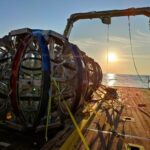
The deck of the Handin Tide at the start of the operations (note that the yellow vehicle on the left is the Remotely Operated Vehicle – ROV – to be used for underwater operations). Credits: KM3NeT
The empty deployment structures that will be reused in the future. Credits: KM3NeT
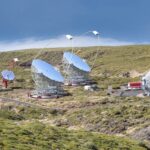
On summer 2021, the Board of Governmental Representatives (BGR) approved the Cherenkov Telescope Array Observatory’s (CTAO’s) Cost Book and Scientific & Technical Description, fundamental documents towards the establishment of the final legal entity of CTAO as a European Research Infrastructure Consortium (ERIC). In particular, these documents include the configuration of the telescope arrays at the two sites for the first construction phase, named “Alpha Configuration.” This configuration includes 4 Large-Sized Telescopes (LSTs) and 9 Medium-Sized Telescopes (MSTs) for the northern array located on La Palma (Spain), and 14 MSTs and 37 Small-Sized Telescopes (SSTs) for the southern array situated in the Atacama Desert (Chile). The definition of these configurations is the result of a meticulous optimization process for each array’s scientific capabilities, which implies the specialization of the northern array in extragalactic sources (low and medium CTAO’s energy range) and that of the southern array in Galactic targets (medium and high CTAO’s energy range) for the first construction phase.
Rendering of the CTAO northern telescope array. Credit: Gabriel Pérez Díaz, IAC.
Moreover, new performance plots and the Instrument Response Functions (prod5 IRFs) for this Alpha Configuration are now publicly available on the CTAO website, in FITS and Root format, for three different zenith angles (20-40-60deg), averaged azimuth and dark conditions. Visit https://www.cta-observatory.org/science/ctao-performance/
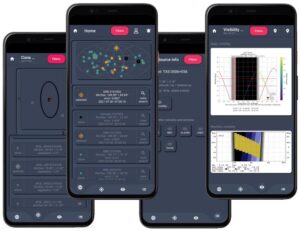
Illustration of the Astro-COLIBRI smartphone application
After three years of reflection and development, the “Astro-Colibri” application has just been launched. This digital interface, created by researchers at Irfu/DPhP, aims to make information on transient and multi-messenger phenomena easily accessible in real time. The need to react quickly to the most violent explosions in the universe and the large amount of information provided by the global network of observatories requires new approaches and new tools. Through “Astro-Colibri”, several observatories now have the capacity to coordinate in monitoring and identifying the sources of physical phenomena in the transient sky.
The platform, which exists in the form of a smartphone application (IOS and Android) and a website, allows alerts to be put into their observational context by cross-referencing them with already known data. This saves researchers a considerable amount of time. In addition, the application anticipates the best possible observation periods for a given observatory. This free interface is also a fun and practical tool for astrophysics enthusiasts who will be able to easily move around this functional application.
A paper describing the functionalities has just been published in the Astrophysical Journal (P. Reichherzer et al 2021 ApJS 256 5, journal link + arXiv)
Concrete examples of use-cases are described in F. Schüssler et al. PoS (ICRC2021) 935 (2021), arXiv
The International Cosmic Day will take place this year on November 10, 2021. And there is a reason to celebrate: it is the 10th anniversary.
The International Cosmic Day (ICD) focuses on the cosmic rays that surround us all the time, but are always unnoticed. So let’s explore them for one day and discover what secrets they bring.
During this day, students, teachers and scientists get together to talk and learn about Cosmic Rays. Questions that can be discussed are:
What are cosmic particles?
Where do they come from?
How can they be measured and what can we learn from them?
If you want to be part of this day and plan a program, you can get more information here.





 From Sep. 29th until Oct. 1st the LNGS Laboratories hosted an international, hybrid workshop on Neutrinoless Double Beta decay focussed on a common strategy of European and North American agencies on that topic, see