In light of the present COVID-19 worldwide crisis and after carefully considering all options, it has been decided that Neutrino 2020 will be held as an online-only conference. It is assumed that it will take place on or close to the originally planned dates and it is expect that there will be a process for online poster presentation. More details on the conference format will be announced on the conference website.
The XIX International Conference on Neutrino Physics and Astrophysics will be held June 21 to 27, 2020, in Chicago, Illinois. Its primary focus is to review the current status of neutrino physics, the impact of neutrino physics on astronomy and cosmology, and the vision for the future development of these fields. The conference consists of invited plenary talks and contributed poster sessions.
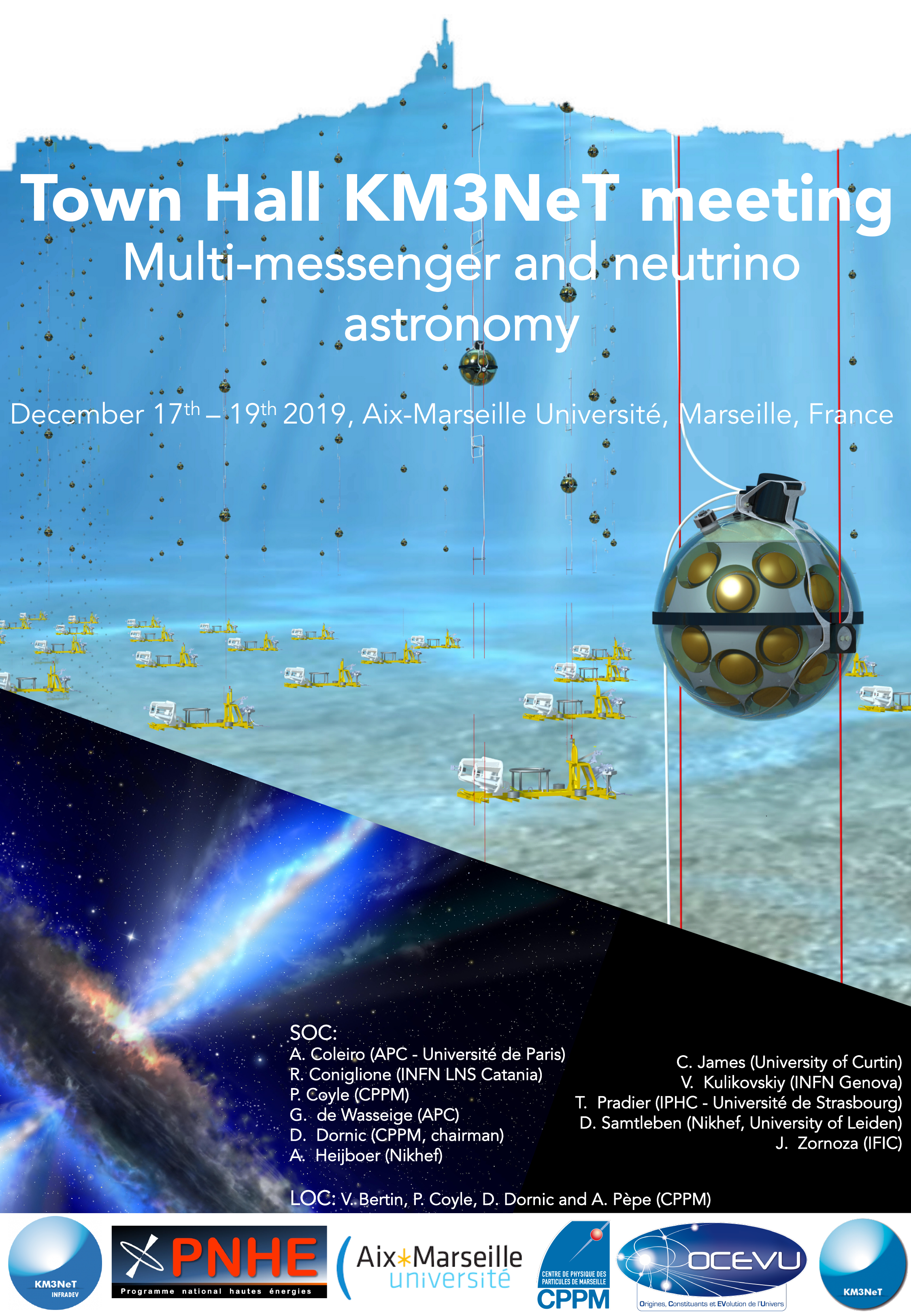
The KM3NeT Collaboration is organizing a Town Hall Meeting to promote its multi-messenger programs. The workshop will take place from 17-19 December 2019 at the Aix-Marseille Université in Marseille, France. During this workshop, they would like to review the most up-to-date neutrino production models and present KM3NeT performances and multi-messenger programs.
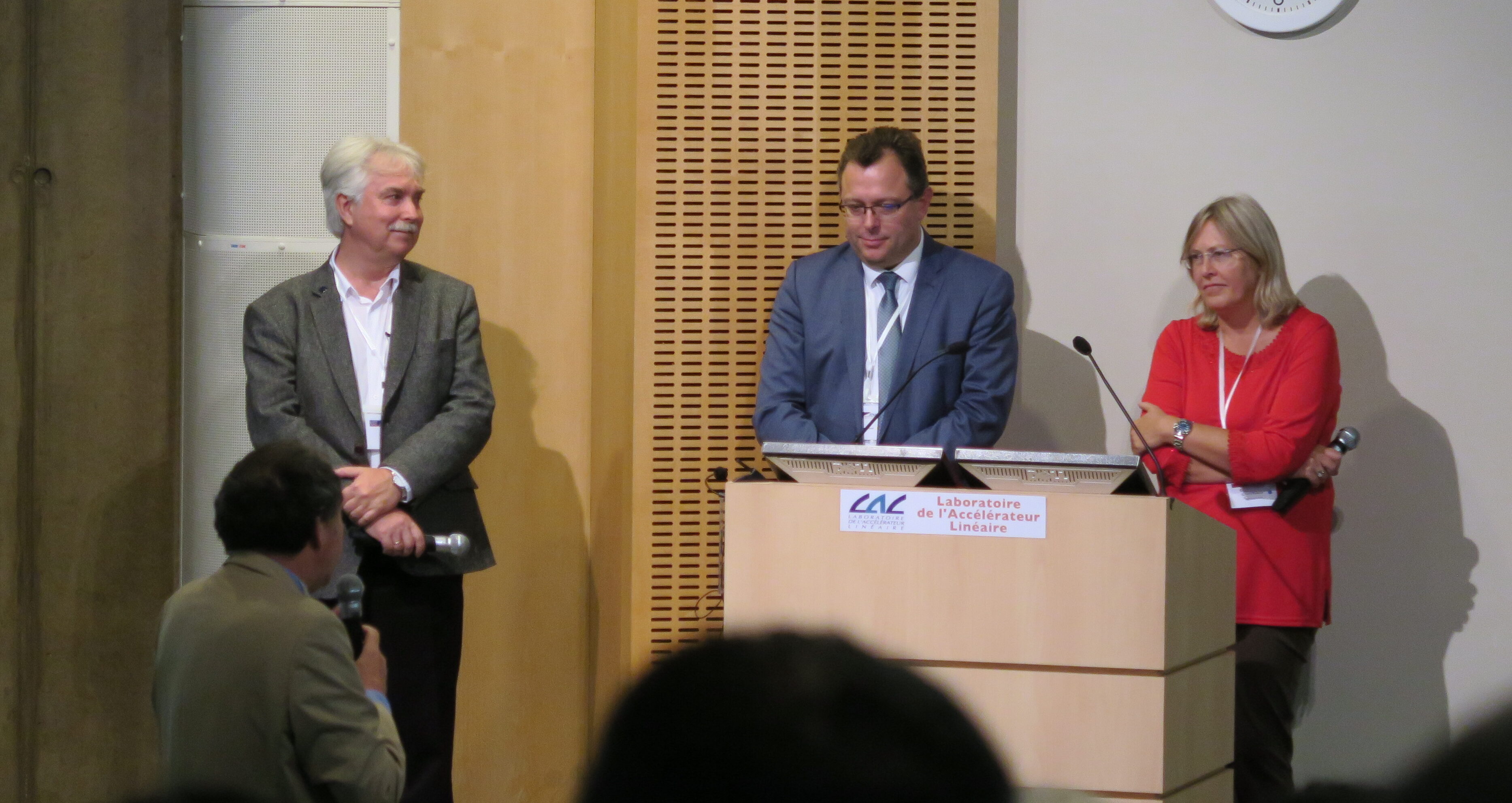
The first JENAS, Joint ECFA (European Committee for Future Accelerators)-NuPECC (Nuclear Physics European Collaboration Committee)-APPEC (AstroParticle Physics European Consortium) Seminar, attracted 230 participants resulting in a full auditorium at the Laboratoire de l’Accélérateur Linéaire (LAL) in Orsay. Beyond the regular information exchange across the three European committees, the importance is recognized to reinforce their interdisciplinary links. For three days senior and junior members of the astroparticle, nuclear and particle physics communities presented their overlapping challenges. Together they have a strong aspiration to explore nature with a view to understand both the smallest and the largest structures. On the technology front they seek to make visible the invisible at these extremes, and these successes are transformed into opportunities at the human scale for amongst others health, energy and safety. Readout electronics, Silicon Photomultipliers, Big Data computing and Artificial Intelligence for analysis are only some examples of developments essential for our research. Related to the quest of unravelling new insights in fundamental physics, coverage is required from all three fields in order to address the dark matter problem, the neutrino sector and the physics with gravitational waves. In presentations on organizational matters related to education, outreach, open science and software as well as careers, synergies are clearly identifiable. At the occasion of this meeting a Diversity Charter has been launched by APPEC, ECFA and NuPECC. From a survey among the seminar participants the diversity aspects will be analyzed together with those from other conferences and events organized by the three communities.
Marek Lewitowicz (NuPECC), Jorgen D’Hondt (ECFA) and Teresa Montaruli (APPEC)
The JENAS2019 event, which was jointly organized by LAL-Orsay, IPN-Orsay, CSNSM-Orsay, IRFU-Saclay and LPNHE-Paris, allowed astroparticle, nuclear and particle physics researchers to sniffle into each other’s activities. The identified challenges can transform via joint programs into opportunities to deepen our understanding of physics. Being informed by the presentations and discussions and with a view to further explore topical synergies between the disciplines, in the closing remarks a call has been issued for novel Expressions-of-Interest. Bottom-up and community thoughts can be submitted to the chairs of the three committees/consortia for further discussion within APPEC, ECFA and NuPECC. Thoughts revolving around potential synergies in technology, physics, organization and/or applications are welcome. The letters should elaborate on the synergy topic, the objectives, the initial thoughts and the potential communities involved. These letters are not the end of the process, but potentially the start of further communications on the expressed interest. APPEC, ECFA and NuPECC will discuss and propose actions to pursue your thoughts with a view to the next JENAS event in two years.
Website: https://jenas-2019.lal.in2p3.fr
The VIth CNRS thematic School of Astroparticle Physics on “PHYSICS and ASTROPHYSICS of COSMIC RAYS” will be held from November 25th – 30th 2019 at the OHP Saint Michel l’Observatoire in France. This school follows several other schools supported / organized by the Programme National Hautes Energies (PNHE), the latter focusing on the physics of the Universe X-ray (2016), gravitational waves (2013) and gamma astronomy (2011). This one will present an observational and theoretical overview of the physics and astrophysics of cosmic rays, with hands-on training sessions on Cherenkov Telescope Array (CTA) data analysis as well as on CR propagation codes. Particular attention will be given to taking into account statistical and systematic errors in both measures and theoretical models. It will enable current and future actors in the field to understand the various transverse aspects, such as the very great importance of multi-messenger and multi-wavelength observations for understanding the key physical mechanisms in acceleration and transport. Opening up to a broader scientific community, this school aims at bringing together specialists on these topics with the aim of training the next generation of young researchers, in addition to transfer/share skills.
The Gravitational Wave Probes of Fundamental Physics (GW4FP) workshop will take place from 11-13 November at the Volkshotel in Amsterdam, The Netherlands.
As the first workshop by the European Consortium for Astroparticle Theory (EuCAPT), GW4FP aims to bring together the Gravitational Wave and Fundamental Physics communities to discuss topics in Dark Matter, exotic objects, tests of GR and early Universe physics, as well as tests of Standard Model physics in unexplored regimes.
The workshop will involve invited plenary talks covering these broad areas as well as shorter submitted talks for researchers to present their work. Since a key goal of the workshop is to foster collaboration, there will also be discussions, lightning talks and a “four corners” discussion session.
The Paris-Saclay AstroParticle Symposium 14 October – 8 November takes place at the Institut Pascal of the Paris-Saclay University. Around 30 specialists of astrophysics, cosmology and particle physics are invited to discuss and work on the themes: Dark Energy and Dark Matter. Besides the working sessions, there will be also an Open Program with specific workshops, colloquiums and general public talks.
The High Energy Physics Software Foundation (https://hepsoftwarefoundation.org) is a community that intends to facilitate cooperation and common effort in software and computing internationally. In this context, a first discussion after the JENAS meeting is being organized to discuss common grounds on software challenges across the different communities of particle physics, astrophysics, neutrino physics and nuclear physics.
The meeting will be at LAL and on Vidyo on the afternoon of Wednesday October 16 at LAL, at 16:00-17:30, with agenda and videoconference coordinates here: https://indico.cern.ch/event/852242/
The discussion will start with a short introduction from Graeme Stewart, the coordinator of the HEP Software Foundation, presenting what the HEP Software Foundation is and what it facilitated so far. Then there will be contributions from the astrophysics, neutrino physics and nuclear physics communities, with time for discussion. This meeting is a first step to start a discussion on possible areas of collaboration in topics from software event selection and reconstruction all the way to data analysis that can continue in future occasions.
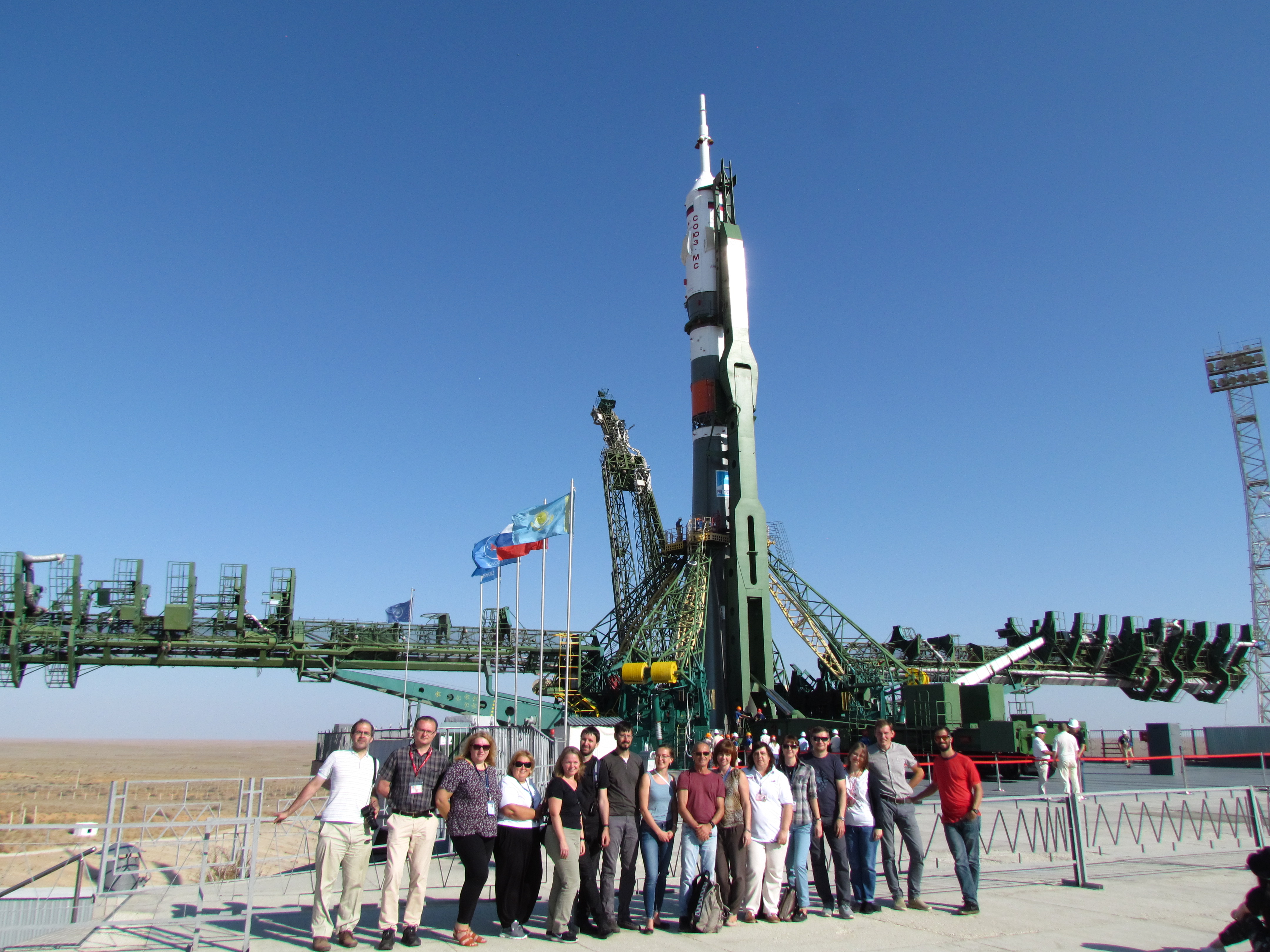
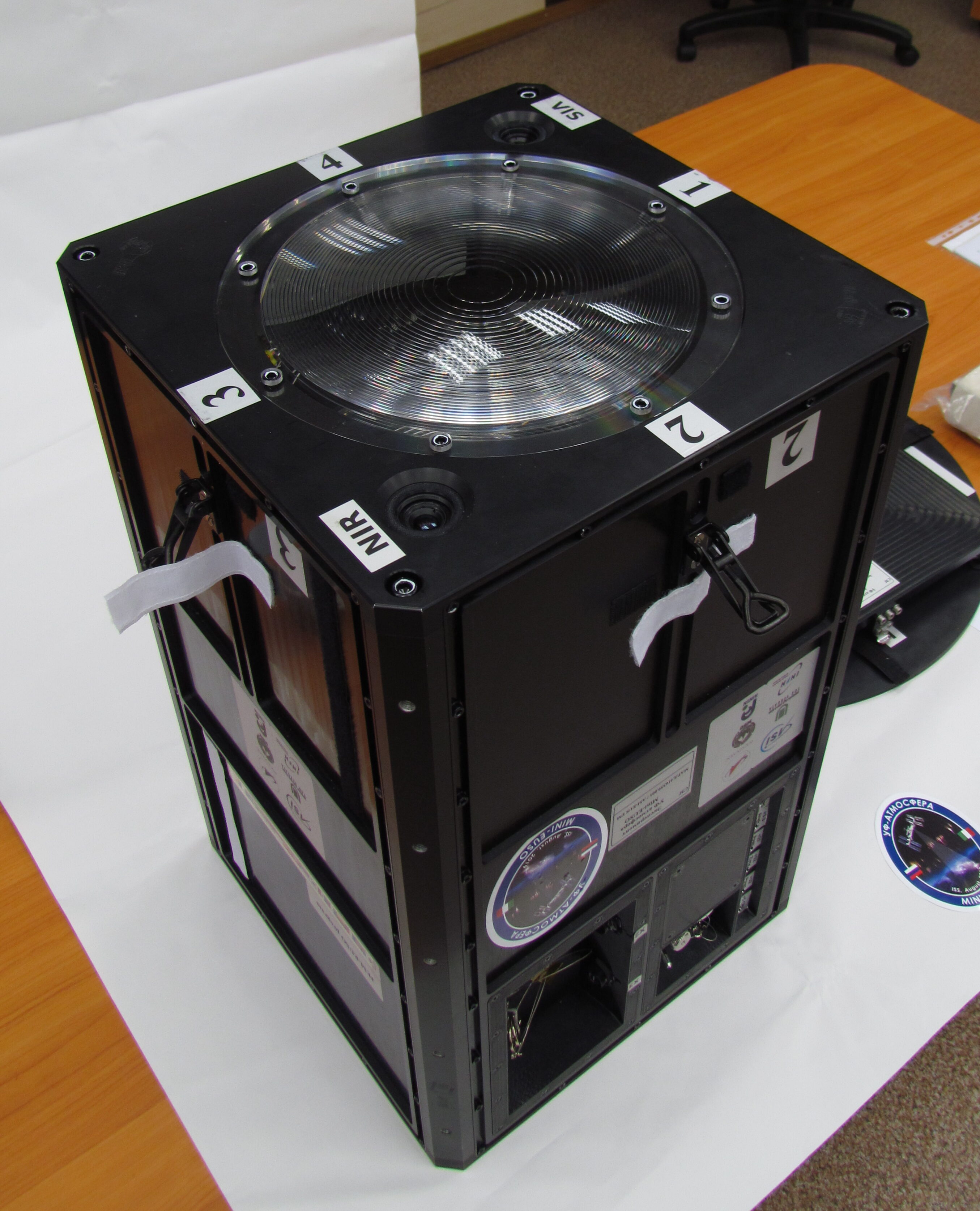
Before the launch at the Baikonur Cosmodrome. (Credits: Mini-EUSO)
On August 27th Mini-EUSO has been launched from the Baikonur cosmodrome and docked to ISS on August 27.
Mini-EUSO is part of the JEM-EUSO program. JEM-EUSO is a new type of observatory to be attached at the International Space Station or orbiting as a free flyer, based on a UV very large telescope, which uses the whole Earth as detector. It will observe, from an altitude of several hundreds of km, the fluorescence tracks produced at (330-400) nm by Extensive Air Showers (EAS) originated by UHE primaries which traverse the Earth’s atmosphere at ultra-relativistic speed.
Mini-EUSO flight model. (Credits: Mini-EUSO)
Mini-EUSO (Multiwavelength Imaging) is a next-generation telescope for the study and monitoring of terrestrial, atmospheric and cosmic emissions in Ultraviolet (UV). The instrument (37 * 37 * 62 cm3), is an ultra-fast video camera (400 thousand frames per second, 2.5 microsecond/frame), capable of single photon detection on each of the 2304 pixels of the focal surface. The optics is based on Fresnel lenses with 25 cm diameter. The thin and compact construction of the lenses is particularly suitable for space-borne detectors. The field of view on the ground is 40 degrees, corresponding to 260 * 260 km2 on the surface of our planet. With the continuous acquisition of data we can therefore – for the first time – create a dynamic map of nocturnal emissions of ultraviolet in the earth. These measurements are completed by a near infrared and a visible camera.
Mini-EUSO will carry out the first ever night time observations of Earth’s atmosphere from space in the near-ultraviolet band from the UV transparent window in the Zvezda Russian module in the ISS, looking at Earth in a nadir position.
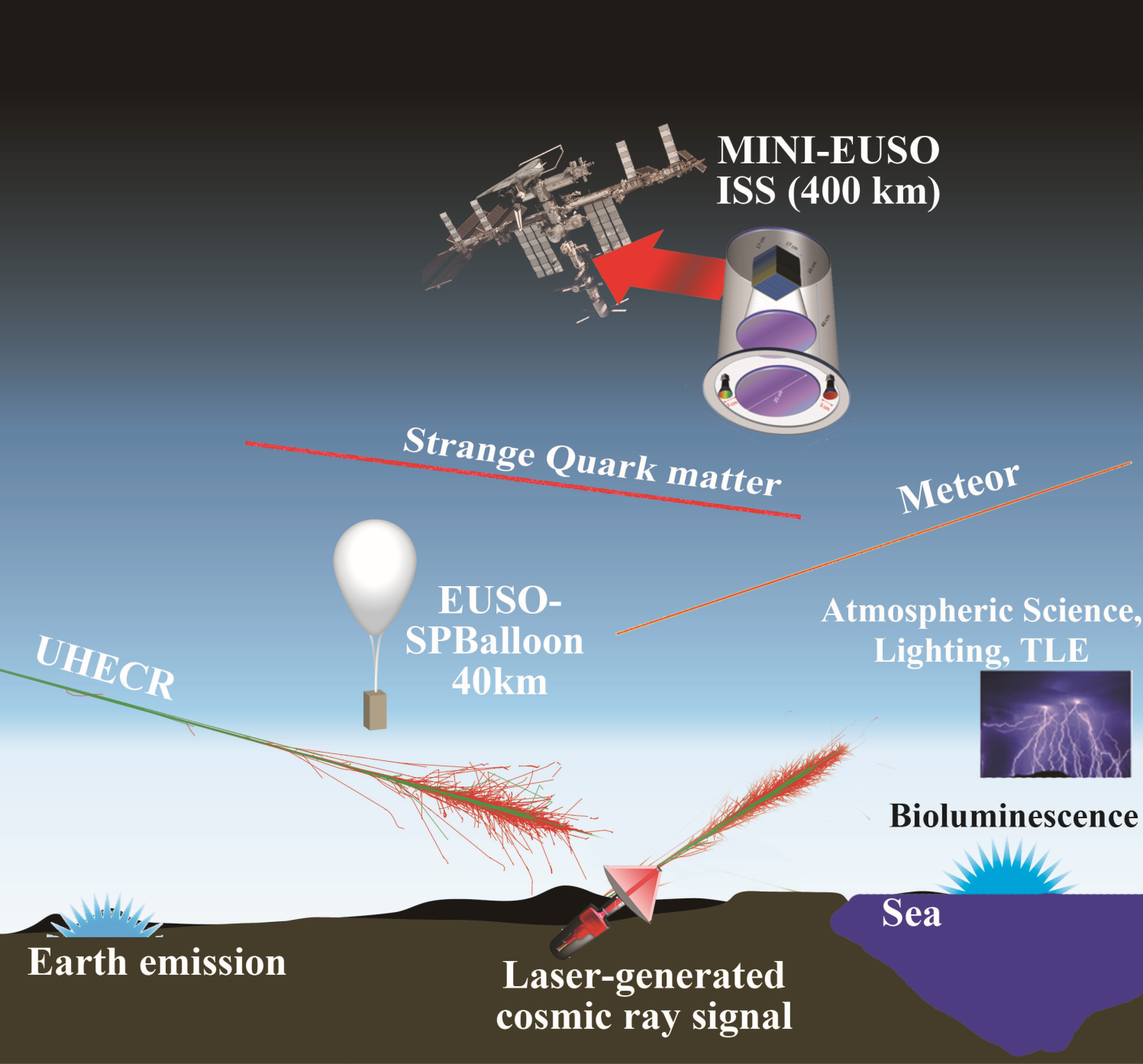
Scientific objectives include:
Scientific objectives of Mini-EUSO. (Credits: Mini-EUSO)
Realization of the first UV night map of the Earth with a resolution of a few km.
Detection and study of meteorites.
Search for quark strange matter. This hypothetical new state of matter could exist in quarks stars or at the center of neutron stars and reach the Earth in the form of interstellar meteorites. Due to their high density, these fragments of nuclear strange matter would appear as interstellar (220km/s) meteorites that burn for a long time in the atmosphere and with spectral emissions different from the classical meteorites.
Monitoring and tracking of space debris for the realization of future laser-based removal methods. This is part of a collaboration with Ecole Politecnique (Prof. Morou) to develop a road for debris mitigation using a CAN (Coherent amplification network) laser coupled with a EUSO-like detector to ablate debris in space
Search for Ultra-high-energy cosmic rays. Detection of artificial showers generated from the ground with UV laser (collaboration with USA/U Chicago and Colorado school of mines)
Study of marine bioluminescence and of the ‘milky sea’ phenomenon, generated by plankton.
Technological goals include:
First use of a refractive telescope based on Fresnel lenses in space
First use of a high sensitivity focal surface, capable of detecting a single photon, and related electronics resistant to the space environment
This type of technologies have applications ranging from the creation of new and larger spatial telescopes such as EUSO, for the study of fundamental physics phenomena in space to practical applications related to the new type of optics and detectors in space (solar energy concentrators, removal of space debris, monitoring of land and pollution …)
The apparatus is made by an international collaboration of 16 nations, in the framework of an agreement between the Italian and Russian space agencies.
Among the contributions we mention (in random order): Japan/Riken Lens and Photomultipliers; France/APC: Integration of focal surface, front-end electronic (with Omega team of Ecole Politechnique), Italy/INFN-University of Rome Tor Vergata: CPU, mechanics, ancillary detectors, integration and qualification, Sweden/KTH: acquisition software, Lodz University /Poland: High Voltage power supply.
In Italy the University of Rome Tor Vergata and the National Institute of Nuclear Physics coordinate the work of a team involving the Universities of Bari, Catania, Naples, Turin, the Uninettuno Telematic University and INAF.
M. Casolino, INFN / Università di Roma Tor Vergata / RIKEN
Mini-EUSO: A high resolution detector for the study of terrestrial and cosmic UV emission from the International Space Station: https://doi.org/10.1016/j.asr.2017.08.030
AHEAD2020 is the H2020 infrastructure program for the High-Energy Astrophysics Domain recently approved by EU. Scientists and engineers from 38 research institutions and companies in 16 European countries will pool their talents to develop cutting-edge technologies and research infrastructure to learn more about the universe at high energies.
AHEAD2020 builds on the previous program, AHEAD, that was successfully completed February this year. It focused on infrastructures and technology for future high-energy satellites, in particular the Athena mission, the large X-ray space observatory due to be launched by the European Space Agency in 2030.
AHEAD activities have led to a strong improvement in the technologies for mirrors, sensor and background, to such an extent that most of the AHEAD-led studies are now being incorporated into the design of the instruments for Athena. Similar studies were carried out for the benefit of space-based gamma-ray missions focusing on the transient and multimessenger, strengthening the link between X-ray and gamma-ray communities.
AHEAD’s consortium also carried out a pilot investigation to see whether the technologies in use at its member organizations could be applied to fields other than astrophysical research. It identified a high-spectral resolution X-ray microcalorimeter cryogenic detector in a Particle Induced X-ray Emission system as suitable for non-invasive analysis in biology, fine art and archeological items or for high-sensitivity environmental measurements.
AHEAD delivered a strong visiting programme, that provided young astronomers with the theoretical and practical skills to exploit current and future generation of facilities. It opened up facilities for space-based environmental test to a wider community, including SMEs and disseminated the results to a wider audience through workshops and educational material. One video for planetary, translated into more than a dozen languages, reached an audience of 10 million people.
The successful conclusion of its acitivities allowed the AHEAD community to qualify at the advanced stage, a fundamental pre-requisite for the successful bid achieved with AHEAD2020. The overall objective remains to advance further the integration of national efforts in high-energy astrophysics keeping the community at the cutting edge of science and technology and ensuring that observatories are at the state of the art. At the same time, AHEAD2020 aims at widening its horizons to further integrate activities with the newly born multi-messenger astronomy, boosted very recently by the discovery of gravitational waves and cosmic neutrinos and of their first high energy counterparts. This will be achieved by involving a new larger community of high energy astronomers, gravitational wave and astro-particle scientists.
AHEAD2020 will strengthen the link between the theoretical efforts and the results of the observations of multimessenger sources; and continue opening the best infrastructures for data analysis of high-energy space and ground observatories. Furthermore it will integrate key infrastructures for on-ground test and calibration of space-based instrumentation and promote their coordinated use. Technological developments will focus on the improvement of selected detector, optics devices and advanced analysis tools for the benefit of future space missions and ground-based multimessenger facilities, with more emphasis on the observation of the new transient Universe. This will include the new venue of micro-satellite constellations. AHEAD2020 will support the community via grants for collaborative studies, dissemination of results, and promotion of workshops and a strong public outreach package will ensure that the domain is well publicized at both national and international level. It will also contribute to the benefit of society and to the growth of the European technology market, with specific studies of devices for cultural heritage, material composition and environmental monitoring, as well as the creation of a new generation of researcher. AHEAD2020 is expected to kick off the activities around March 2020.
In preparation of the next generation of gravitational wave telescopes, a 20-meter prototype, called the ETpathfinder, will be built in Maastricht. Now the first researchers around Prof. Stefan Hild have moved into the hosting building. At the beginning of next year, construction of the prototype for the Einstein Telescope will begin.
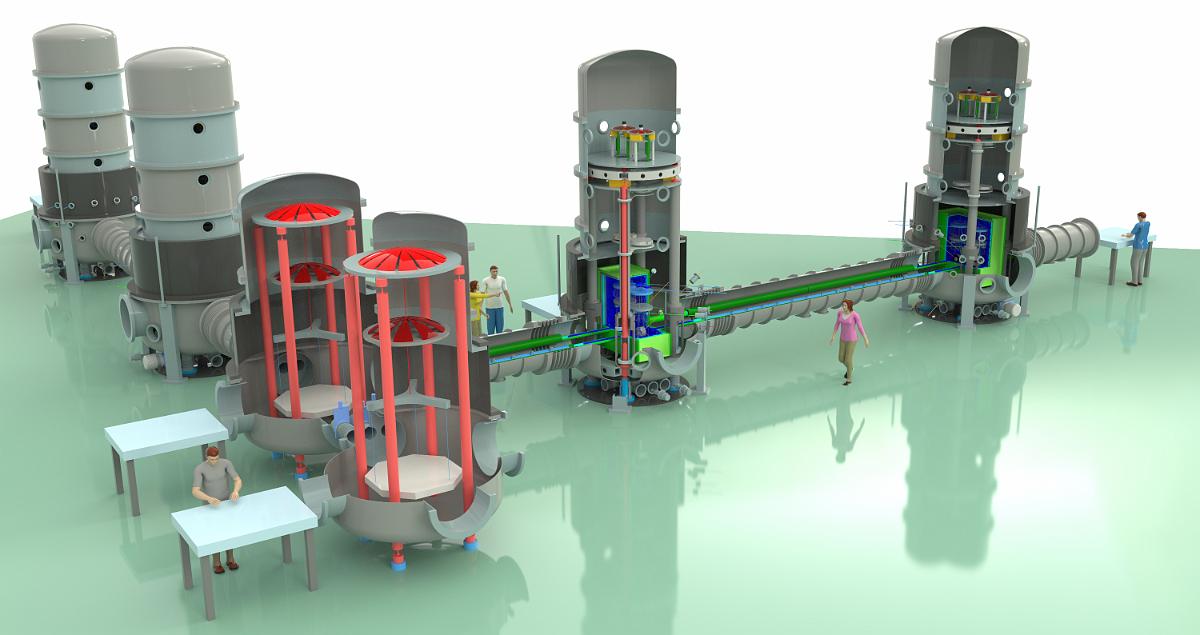
Model of the ETpathfinder. (Credits: Marco Kraan, Nikhef)
The location of the actual Einstein telescope will not be finally decided until 2021, but the Meuse–Rhine Euroregion around the city-corridor of Aachen–Maastricht–Liège, is under consideration. The Einstein telescope, Europe’s next-generation ground-based interferometer, which is more than a billion of euros, will be able to measure gravitational waves with unprecedented precision and range and to gain an insight into the early days of the universe.
To reach this goal new technologies need to be developed and shall be investigated at the ETpathfinder. “It needs to be at least 10 times more sensitive than the current generation of detectors. So we first have to develop the right low-noise technologies. Think of the glass used in the mirrors. To be able to ‘listen’ to gravitational waves, which are actually ripples in space and time, the material has to be cooled to the extreme. That’s not possible with glass, so we’re developing mirrors made of silicon”, Hild explains in an interview with M. van der Linde.
Artist view of the Einstein Telescope. (Credits: Marco Kraan, Nikhef)
The Prototype ETpathfinder is a true-to-scale model of the Einstein telescope, which will be used to test and optimize new techniques. For this purpose, a former transport hall is converted into a clean room with a low-vibration floor in which two approx. 20-metre-long arms of the interferometer are to be accommodated. The prototype is focused on cryogenic payloads to reach the following science goals:
Build a low phase noise interferometry with cryogenic silicon mirrors of up to ~100kg
Provide a flexible testbed to explore various combinations of cryogenic temperatures and laser wavelength
Investigate the interplay of thermal noise, quantum noise and control noises in the sub 10Hz region
Perform various tests of cryogenic issues (liquids vs cryo-coolers; stable control of mirror temperature; contamination handling of mirror surfaces; low power actuators …)
Commission of a testbed for new control techniques and sensors
The prototype is partly financed by an Interreg Euregio Meuse-Rhine Project and partly by different funds from the involved Institutes and Institutions. You can find a list of these partners below.
With the construction of the Pathfinder, they hope not only to gain new physical knowledge and experience in technology, but also to better position the Euregio in the decision on the final location of the Einstein telescope and to strengthen cooperation and gravitational wave knowledge in this region.
As mentioned in the roadmap, APPEC strongly supports further actions strengthening the collaboration between gravitational-wave laboratories. It also strongly supports Europe’s next-generation ground-based interferometer, the Einstein Telescope (ET) project, in developing the required technology and acquiring ESFRI status.
List of involved Institutes/Institutions
with funding from the Interreg Programm Meuse-Rhin:







 The VIth CNRS thematic School of Astroparticle Physics on “PHYSICS and ASTROPHYSICS of COSMIC RAYS” will be held from November 25th – 30th 2019 at the OHP Saint Michel l’Observatoire in France. This school follows several other schools supported / organized by the Programme National Hautes Energies (
 The
The