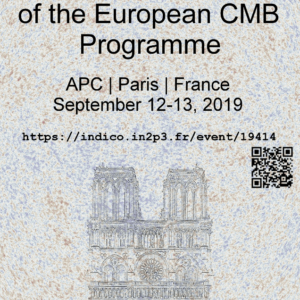
The meeting “Towards the Coordination of the European CMB program”, September 12-13, 2019 at the AstroParticle/Cosmology (APC) Labs in Paris, France, will gather experiment builders, observers and agency representatives in a continuing effort to chart the necessary steps towards European coordination on CMB experiments, including collaboration in technology development, and seeking synergy with similar efforts in other parts of the world.
This workshop is the 5th in the “Florence Process” meeting series, previous meetings being held in Florence. Registration is free of charge, and is open now. The meeting is open to all interested participants but registration is necessary as seating is limited.
More information is available here: https://indico.in2p3.fr/event/19414/
The APPEC Community Meeting on Neutrinoless Double Beta Decay will take place on 31 October 2019 at the Hallam Conference Centre, London, UK.
This meeting aims at discussing and collecting the input of the community on the roadmap document (to follow) prepared by the Double Beta Decay APPEC Committee for the APPEC SAC on the future neutrinoless double beta decay experimental programme in Europe. The ultimate goal is to maintain a leading role in this scientifically important quest, in line with APPEC Roadmap recommendations. We will assess the existing, planned and proposed technologies, their discovery potential and technical challenges, making a critical examination of resources and schedules. We will also review the theoretical issues and the status and uncertainties on the nuclear matrix element evaluation.
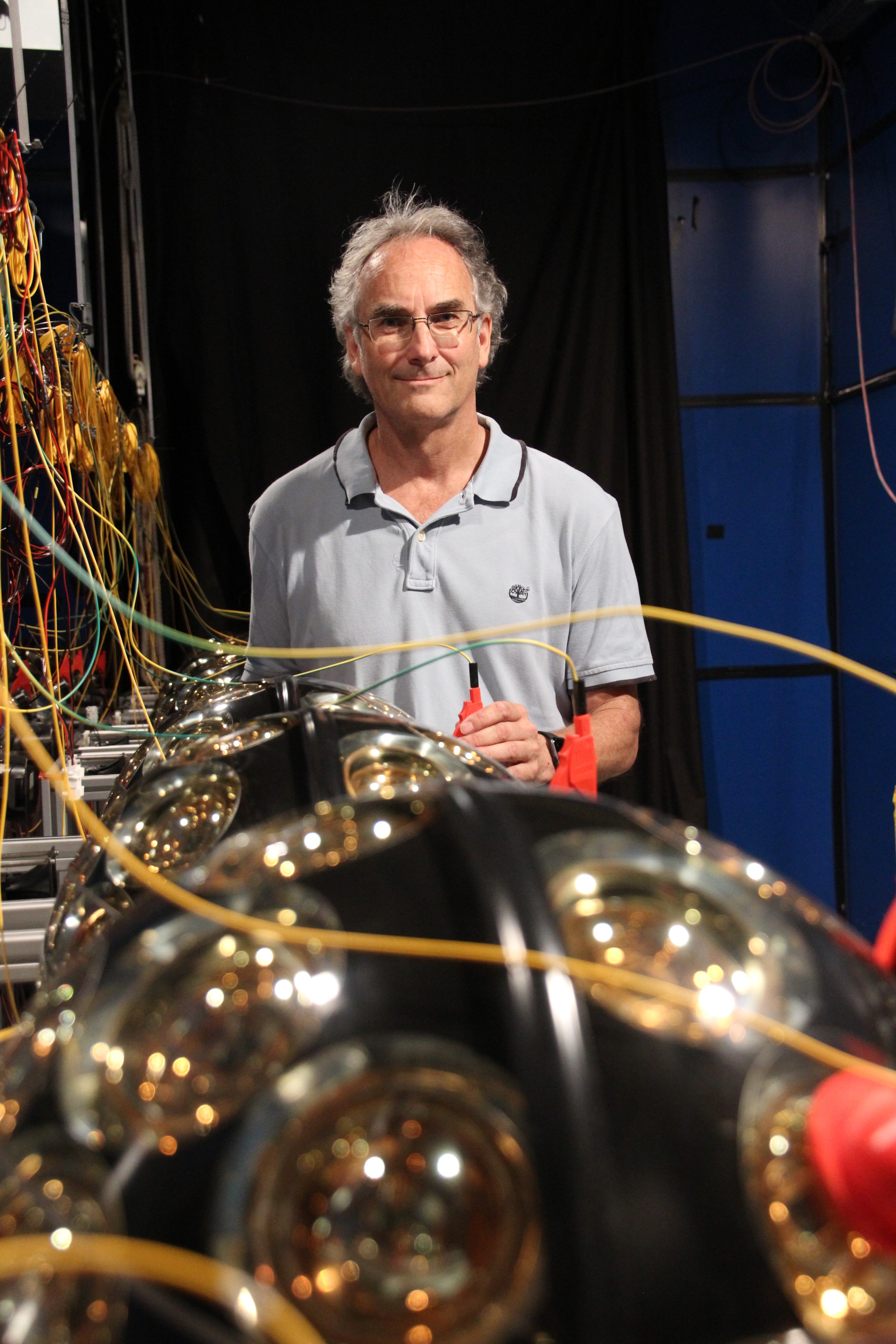
Interview with Paschal Coyle on the recent deployment campaign for KM3NeT
During the last month Paschal Coyle and his colleagues from the deployment team were busy installing additional Detection Units (DUs) in the Mediterranean Sea.
The most recent campaign was from 29th of June until 1st of July 2019 and since then the KM3NeT/ORCA deep-sea neutrino detector is continuously taking data with its first four neutrino detection units.
What is the current status in the two KM3NeT sites, in front of Toulon and Capo Passero?
KM3NeT is an ESFRI roadmap project aimed at constructing a neutrino telescope with sites in France and Italy. The project has the dual goal of high-resolution, multi-flavour neutrino astronomy and the study of neutrino oscillations in the GeV range to establish the neutrino mass ordering.
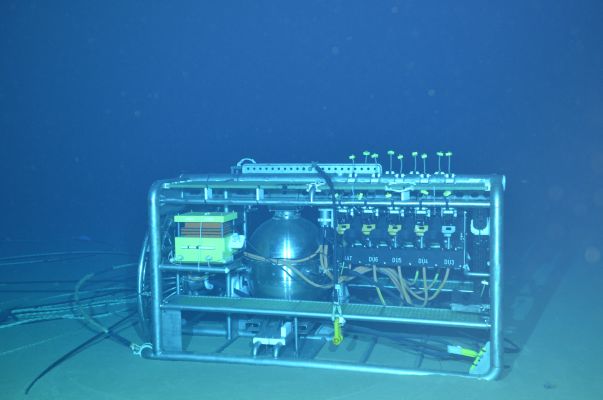
After some delays related to issues with the seafloor network, four DUs are now operational at the French site. The Italian site also hosts one operational DU, which has been working now for 3 years. The data from the first DUs have provided an important validation of the KM3NeT technology. In particular, we have demonstrated the capability to precisely position (less than 1 m) the detection units on the seafloor and measure the real-time position of the optical modules to a few centimetres using the acoustic positioning system. We have also confirmed that we can determine in real-time the in-situ time/gain/efficiency calibrations based on signals from the radioactive decays of the potassium isotope 40K present in the seawater. Combining data from both the ARCA and ORCA detectors we have recently published the depth dependence of the atmospheric muon flux over a depth of more than one kilometre (arXiv:1906.02704). At the ICRC 2019 conference we will present our first detection of atmospheric neutrinos with these DUs.
What are your future milestones?
With the advent of recent new funding in France, Italy and the Netherlands, the Collaboration currently has the means to build a total of about 100 DUs, along with the seafloor infrastructure to accommodate more DUs. At this moment, the optical modules for 20 DUs have been assembled; these will be deployed at the Italian site once refurbishment of its sea floor network will be completed summer 2020.
With several optical module and detection unit construction sites across Europe, the completion of the 115 (230) DUs for the French/ORCA (Italian/ARCA) sites could be achieved in 2024(26), assuming timely availability of the full funding. The Collaboration has also started the process to set up a legal entity in the form of an European Research Infrastructure Consortium (ERIC).
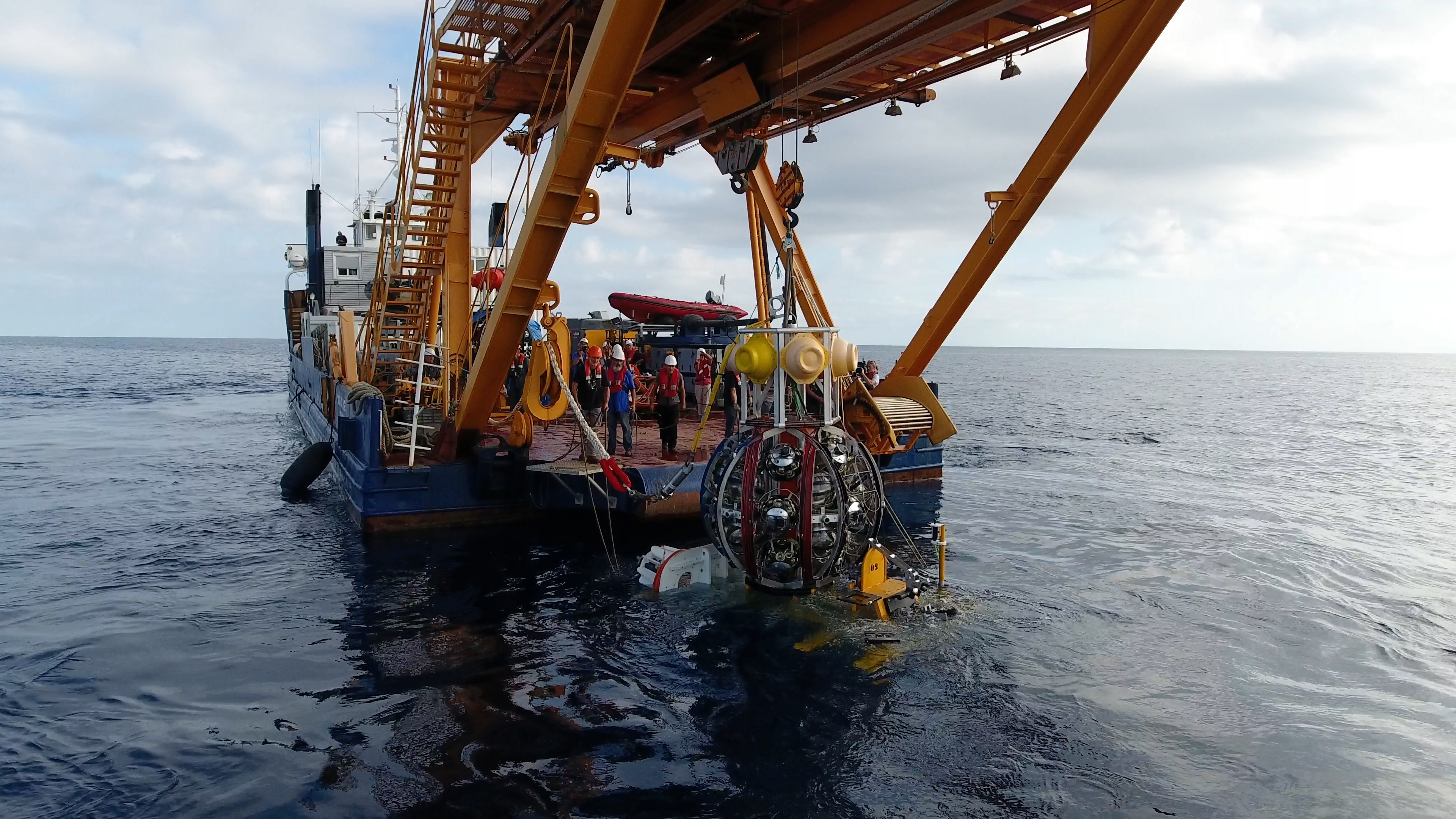
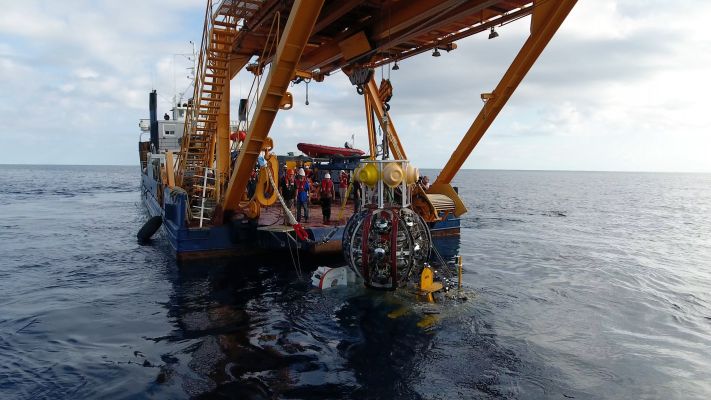
Deployment of the furled detection unit.
KM3NeT is an infrastructure that can be used in other fields of science– tell us about those activities.
The KM3NeT research infrastructure is also a cabled deep-sea marine observatory and will provide open access to instrumentation from the Earth and Sea science community. Until now, measurements in the deep sea are typically performed by deploying and recovering autonomous devices that record data over periods of months to years. This method is severely constrained by bandwidth limitations, by the absence of real-time interaction with the measurement devices and by the delayed access to the data. A cabled observatory like KM3NeT remedies these disadvantages by essentially providing a power socket and high bandwidth Ethernet connection at the bottom of the sea. This is an important and unique opportunity for performing deep-sea research by scientists from the fields of marine biology, oceanography, environmental sciences and geosciences. To this end, both the French and Italian KM3NeT sites are nodes of the European Multidisciplinary Seafloor and water column Observatory (EMSO).
For example, an EMSO sea science instrumentation module was recently connected to the KM3NeT-France infrastructure. This module hosts sensors that provide real-time monitoring of a plethora of environmental parameters including temperature, pressure, conductivity, oxygen concentration, turbidity and sea current. Soon additional instrumentation including a benthic crawler, a seismograph, a deep-sea Germanium gamma detector and a high-speed, single-photon video camera for bioluminescence studies will also be installed. Furthermore, the KM3NeT optical modules themselves provide invaluable data on deep-sea bioluminescence and bioacoustic monitoring of the local cetacean populations. A recent nice spinoff is the exciting possibility to use the optical fibres in the main electro-optical cables, that run for many tens of kilometre along the seafloor, for seismological studies via the technique of laser Distributed Acoustic Sensing (https://eartharxiv.org/ekrfy/).
We have now three major efforts in the world: KM3NeT and Lake Baikal with infrastructure located in countries belonging to APPEC, and IceCube at South Pole to which some European countries contribute. What are common activities? Do you think this cooperation could become a real network of detectors such as in the case for gravitational waves, namely LIGO and Virgo, who publish common papers?
In 2013, the Antares, IceCube, KM3NeT and Lake Baikal collaborations signed the Memorandum of Understanding for a Global Neutrino Network (GNN). This step formalised the already active cooperation between the different groups. Once infrastructures of similar scale are operational on the three continents, the stated aim of the GNN is a worldwide Global Neutrino Observatory. Within the framework of the GNN we have published a number of joint papers combining the data from ANTARES and IceCube resulting in improved limits on point sources and dark matter searches. A joint paper was also made on the follow up of the GW170817 gravitational wave alert. Furthermore, GNN organises yearly common meetings of the four collaborations and the biennual Very-Large Volume Neutrino Telescope conference (VLVnT).
Dr. Paschal Coyle is a Director of Research, CNRS, at the Centre de Physique des Particules de Marseille (CPPM). Since 2000 he has been involved in the ANTARES deep-sea neutrino telescope and during 2008-2014 was the Spokesperson of the Collaboration. He was the Deputy Spokesperson of the KM3NeT Collaboration (2013-2016) and is currently the Physics and Software Manager of KM3NeT.
After a series of sea operations this year, the most recent of which was 29 June-1 July 2019, the KM3NeT/ORCA deep-sea neutrino detector is now continuously taking data with its first four neutrino detection units.
Located in the Mediterranean Sea at a depth of 2437 m and 40 km offshore from Toulon, France, the ORCA detector together with its sister ARCA, located offshore from Sicily, will allow the scientists of KM3NeT to study the fundamental properties of the neutrino elementary particle and perform neutrino astronomy.
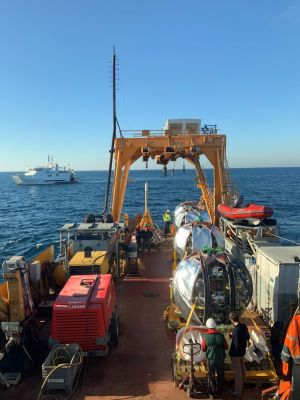
During the sea operation, a detection unit (DU), wound like a ball of wool around its spherical deployment frame, is carefully lowered from a boat to its designated position on the seafloor. Using a remotely operated submersible, controlled from a second boat, the detection unit, still on its frame, is then connected to the junction box of the seafloor network. Once the electrical and optical connections to the shore station in La Seyne-sur-Mer are confirmed, the go ahead is given to trigger the unfurling of the detection unit to its full 200 m height. During this process, the deployment frame is released from its anchor and floats towards the surface while rotating. In doing so, the string unwinds, eventually leaving behind a vertical detection unit.
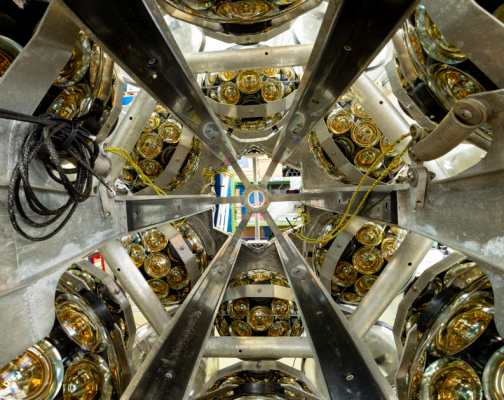
The KM3NeT design features multi-PMT optical modules each comprising 31 three-inch PMTs and each detection unit comprises 18 such optical modules. For ORCA, the detection units are spaced about 20 m from each other on the seafloor and the vertical spacing of the optical modules is about 9 m.
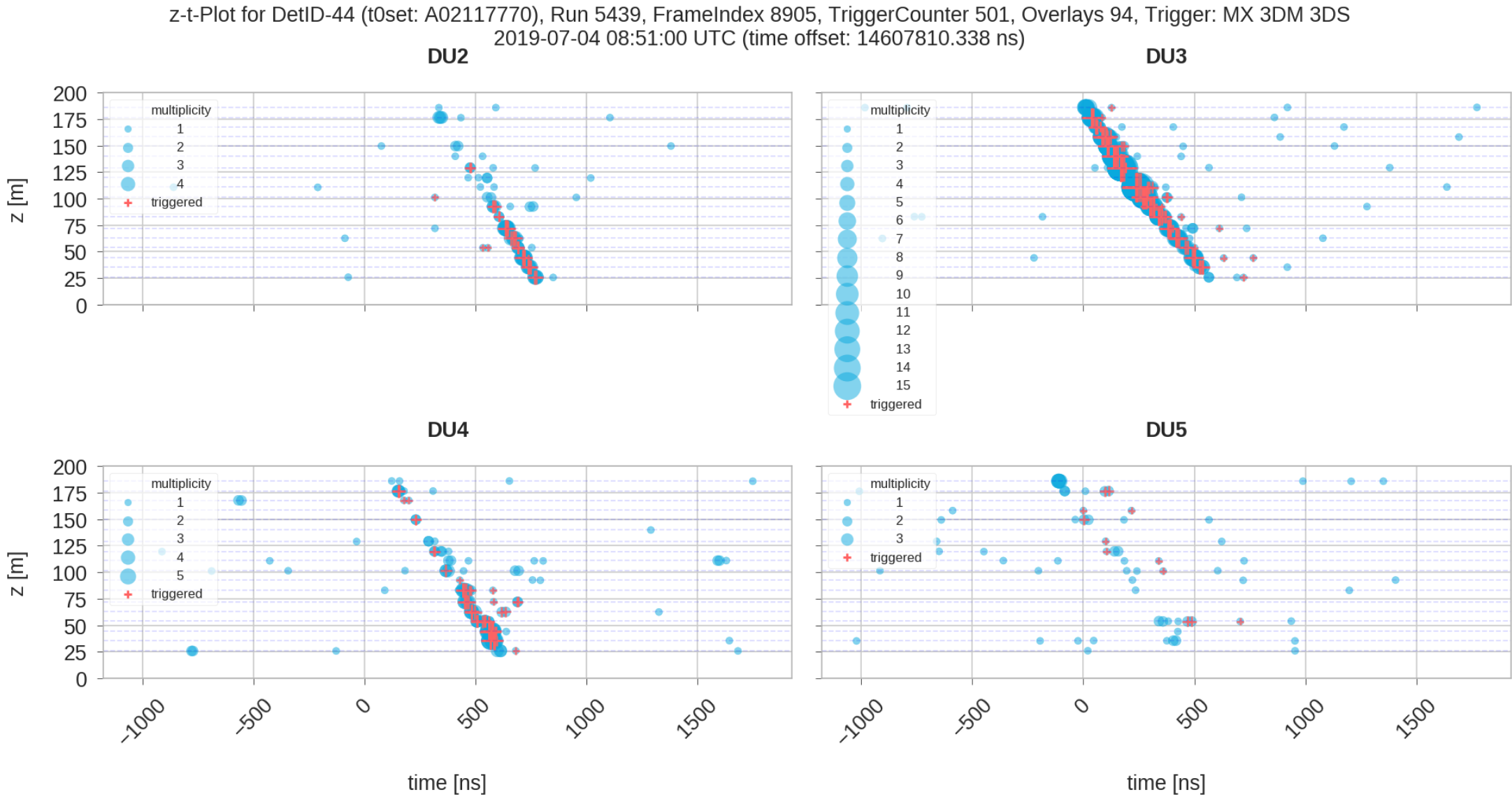
Almost immediately after power on, the trajectories of downgoing atmospheric muons, resulting from cosmic ray interactions above the detector, were reconstructed from the recorded light signals of the more than 2000 PMTs.
Online display of a downgoing muon event detected simultaneously by all four detection units. The height versus the time of the recorded light signals are shown separately for each of the detection units. The size of the circle indicates the number of PMTs giving a hit on that optical module.
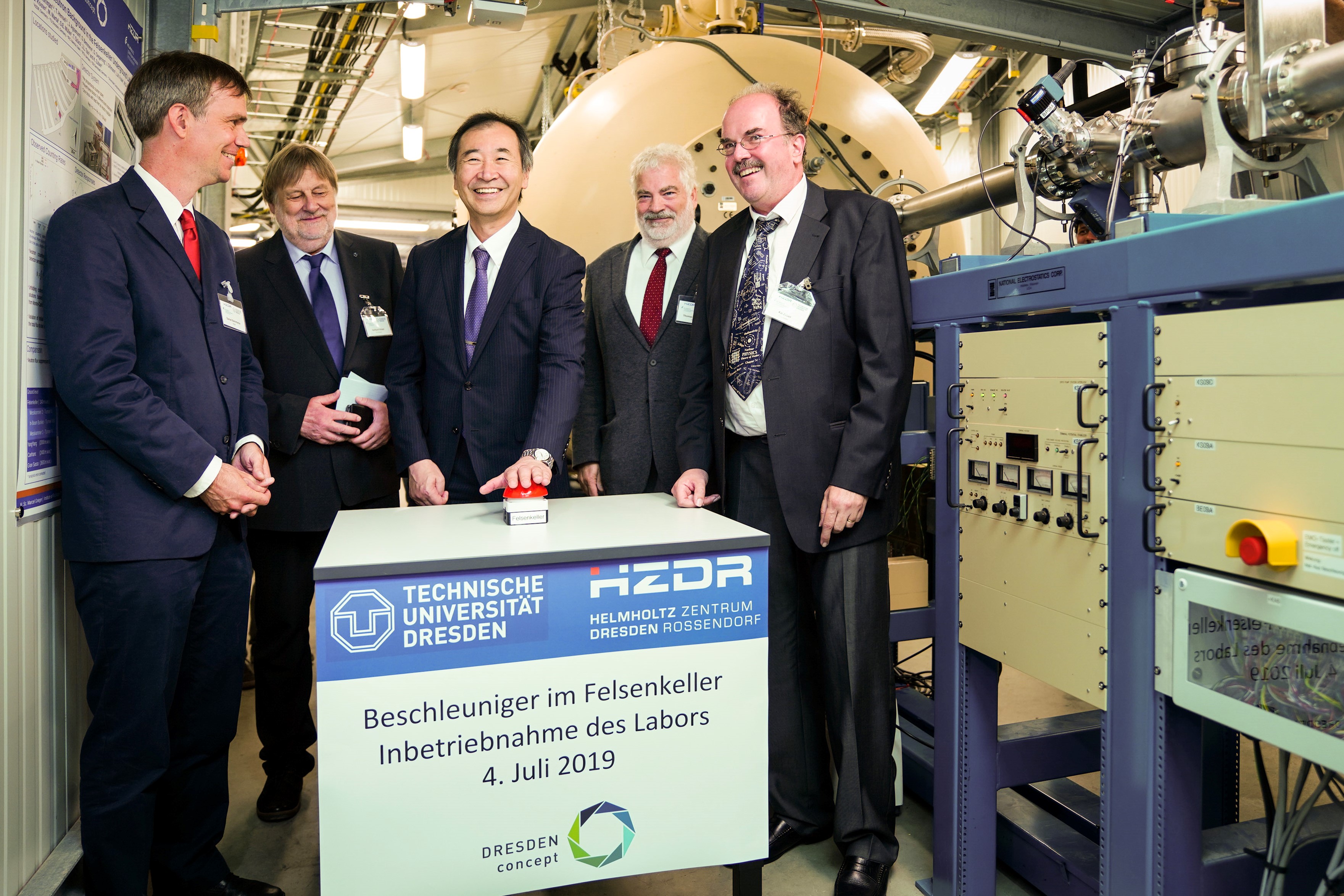
Physics Nobel Prize winner Takaaki Kajita officially launches the particle accelerator at Dresdner Felsenkeller.
What is happening inside the sun and the countless other stars of the universe? This question concerns scientists worldwide. After two years of construction, a new research facility has now been inaugurated: On 4 July, the Felsenkeller Laboratory jointly built by Helmholtz-Zentrum Dresden-Rossendorf (HZDR) and TU Dresden was commissioned. The research facility, located on the south-western outskirts of Dresden in the former Felsenkeller brewery, was opened in the presence of Physics Nobel Laureate Prof. Takaaki Kajita from the University of Tokyo.
Together with Dr. Daniel Bemmerer, Prof. Gerhard Rödel, Prof. Thomas Cowan and Prof. Kai Zuber (from left), Nobel Laureate Prof. Takaaki Kajita (centre) symbolically opened the particle accelerator in Dresden’s Felsenkeller.
“The underground accelerator in the Felsenkeller will be a crucial tool to understand the origin of the elements in the universe and to make better predictions about the neutrino flux from the Sun. Since this machine is open to scientists from all over the world, the entire nuclear astrophysics community can benefit from it. As a neutrino and gravitational wave physicist, I am therefore very much looking forward to new data from the Felsenkeller underground particle accelerator,” Kajita explained at the opening ceremony of the ion accelerator, which is located beneath a 45-metre-thick rock surface. The Dresden laboratory is only the second of its kind in Europe and the third in the world. “This enables us to simulate fundamental processes that take place in all stars,” added Dr. Daniel Bemmerer of the HZDR, technical director of the Felsenkeller Laboratory.
Kajita and Prof. Arthur B. McDonald from Canada were honoured with the Nobel Prize in Physics in 2015 for their discovery that tiny elementary particles released by reactions inside the Sun, or created in the Earth’s atmosphere, transform into another particle family on their way to Earth, the so-called neutrino-flavour oscillation.
Encouraged by this discovery, physicists around the world have since then been working to improve the model of the Sun in order to obtain more precise predictions about the number of neutrinos emitted by the Sun, i.e. before oscillation. For this purpose, among other things, the nuclear reactions from the interior of the sun are simulated in the laboratory. Because these reactions take place very slowly, they can only be studied underground in specially shielded accelerator laboratories. The tunnel rock forms a natural shield against cosmic radiation, which bombards the earth with particles every second. “Since this distorts our measurements, we cannot perform the experiments on the Earth’s surface,” explained Kai Zuber, Professor of Nuclear Physics at TU Dresden and scientific director of the laboratory.
Joint press release of TU Dresden and Helmholtz-Zentrum Dresden-Rossendorf of 4 July 2019
The Baksan Neutrino Observatory (BNO) of the Institute for Nuclear Research of the Russian Academy of Sciences started the BEST (Baksan Experiment on Sterile Transitions) experiment with a 51Cr artificial electron neutrino source to search for the transitions of electron neutrinos to sterile states on very short baseline. The 51Cr source with an estimated activity of 3.28 MCi was delivered to BNO on July 5, 2019, and has been immediately placed at the center of the two-zone target of liquid gallium. At 14:02 Moscow time, the first run of the experiment has begun.
The idea of BEST is to place a 51Cr source with an initial activity of about 3 MCi in the center of the 50-tonne target of liquid gallium metal, which is divided into two concentric zones, the inner 8-ton volume and the outer 42-ton one. Assuming no transition of electron neutrino to eV-scale sterile states, at the beginning of exposure one expects a mean of 65 atoms of 71Ge per day to be produced by the neutrinos from the source in each zone. However, if oscillations to a sterile neutrino take place, then the germanium production rates in the outer and inner zones of gallium would be different. This opens the possibility to obtain information on the allowed regions of the oscillation parameters of active-sterile neutrino transitions.
The source is delivered and placed to the BEST setup.
The chromium used for the source production was enriched to 98% in 50Cr. The enriched chromium was produced by the Joint Stock Company “Production Association “Electrochemical Plant” (JSC “PA ECP”) by gas centrifugation of chromium oxyfluoride, CrO2F2. The source was produced by irradiating of 4007.5 g of the 98% -enriched 50Cr in a high-flux research nuclear reactor SM at RIAR Dmitrovgrad, Russia. The source consists of 26 metallic Cr disks, each of 88 mm diameter and 4 mm thickness, placed in a steel capsule shielded by a tungsten biological protection. The overall dimensions of the source are: 160 mm diameter and 226 mm height.
Main hall of GGNT with the assembled BEST setup.
The BEST calorimetric system.
For BEST, a set of new facilities including the two-zone tank for irradiation of 50 tons of metal Ga as well as additional modules of the GGNT counting and extraction systems were constructed. Ten exposures of the gallium to the source, each of 9 days duration, will be carried out. The source activity will be determined by measuring its heat with a calorimeter system and by gamma-ray spectroscopy with high-purity germanium detectors between extractions for the ten measurements. Expected accuracy of measurements of the source intensity is better than 1%.
Contacts and picture courtesy:
V.N. Gavrin, Principle Investigator of the “BEST” collaboration – gavrin@inr.ru
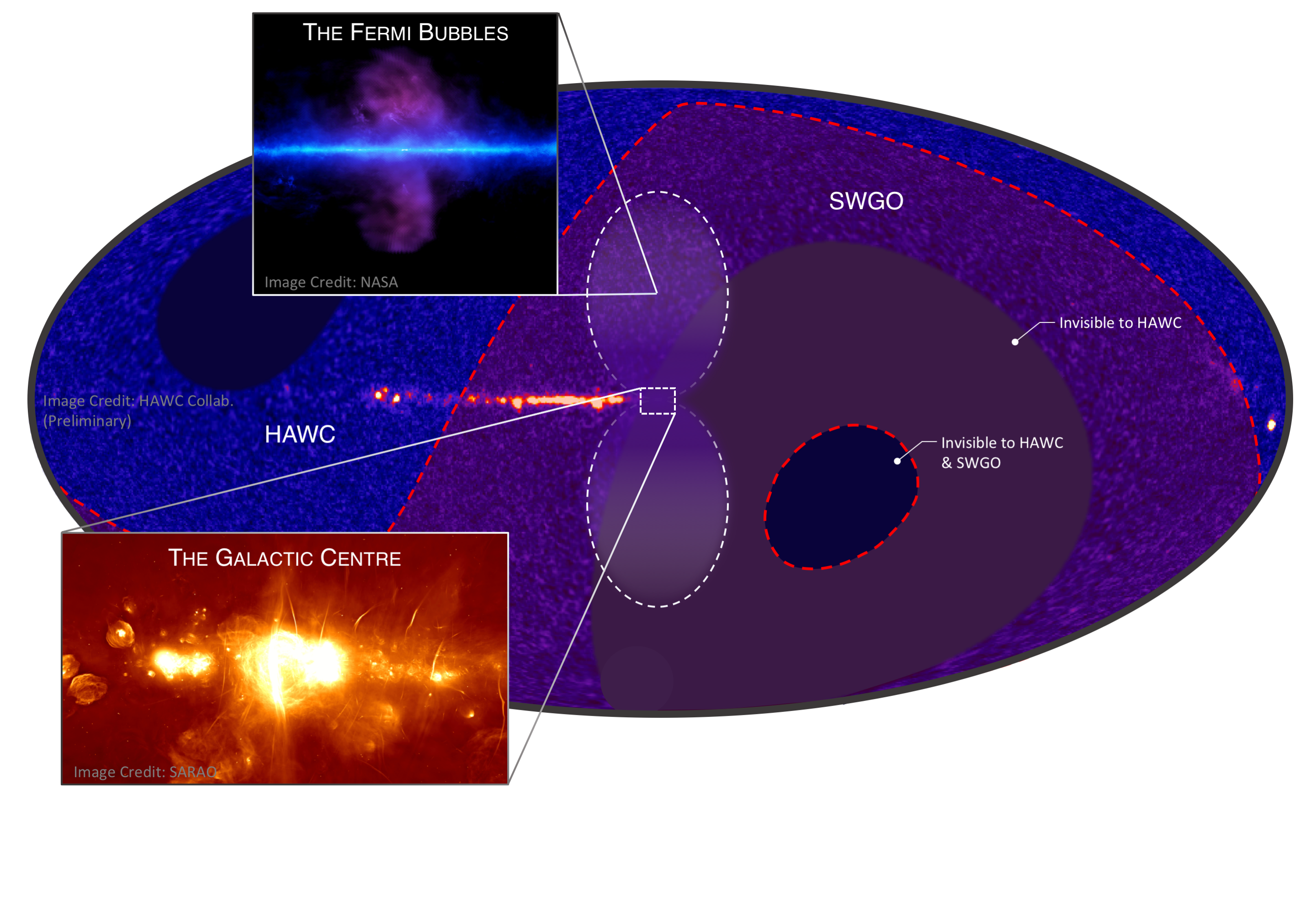
On July 1st 2019, close to 40 research institutions from nine countries officially signed the agreement for the creation of a new international R&D collaboration for a future wide field-of-view gamma ray observatory in the southern hemisphere. The founding countries of the newly created Southern Wide field-of-view Gamma-ray Observatory (SWGO) are Argentina, Brazil, Czech Republic, Germany, Italy, Mexico, Portugal, the United Kingdom and the United States of America, creating a worldwide community around the project. SWGO unifies different communities that were already involved in R&D in this field. The signature of the agreement comes after a successful meeting of the scientists from the different countries, held in Lisbon in May.
Gamma-ray sky image as seen by the (current) HAWC and (future) SWGO observatories. Credits: Richard White, MPIK (preliminary)
The new observatory is planned to be installed in the Andes, at an altitude above 4.4 km, to detect the highest energy gamma rays – particles of light billion or trillions of times more energetic than visible light. It will probe the most extreme phenomena and environments to address some of the most compelling questions about our Universe, from the origin of high-energy cosmic rays to searching for dark matter particles and for deviations from Einstein’s theory of relativity. Its location in the southern hemisphere will allow the most interesting region of our galaxy to be observed directly, in particularly the Galactic Centre, hosting a black hole four million times the mass of the sun. Wide field-of-view observations are ideal to search for transient sources but also to search for very extended emission regions, including the ‘Fermi Bubbles’ or annihilating dark matter, as well as to discover unexpected phenomena. The new observatory will be a powerful time-variability explorer, filling an empty space in the global multi-messenger network of gravitational, electromagnetic and neutrino observatories. It will also be able to issue alerts and be fully complementary to the next generation imaging atmospheric Cherenkov telescope array, CTA.
The baseline for the new observatory will be the approach of the current ground-based gamma-ray detectors, namely HAWC in Mexico and LHAASO in China. In particular, water Cherenkov detectors will be used to sample the particle showers produced by gamma rays in the atmosphere, by recording the light produced when particles pass through tanks full of purified water. New layouts and technologies will however be explored in order to increase the sensitivity and lower the energy threshold of the observatory.
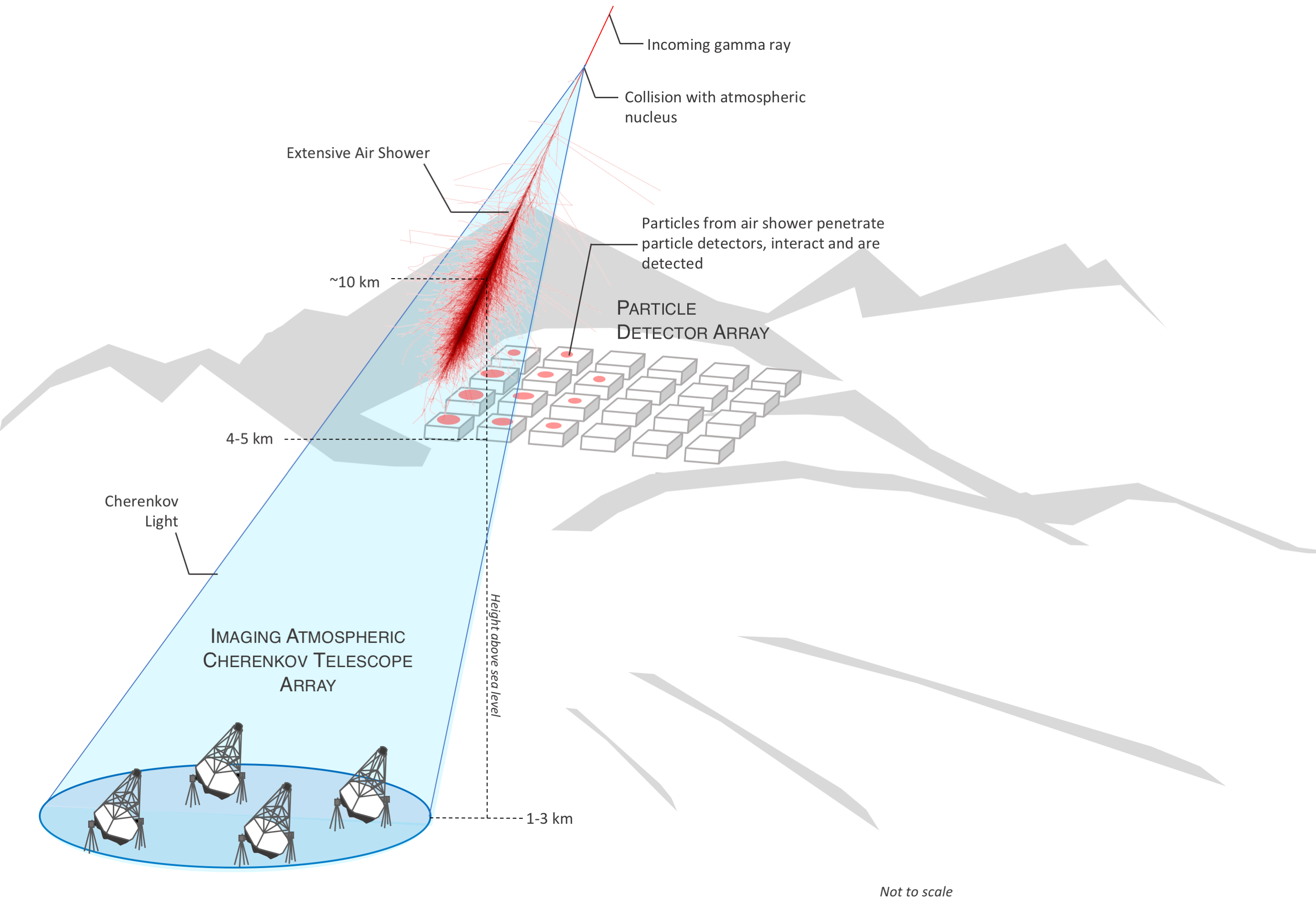
Illustration of the complementary detection techniques of high-energy gamma rays on ground Credits: Richard White, MPIK
The first very-high-energy gamma-ray emission was observed only 30 years ago, from the Crab Nebula. Hundreds of sources have been discovered since then at these extreme energies. Many extragalactic and some galactic sources present variability, and the duration of flares and transients can be days, hours, minutes or even just a few seconds. The study of these phenomena requires instruments such as SWGO, able to monitor in a continuous way large portions of the sky, sensitive to energies above the reach of satellite-based experiments, and operating in a multi-messenger context: able to alert and to follow up on neutrino and gravitational wave detections as well as other photon observatories.
Direct detection of primary gamma-rays is only possible with satellite-based detectors, such as Fermi. However, the cost of space technology limits the size of satellite-borne detectors, and thus their sensitivity, as fluxes become too small at higher energies. In the atmosphere, gammas interact creating a shower of particles. These showers can be studied in observatories of two complementary types: imaging atmospheric Cherenkov telescopes, pointing instruments such as CTA, and high altitude air shower arrays, such as SWGO. Cherenkov telescopes are highly sensitive pointing detectors, with high precision but limited duty cycle and narrow field-of-view, benefiting from pointing alerts provided by complementary observatories. Wide field-of-view observations from the ground have the highest energy reach, and are ideal to search for transient sources and for emissions from very extended regions of the sky.
Argentina PI: Adrián Rovero, IAFE; Institutes: Instituto de Astronomía y Física del Espacio (IAFE), Universidad Nacional de Salta, DPC-Centro Atómico de Bariloche
Brazil PI: Ronald Shellard, CBFP; Institutes: Centro Brasileiro de Pesquisas Físicas (CBPF), Instituto de Física de São Carlos (Univ. S. Paulo)
Czech Republic PI: Jakub Vicha, FZU- Institute of Physics; Institutes: Institute of Physics of the Czech Academy of Sciences (FZU- Institute of Physics)
Germany PI: Jim Hinton, MPI-K; Institutes: Max Planck Institute for Nuclear Physics (MPI-K), Erlangen Centre for Astroparticle Physics
Italy PI: Alessandro De Angelis, Univ. Udine/Padua and INFN Padua; Institutes: Univ. Udine, Univ. and INFN Trieste, Univ. Catania, Univ. and INFN Torino, Univ. Perugia, Univ. Siena, Univ. Padova, Univ. Bari, Univ. Venice, Univ. Rome Tor Vergata, Politecnico di Milano, INAF
Mexico PI: Andrés Sandoval, UNAM; Institutes: Univ. Nacional Autónoma de México (UNAM, Instituto de Astronomía, Instituto de Ciencias Nucleares, Instituto de Física, Instituto de Geofísica), Instituto Politécnico Nacional – Centro de Investigación en Computación, Univ. Autonoma de Puebla, Instituto Nacional de Astrofísica, Óptica y Electrónica, Univ. Autónoma del Estado de Hidalgo, Univ. de Guadalajara, Univ. Michoacana de San Nicolás de Hidalgo, Univ. Autónoma de Chiapas, Univ. Politécnica de Pachuca
Portugal PI: Mário Pimenta, LIP/IST; Institutes: Laboratory of Instrumentation and Experimental Particle Physics (LIP)
UK PI: Jon Lapington, Univ. Leicester; Institutes: Univ. Durham, Univ. Leicester, Univ. Liverpool
USA PI: Petra Huentemeyer, MTU; Institutes: Michigan Technological Univ. (MTU), Univ. Maryland, Univ. Wisconsin, Los Alamos National Laboratory
The Pierre Auger Observatory is the world-wide largest cosmic ray detector, covering an area of 3000 km2. It is operated by a collaboration of more than 400 scientists from 17 countries. The aim of the Observatory is the study of the highest-energy particles of the cosmos, up to 1020 electronvolts and above. Data of the Auger Observatory led to major advances in our understanding of high-energy phenomena linked to the most violent processes in the Universe. Scientific breakthroughs have been achieved in several fields. Still, the sources of the particles of such extreme energies have not been identified. In addition, the properties of multiparticle production are studied at energies not covered by man-made accelerators searching for new or unexpected changes of hadronic interactions. The currently ongoing upgrade of the Pierre Auger Observatory, called AugerPrime, will help to address also those remaining open questions and will favor the emergence of a uniquely consistent picture.
The Scientific Symposium, Science Fair and official Celebration will take place in Malargüe (Province Mendoza, Argentina), at the site of the Pierre Auger Observatory.
The event is organized as follows:
14-15 November:Scientific Symposium focused on UHE cosmic rays, cosmic ray sources and propagation, high-energy neutrinos and gamma rays, hadronic interactions and multi-messenger astronomy, with an overview on the status and perspectives of astroparticle physics. Scientific presentations on the status of the field will be given. In parallel a Science Fair set up in co-operation with local schools will be held at the Auger Assembly Building. The meeting will be concluded with a half-day guided tour to the Observatory to get an insight of the Fluorescence and Surface detectors.
16 November, Saturday:Official Celebration Ceremony to recognize the role of the Pierre Auger Observatory with the participation of national and international VIPs and members of finantial institutions supporting the project.
The International school of Cosmic Ray Astrophysics (ISCRA) holds biennial courses for graduate students and young researchers that stress the inter-relationships between sub-disciplines in Astrophysics, Particle Physics and Cosmology and focus upon recent results from different specialty areas. The 22nd Course: From cosmic particles to gravity waves: now and to come will take place from 28 August 2020 to 5 September 2020 in Erice, Sicily, Italy.
The ISCRA is not a conference or a workshop, but is a School that provides lectures by outstanding scientists who cover the latest results and also the background and steps that lead to them. Everyone is encouraged to question the experts both during the lectures and informally over relaxing meals so that one often finds beginners dining with experts in an ambiance of friendship and science that otherwise might never happen. Discussions naturally happen — sometimes a seemingly simple question may pause the expert and in the by and by lead to new research. Additionally many attendees have developed their careers following contacts made at the School.
Graduate students and postdoctoral scientists (experiment & theory) are encouraged to register as soon as possible on this INDICO page as numbers are constrained by the Centre; late applicants may be disappointed.
Two new clusters of optical modules of the Baikal deep underwater neutrino telescope, Baikal-GVD, were put into operation. The effective volume of the facility, which already includes five clusters, increased to 0.25 km3.
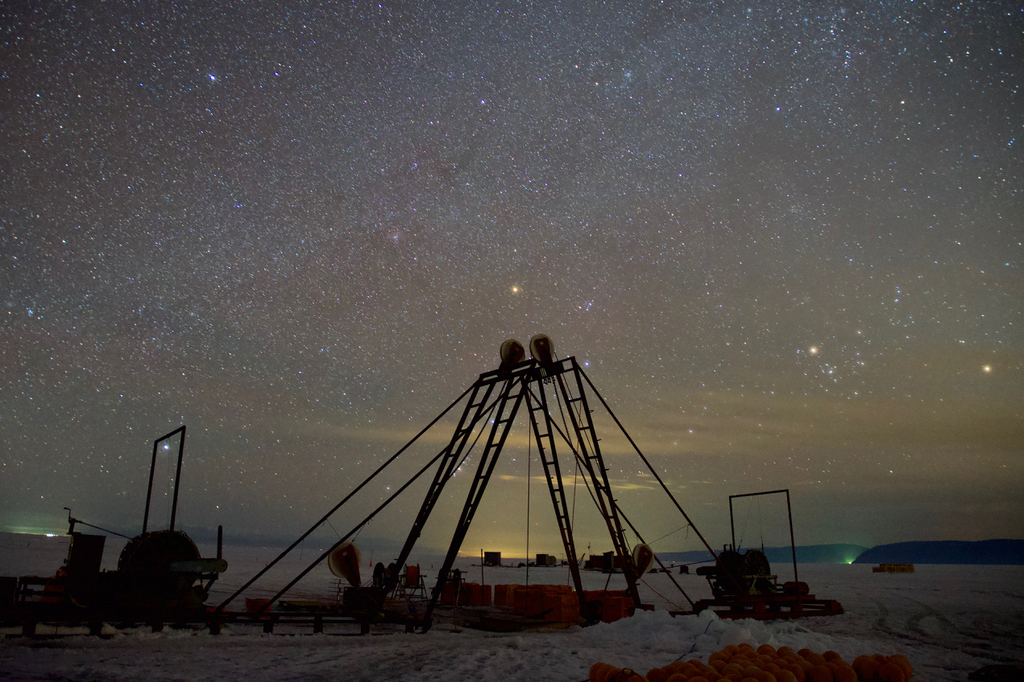
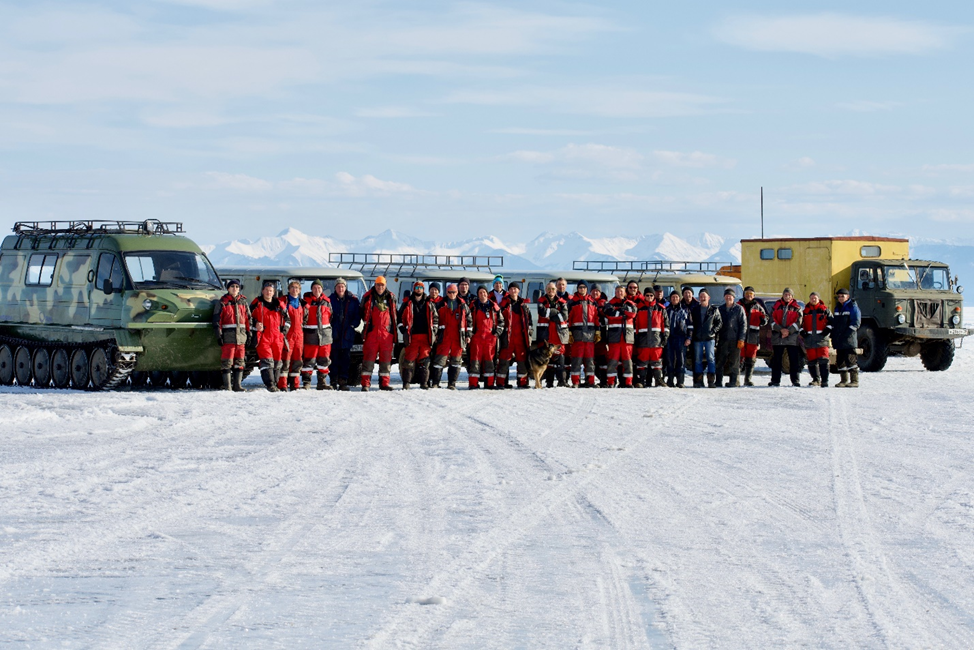
Night sky on the Baikal Lake during the expedition 2019.
Neutrinos, due to their weak interaction, are unique messengers of domains in the Universe, opaque to any other particles.
The proposal to detect high energy neutrinos with help of large natural media like water was first made by a Soviet physicist M.A. Markov in 1960. The key of neutrino detection is the Cherenkov light produced by charged energetic particles born in the neutrino interaction.
The lake Baikal pioneered the field by the first observation of atmospheric neutrinos by a deep-underwater detector in the 90’s, thus proving the proposal of M.A. Markov. The next breakthrough was due to the IceCube experiment on the South Pole in 2012 which discovered astrophysical neutrinos of ultra-high energies1.
The last photo before leaving the ice. Expedition 2019 is completed.
In 2015 the Baikal-GVD Collaboration, led by the Institute of Nuclear Research (Moscow) of Russian Academy of Science and Joint Institute for Nuclear Research (Dubna), started deployment of the deep-underwater neutrino telescope of cubic-kilometer scale, Baikal-GVD, consisting of independent physical units, so called clusters.
As reported by the Collaboration two more clusters were brought into operation during the expedition to Lake Baikal from 15 February to 12 April 2019. This is the result of joint efforts in research, developments, production and assembly. Remarkably, this is the first time when two clusters were installed during one expedition.
In total, five clusters, including all auxiliary systems, have been repeatedly tested and put into regular data acquisition mode. Each cluster consists of 8 vertical strings of optical modules with each string containing 36 modules. There are 1440 optical modules in total, placed at a depth of 750 – 1350 m located 4 km away from the bank of Lake Baikal, near the 106th km of the Circum-Baikal Railway.
The effective volume of the facility reached a level of 0.25 km3 for shower events from high-energy neutrinos, thus allowing scientists to expect two to three events per year from astrophysical neutrinos with energies exceeding 100 TeV.
The Baikal deep underwater neutrino telescope is a unique scientific facility, and, along with IceCube, ANTARES and KM3NeT, is part of the Global Neutrino Net (GNN).
One more optical module is prepared for immersion.
Central module of the section.
Underwater acoustic modem.
Pulsed semiconductor laser.
The full press-release (in Russian) is available at:



 The meeting “Towards the Coordination of the European CMB program”, September 12-13, 2019 at the AstroParticle/Cosmology (APC) Labs in Paris, France, will gather experiment builders, observers and agency representatives in a continuing effort to chart the necessary steps towards European coordination on CMB experiments, including collaboration in technology development, and seeking synergy with similar efforts in other parts of the world.