During the last meeting of the General Assembly Federica Petricca was elected as new representative of APPEC in the ECFA Detector Panel.
She did her PhD in 2005 at the Max-Planck-Institut für Physik and the Ludwig Maximilian Universität, Munich, and since then she was working on cryogenic detectors. Since 2014 she is spokesperson of the CRESST (Cryogenic Rare Event Search with Superconducting Thermometers) collaboration for the direct search of dark matter interactions with cryogenic detectors. In the ECFA detector panel she will contribute her experience in low-temperature detector technology and methods, low-background techniques and electronics of data acquisition systems and signal processing.
She is accepting the charge with pleasure and hopes to be soon able to provide a constructive contribution.

This first Joint ECFA-NuPECC-APPEC Seminar (JENAS) jointly organized by LAL, IPNO, IRFU and LPNHE will be held from October 14 to October 16, 2019 in Orsay.
Profound explorations of both the smallest and largest structures in the universe made possible numerous breakthroughs in astroparticle, nuclear and particle physics. Additional to the well-known scientific interplay between our disciplines, the strength to transform challenges into opportunities in the pursuit of our aspirations is driven by our innovations in technology, scientific creativity and organisational rigour, while typically embracing the long-term nature of our research.
A first triennial 3-day Joint Seminar is being organised by the European representative committees/consortia, APPEC for astroparticle physics, ECFA for particle physics and NuPECC for nuclear physics. Facilitated by the local organisers in the Paris region, the intention is to inform the communities about each other’s scientific, technological and organisational challenges and successes, as well as to identify and explore potential synergies and avenues for collaboration across communities. Additional to the physics highlights and the evolution of theoretical research, also topics related to for example detector R&D, technology, software and computing, valorisation, outreach, education will be scheduled in plenary talks.
From 1 June 2019 the community at large will be invited to register, and the remaining seats will be allocated on a first come basis.
Interview with Sera Markoff on the first image of a black hole
On April 10th 2019, the Event Horizon Telescope (EHT) Collaboration presented its first results – an image of the supermassive black hole in galaxy M87 – in multiple simultaneous press conferences around the world, see also here in the APPEC news. Sera Markoff is working on EHT and also on CTA. In this interview she tells us about the exciting times with EHT and the connection to multimessenger astroparticle physics.
Sera, you are enjoying the well-deserved success for the wonderful result on the first image of a black hole in the centre of the M87 galaxy. What is that impressed you most about this success story?
First image of black hole in galaxy M87, credits: Event Horizon Telescope
I think the reaction of the world to our result was not something we had fully anticipated. Gravitational waves were also a ground-breaking result but I don’t think they made it quite so far particularly in social media, because it was maybe a bit too abstract for many members of the public. The image triggered a lot of hilarious posts and memes, which I think is a very positive sign that the world wanted to claim a sort of ownership of the result, and make it relevant to their lives in some way.
What are the next targets and steps?
We still have an enormous amount of data from 2017 and 2018 to analyze, from both the horizon targets (M87 and Sgr A*) as well as many other jetted AGN, some of which were also calibrators for the horizon sources so we have lots of hours on them. These include for instance 3C279, OJ287, and quite a few more. The data analysis and image reconstruction is very tricky particularly for variable sources like Sgr A* so the collaboration are working hard, and one can expect much more science to come. We have also proposed for observations again in 2020, so encourage multi-wavelength facilities to coordinate with us then!
What will be the kind of targets for which you will attempt the reconstruction of the inner jets?
As I mentioned above, these are mostly radio galaxies for obvious reasons, we want sources with well studied jets from other wavelengths particularly with VLBI so we can add another piece at the highest resolution, closest to the core.
You are also working in CTA, hence could you highlight possible connections between the EHT work and the astroparticle community working on multi-messengers high energy astrophysics? What do you expect that can be done in synergy ?
Well EHT is not its own instrument, we use existing facilities during about 10-12 days per year in this special mode. So it’s hard to say whether EHT will exist in its current form when CTA is open for business, but we certainly hope so. We are already adding new elements to the array since 2017, and hopefully will be able to go to higher frequency soon as well. The systems we are studying, with the exception of Sgr A*, all show powerful jets and are high-energy emitters, but we still do not fully understand how these jets are launched, or their internal properties, and there is of course significant debate about the origin of the VHE gamma-ray emitting particles. Where particle acceleration happens exactly, and via which process (e.g., diffusive shock acceleration vs magnetic reconnection) is something one might be able to resolve, if there happened to be a VHE flare during an EHT observation and we could actually resolve associated structural changes in the jet with EHT. I think that is the ‘holy grail’ we would all like to see. We are already observing together with existing VHE facilities like H.E.S.S., MAGIC and Veritas, so this may even happen before CTA and then the work could continue even deeper once we have the much better spatial resolution in the VHE range that CTA offers.
Sera Markoff is a professor of theoretical high energy astrophysics at the University of Amsterdam. Her research focuses on the interface between astrophysics and particle physics, in particular problems relating to processes occurring around dense objects such as black holes. She is a member of a number of large scale research projects including Cherenkov Telescope Array and Event Horizon Telescope, which produced the first image of a black hole. She is a member of the leadership of the Event Horizon Telescope project where she serves as a member of the science council and as one of the working group coordinators.
Sera Markoff is a professor of theoretical high energy astrophysics at the University of Amsterdam. Her research focuses on the interface between astrophysics and particle physics, in particular problems relating to processes occurring around dense objects such as black holes. She is a member of a number of large scale research projects including Cherenkov Telescope Array and Event Horizon Telescope, which produced the first image of a black hole. She is a member of the leadership of the Event Horizon Telescope project where she serves as a member of the science council and as one of the working group coordinators.
The 16th International Conference on Topics in Astroparticle and Underground Physics (TAUP2019) will be held at the Toyama International Conference Center, Toyama, Japan, on September 9-13.
The biennial TAUP series covers recent experimental and theoretical developments in astroparticle physics by invited plenary review talks and parallel workshop sessions of invited and contributed presentations. The conference is hosted by ICRR, The University of Tokyo, and supported by Kavli IPMU, The University of Tokyo and University of Toyama.
Topics:
Cosmology and particle physics
Dark matter and its detection
Neutrino physics and astrophysics
Gravitational waves
High-energy astrophysics and cosmic rays
Registration will be open until August 8, with early registration until June 30. The deadline for submitting parallel session and poster presentation abstracts for TAUP2019 has been extended to May 31, 2019.
Interview with Juan José Gómez Cadenas about the NEXT experiment
Recently, a committee working on neutrino less double beta decay, composed by Silvia Pascoli (Chair, Durham U.), Andrea Giuliani (CSNSM), Juan Jose Gomez-Cadenas (DIPC), Ezio Previtali (INFN, MI) Ruben Saakyan (UCL), Karoline Schaeffner (GSSI), Stefan Schoenert (TUM), was set in place in order do define a document describing the efforts towards a new generation of more sensitive detectors than the current existing, which will include a SWOT analysis and a critical evaluation of resources and possible schedules. This document, to be approved in the Scientific Committee of APPEC, will set the guidelines for funding agencies in the General Assembly to understand expected sensitivity of various technologies and scientific goals and reach of various techniques. A great effort is ongoing and one of them recently obtained an experimental success. Juan Jose Cadenas explains more on it.
What is your technical achievement and how does it compare to past existing ones?
NEXT detector
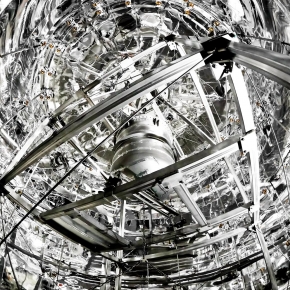
Energy plane illuminated with an UV lamp
Impressions of NEXT-WHITE
NEXT is a high pressure xenon chamber with electroluminescent readout (HPXeEL). It exploits three features of gaseous xenon which are essential to suppress backgrounds in neutrino less double beta decay searches (ββ0ν): excellent energy resolution; the capability of reconstructing the event topology; the capability of identifying the Ba++ ion produced in the ββ0ν decay. The first phase of the experiment, the so-called NEXT-White detector, deploying 10 kg of xenon is currently operating at the Laboratorio Subterráneo de Canfranc (LSC), and the second phase, NEXT-100, with 100 kg of xenon is currently being assembled, with the plan of commissioning in 2020. We are also preparing a Conceptual Design Report (CDR) for a ton-scale detector.
With respect to the pioneer St. Gotthard TPC experiment, which operated at the St. Gotthard tunnel in the mid 1990’s, NEXT introduces two main innovations. The first one is the electroluminescent proportional amplification of the signal (EL), which results in a (measured) energy resolution of 0.5 % FWHM at Qbb (for point-like particles), and better than 1 % FWHM for long tracks (to be compared with 7 % FWHM at Qbb achieved by the St. Gotthard TPC). NEXT is currently the only high-resolution xenon experiment searching for ββ0ν. Furthermore, it is possible to operate NEXT with pure xenon, since no quenching of the ionisation is needed (as was the case for the St. Gotthard TPC), and therefore the scintillation signal is preserved, providing the start-of-the-event and thus the needed fiducialization in Z.
Furthermore, the NEXT collaboration has recently published a proof-of-concept that shows the possibility to capture and identify the Ba++ ion produced in the ββ0ν decay using the so-called SMFI (Single Molecule Fluorescence Imaging) technique. SMFI was invented by physicists and then applied with great success to biological problems. In 2015, Dave Nygren, co-spokesperson of NEXT proposed to use SMFI to tag the presence of the Ba++ ion. In 2017 we published a PRL showing that it is possible to follow the trajectory of single fluorescent molecules chelated with a Ba++ ion, thus opening up the possibility of developing such detection system in NEXT.
Last but not least, NEXT has been developed through a set of carefully planned stages, involving 1-10-100 kg detectors, in order to master the technical details which will allow the extrapolation of the technology to ton-scale detectors.
What is the relevance of your measurements on enriched Xe and what measurements will be particularly improved thanks to it?
Our current run with enriched xenon has two goals. We aim to measure the ββ2ν mode lifetime, which in addition to provide another measurement of this important quantity (there are previous measurements by KamLAND-Zen and EXO), will allow us to quantify with great detail the rejection power of the topological signature. Furthermore, the enriched xenon run will allow us a full characterization of the background budget of the detector.
What is the impact this will have in NEXT and neutrinoless double beta decay?
NEXT is the only high-energy resolution experiment based in xenon. Furthermore, the identification of the two electrons results in a very low background rate in the region of interest (ROI). If we can implement Ba++ tagging, NEXT could evolve into a truly background-free experiment. This is a must to explore very long lifetimes, and thus exploring the inverse and eventually the normal hierarchy.
Are underground laboratories in Europe a great resource and how do you see that they will evolve in next years?
Yes, they are, and Europe science is benefiting immensely from these facilities, with leading experiments in ββ0ν, dark matter and other underground physics areas. I would like to see European underground labs evolving toward a tight network that would permit an intense cooperation in underground science in Europe. Indeed, I believe that this network can be expanded at the truly international level. In the case of NEXT one could very well imagine that such underground lab network would permit the operation of several modules in the range of 500–1000 kg at LSC and LNGS, and possibly in SNOWLAB. It is important to remark that our experiments are run by international collaborations, and the creation of an international network of laboratories could permit far-ahead planning and optimisation of resources. As we are moving into very large and complex apparatus in rare searches, this international network of labs appears essential.
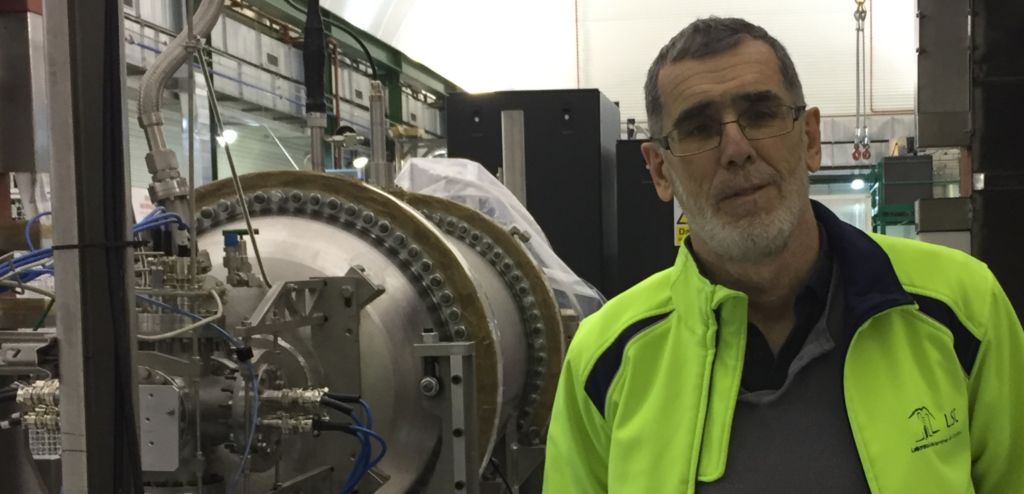
Juan José Gómez Cadenas at the LSC, with the detector in the background
Juan José Gómez Cadenas is an Ikerbasque professor of physics at the Donostia International Physics Center. He has worked in neutrino physics for the last 25 years, contributing to experiments such as NOMAD, K2K and T2K. In 2008 he proposed the NEXT experiment to the LSC. He is the co-spokesperson of NEXT, together with Dave Nygren, inventor of the Time Projection Chamber.
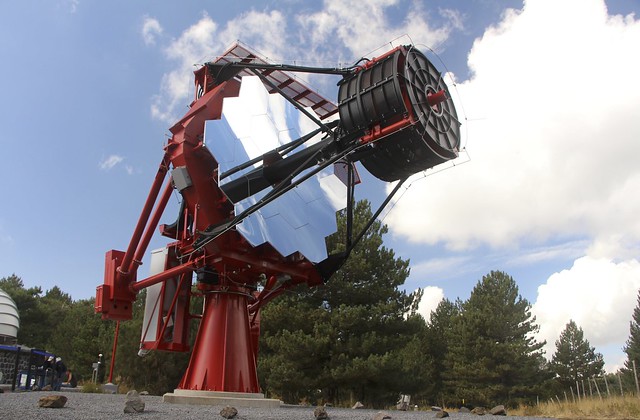
ASTRI-Horn is the first Cherenkov telescope in dual-mirror configuration to detect the Crab Nebula at TeV energies:
The ASTRI-Horn prototype telescope is located at the observing station of the INAF Astrophysical Observatory of Catania, in Serra La Nave, on Etna, where it was installed in 2014. The primary tassellated mirror has a diameter of 4 meters and the secondary monolithic mirror is 1.8 meters in diameter. Credit: CTA collaboration
Exactly 30 years after the first historical observation of Crab nebula at TeV energies, which opened the era of TeV astronomy with the Imaging Atmospheric Cherenkov Technique (IACT), another advancement in IACT technology has been achieved. The ASTRI-Horn Cherenkov Telescope, based on the innovative Schwarzschild-Couder dual-mirror configuration and equipped with an innovative camera, has detected the Crab Nebula at TeV energies for the first time, proving the viability of this technology.
This Cherenkov telescope, named ASTRI-Horn (in honor of Guido Horn d’Arturo an Italian astronomer who first proposed in the past century the technology of tessellated mirrors for astronomy), is adopting a wide (10°x10°) field Schwarzschild-Couder dual-mirror optical configuration and is equipped with a specifically designed, innovative Silicon photo-multiplier (SiPM) camera managed by very fast read-out electronics.
The observations of the Crab Nebula were carried out between December 2018 and January 2019, during the ASTRI-Horn telescope verification phase, for a total observation time of about 29 hours, divided in on- and off-axis source exposure. The camera system was still undergoing assessment, and its functionality was not fully exploited. Moreover, owing to recent eruptions of the Etna Volcano, the mirror reflection efficiency was partially reduced. In spite of such camera and mirrors limitations, observations yielded the detection of the Crab Nebula with a statistical significance of 5.4s above an energy threshold of about 3.5 TeV, definitively probing the new technologies and opening a new era for IACT.
“The result obtained by ASTRI is an important milestone for the IACT technologies. It is demonstrating that the dual mirror configuration, firstly proposed by the great German Astrophysicist Karl Schwarzschild more than a century ago, is performing well. It is now possible to achieve a very large field-of-view with a much more compact Cherenkov telescope design, easily observing very energetic cosmic gamma-rays up to a few hundreds of TeV” says Giovanni Pareschi, astronomer at the INAF-Milano and principal investigator of the ASTRI project.
The universe is almost 14 billion years old. An inconceivable length of time by human standards – yet compared to some physical processes, it is but a moment. There are radioactive nuclei that decay on much longer time scales. With the XENON1T detector at the INFN Gran Sasso National Laboratory, scientists were able to observe the decay of Xenon-124 atomic nuclei for the first time.
The half-life of a process is the time after which half of the radioactive nuclei present in a sample have decayed away. The half-life measured for Xenon-124 is about one trillion times longer than the age of the universe. This makes the observed radioactive decay, the so-called double electron capture of Xenon-124, the rarest process ever seen happening in a detector. “The fact that we managed to observe this process directly demonstrates how powerful our detection method actually is – also for signals which are not from dark matter,” says Prof. Christian Weinheimer from the University of Münster (Germany) whose group leads the study. In addition, the new result provides information for further investigations on neutrinos, the lightest of all elementary particles whose nature is still not fully understood.
XENON1T is a joint experimental project of about 160 scientists from Europe, the US and the Middle East. The results were published in the science journal “Nature” (preprint on the arxiv).
The full press release is available from their website: http://www.xenon1t.org/ and further information is also available here.
Needle-like structures on positively charged lightning leaders
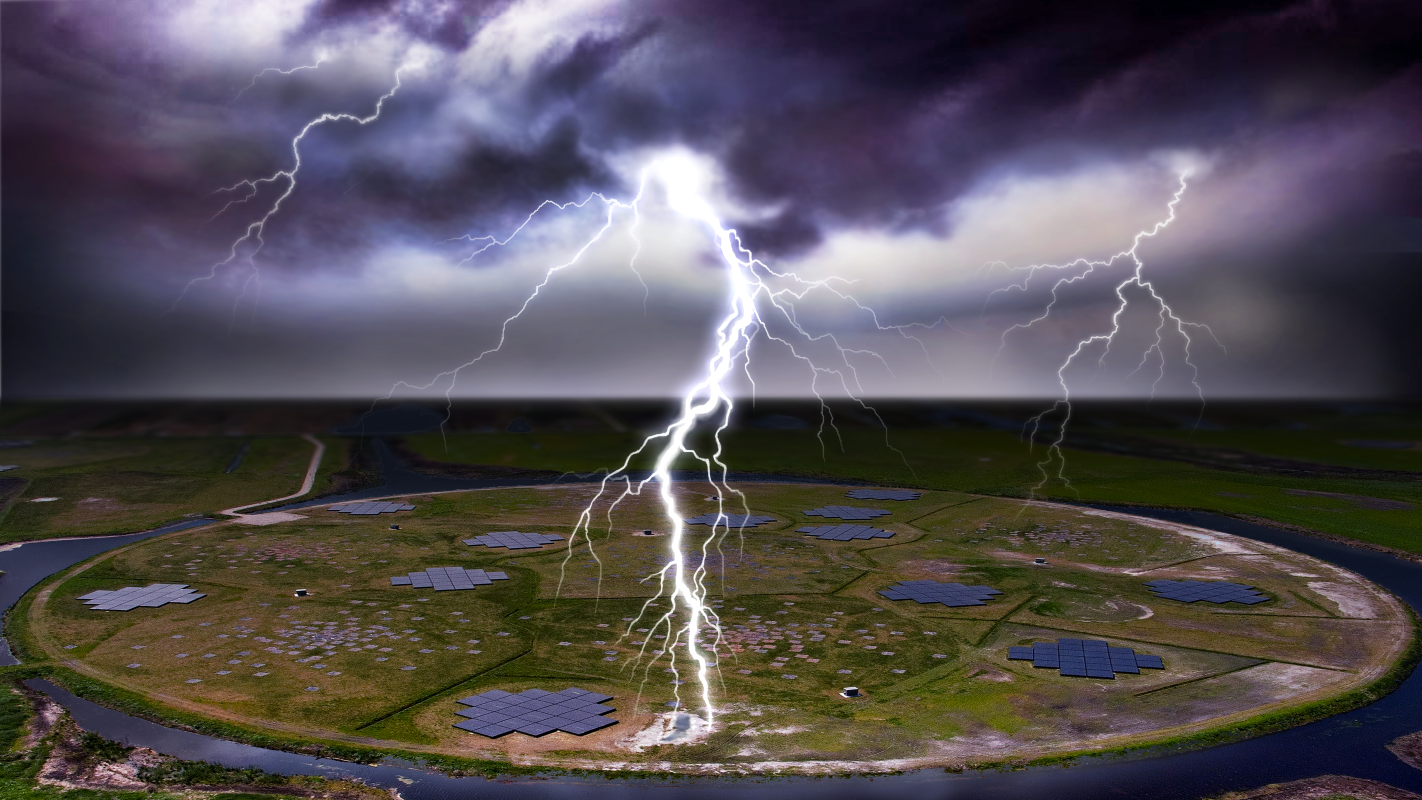
Lightning above LOFAR (montage). Credit: University of Groningen, Olaf Scholten
In contrast to popular belief, lightning often does strike twice, but the reason why a lightning channel is ‘reused’ has remained a mystery. Now, an international research team led by the University of Groningen has used the LOFAR radio telescope to study the development of lightning flashes in unprecedented detail. Their work reveals that the negative charges inside a thundercloud are not discharged all in a single flash, but are in part stored alongside the leader channel at interruptions. This occurs inside structures which the researchers have called needles. Through these needles, a negative charge may cause a repeated discharge to the ground. The results were published on April 18 in the science journal Nature.
“This finding is in sharp contrast to the present picture, in which the charge flows along plasma channels directly from one part of the cloud to another, or to the ground”, explains Olaf Scholten, Professor of Physics at the KVI-CART institute of the University of Groningen. The reason why the needles have never been seen before lies in the ‘supreme capabilities’ of LOFAR, adds his colleague Dr Brian Hare, first author of the paper: “These needles can have a length of 100 metres and a diameter of less than five metres, and are too small and too short-lived for other lightning detections systems.”
Low Frequency Array (LOFAR) is a Dutch radio telescope consisting of thousands of rather simple antennas spread out over Northern Europe. These antennas are connected with a central computer through fibre-optic cables, which means that they can operate as a single entity. LOFAR is developed primarily for radio astronomy observations, but the frequency range of the antennas also makes it suitable for lightning research, as discharges produce bursts in the VHF (very high frequency) radio band.
Reference:
Needle-like structures discovered on positively charged lightning branches; Brian Hare, Olaf Scholten et al.; „Nature“, 2019; DOI: 10.1038/s41586-019-1086-6
On April 10th 2019, the Event Horizon Telescope (EHT) Collaboration presented its first results – an image of the supermassive black hole in galaxy M87 – in multiple simultaneous press conferences around the world. The official EHT press release is available from their website.
For the first time scientists have succeeded in taking a direct image of a black hole. The EHT is a large telescope array consisting of a global network of radio telescopes. By combining data from several very-long-baseline interferometry (VLBI) stations around Earth and using several independent methods the first image of a black hole was produced.
This breakthrough was announced in a series of six papers published in a special issue of The Astrophysical Journal Letters. The image reveals the black hole at the center of Messier 87, a massive galaxy in the nearby Virgo galaxy cluster. This black hole resides 55 million light-years from Earth and has a mass 6.5 billion times that of the Sun.
From 2nd to 10th October 2019 ECAP organises the 16th edition of the international School for Astroparticle Physics for PhD students in Obertrubach Bärnfels, close to Erlangen, Germany. The school will be held in english and is open for international participation.
The program covers topics from astrophysics to particle physics and cosmology. Lectures are given by key scientists in the field, as for example, Karl-Heinz Kampert (cosmic rays), Imre Bartos (astrophysics with gravitational wave observations), Jacco Vink (particle acceleration and magnetic fields in cosmic shocks) and Bela Mojorovits (light dark matter). The school combines education, discussion and contributions by the participants. The participation fee of 280 Euro covers accommodation and meals (breakfast, lunch, dinner, coffee breaks).
















 From 2nd to 10th October 2019 ECAP organises the 16th edition of the international