KM3NeT has taken a major step forward with the creation of the KM3NeT Association Internationale Sans But Lucratif (AISBL), a new international non‑profit entity under Belgian law.
This structure, identified as the best legal framework through the EU‑supported KM3NeT‑Infradev2 project, will streamline and formalise all activities related to the construction, operation, scientific use, and future decommissioning of the infrastructure.
The AISBL was officially signed in Brussels on 18 June 2025 by representatives of the founding members—CNRS, INPP/NCSRD, the University of Valencia, INFN, and NWO‑I— and the Belgian Royal Decree stating the creation of the structure was published in October.
KM3NeT will start operation as an AISBL in January 2026.
Other KM3NeT institutes are expected to join soon as members or observers.
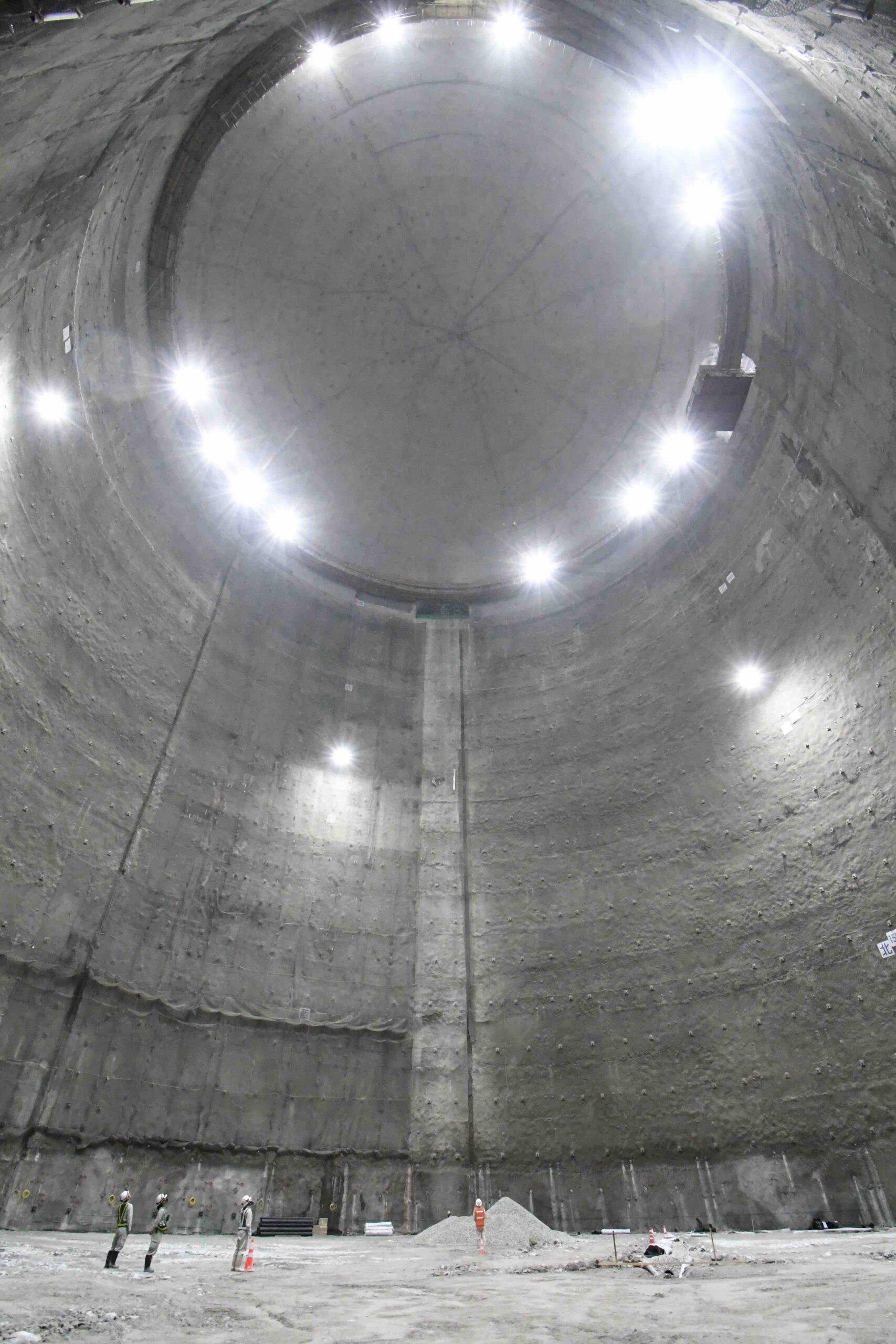
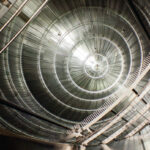
The main Hyper-Kamiokande cavern after excavation completed. Credits: Kamioka Observatory, ICRR (Institute for Cosmic Ray Research), The University of Tokyo
On July 31, 2025, the University of Tokyo completed excavation of the colossal cavern that will house the main detector volume of Hyper-Kamiokande, a next-generation, ultra-large water Cherenkov detector currently under construction in Hida City, Gifu, Japan.
Hyper-Kamiokande (Hyper-K) is a next-generation particle detector consisting of a gigantic water tank with a fiducial volume 8.4 times that of its predecessor, Super-Kamiokande, and is equipped with over 20,000 newly developed photodetectors. It is currently being constructed 600 meters underground beneath a mountain in Hida City, Gifu Prefecture, Japan, with the University of Tokyo leading the effort. In parallel, the High Energy Accelerator Research Organization (KEK) is leading the upgrade of the J-PARC neutrino beam and the construction of a new intermediate detector in Tokai Village, Ibaraki Prefecture. Through the combination of these efforts, the Hyper-Kamioande project aims to precisely measure neutrino properties and to search for proton decay, ultimately contributing to solving fundamental mysteries of the universe and testing the ideas of Grand Unified Theories. The Hyper-K project officially began in February 2020 with the allocation of its initial-year budget.
The Hyper-Kamiokande project is an international scientific research collaboration led by the University of Tokyo and the High Energy Accelerator Research Organization. As of July 2025, approximately 630 researchers from 22 countries are actively contributing to the project.
European institutes and companies are playing a large role in the construction and operation of the Hyper-Kamiokande experiment, with over 50% of the collaboration members from Europe leading the design, construction and installation of multiple elements of the various detectors of Hyper-Kamiokande.
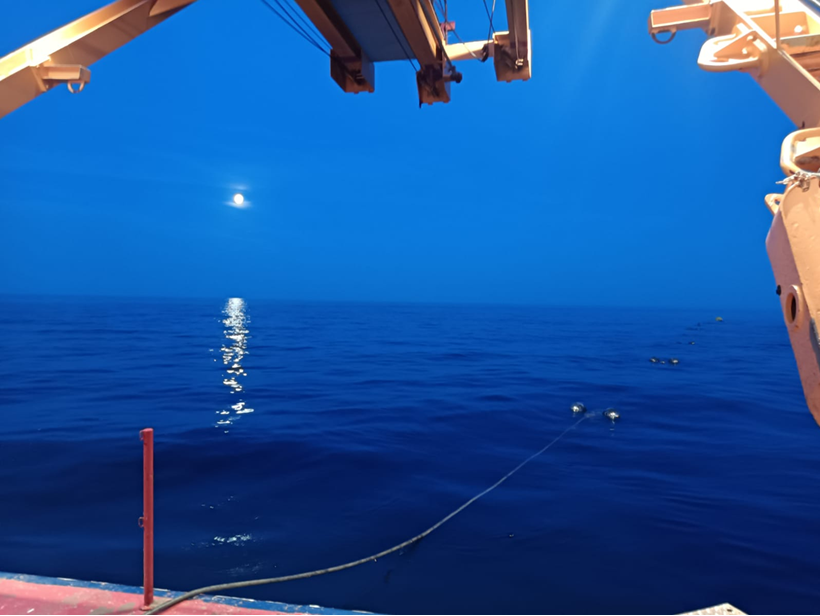
Recovery of one of the last ANTARES detector line on May 2022. Credits: ANTARES
ANTARES, the first neutrino telescope in seawater operated in the Mediterranean for over 15 years before being decommissioned and dismantled in 2022. The ANTARES Legacy paper summarizes two decades of neutrino searches in the Mediterranean Sea, detailing the challenges, achievements, and scientific results. The paper presents the final analysis of cosmic diffuse neutrino flux based on 4541 days of data, reports constraints on steady neutrino sources in the Southern sky, and synthesizes multi-messenger searches, including neutrinos linked to TXS0506+056—the first discovered high-energy neutrino source.
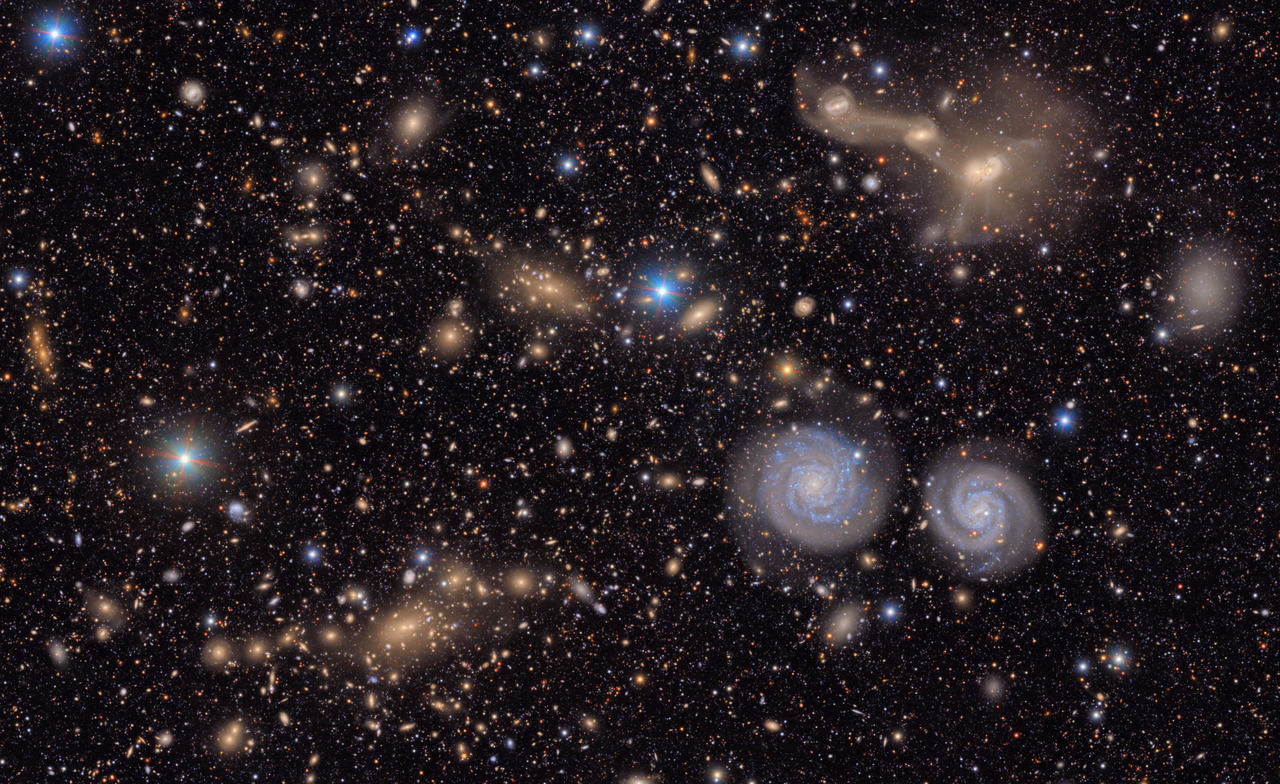
Observatory’s view of the Virgo Cluster, offering a vivid glimpse of the variety in the cosmos. Visible are two prominent spiral galaxies, three merging galaxies, galaxy groups both near and distant, stars within our own Milky Way, and much more. Credit: NSF–DOE Vera C. Rubin Observatory
The NSF–DOE Vera C. Rubin Observatory, a major new scientific facility jointly funded by the U.S. National Science Foundation and the U.S. Department of Energy’s Office of Science, released its first imagery at an event in Washington, D.C. The imagery shows cosmic phenomena captured at an unprecedented scale. In just over 10 hours of test observations, NSF–DOE Rubin Observatory has already captured millions of galaxies and Milky Way stars and thousands of asteroids. The imagery is a small preview of Rubin Observatory’s upcoming 10-year scientific mission to explore and understand some of the Universe’s biggest mysteries.
The result of more than two decades of work, Rubin Observatory is perched at the summit of Cerro Pachón in Chile, where dry air and dark skies provide one of the world’s best observing locations. Rubin’s innovative 8.4-meter telescope has the largest digital camera ever built, which feeds a powerful data processing system. Later in 2025, Rubin will begin its primary mission, the Legacy Survey of Space and Time, in which it will ceaselessly scan the sky nightly for 10 years to precisely capture every visible change.
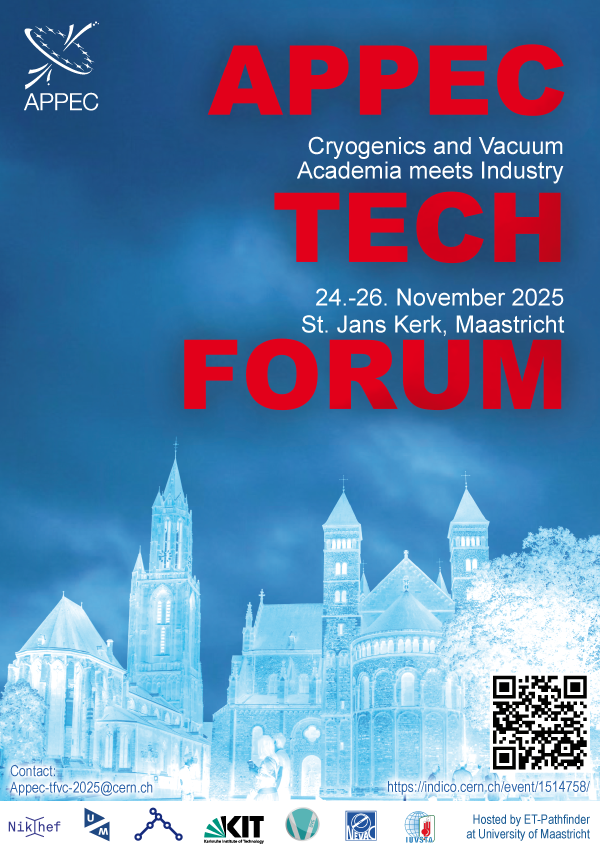
European physicists in astroparticle physics as well as in neighboring fields are planning the next generation of experiments to be built within the next decade. The success of the projects in direct dark matter detection, low energy neutrino physics, neutrino properties, gravitational wave detection as well as related accelerator-based experiments in particle and nuclear physics highly depends on challenging technologies in the domain of vacuum and cryogenics. The first event of this series, focusing on vacuum and cryogenics, took place in Darmstadt/Germany in 2012. A brochure was published after the meeting, providing an overview of participating experiments and companies.
For a thorough planning of all stakeholders it is important to carefully elaborate the timing of the projects and their needs as well as the market availability of key products. The APPEC Technology Forum is organized jointly with the international union of vacuum societies IUVSTA, national vacuum societies from the Netherlands and Germany, Maastricht University, NIKHEF and the Karlsruhe Institute of Technology (KIT) to identify synergies between projects from neighboring fields. It shall provide a discussion forum for companies, project scientist and funding agencies to define future ways of boosting cooperation to the benefit of all stakeholders.
This triennial meeting unites the particle, nuclear, and astroparticle physics communities, funding agencies, and major collaborations to explore synergies, share recent achievements, and address common challenges.
Topics include physics highlights, future projects, detector and computing advances, and updates on seven joint activities.
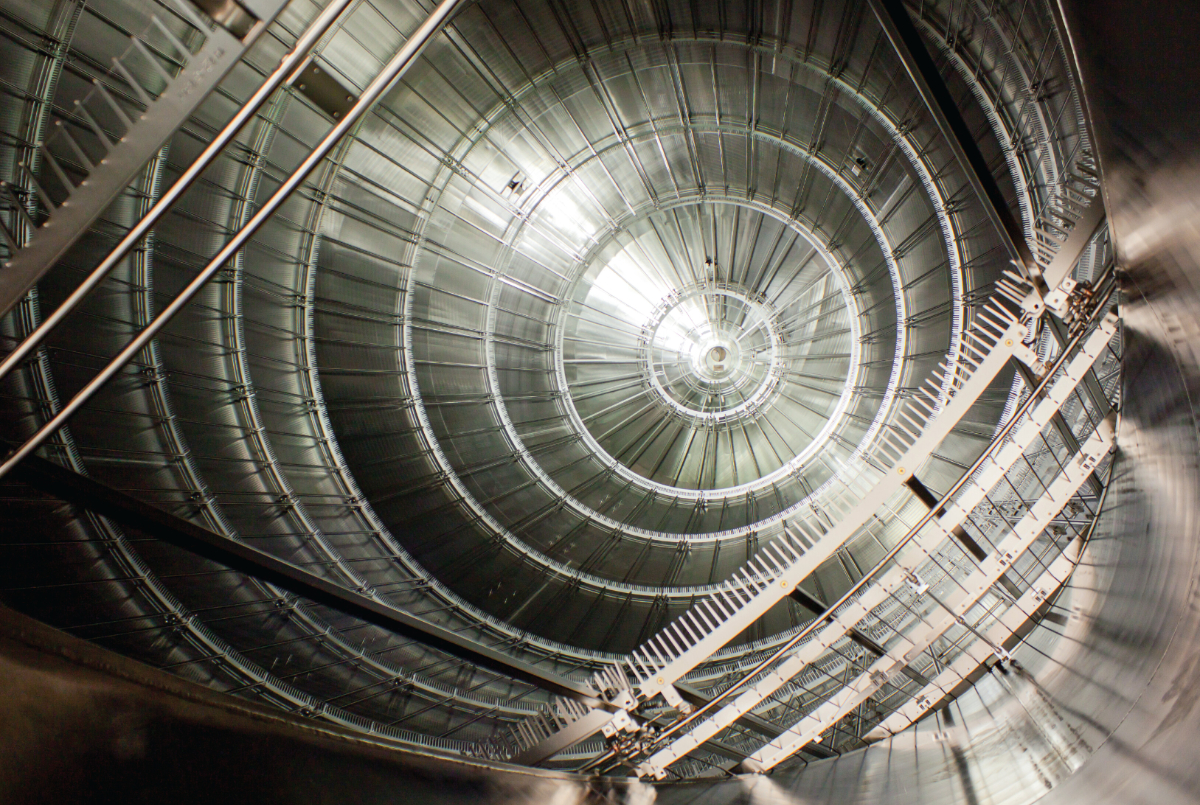
The 24-m-long main spectrometer of the KATRIN experiment is operated under ultrahigh vacuum. Credits: Michael Zacher/ KATRIN Collaboration
The KATRIN collaboration has succeeded in determining a new upper limit of 0.45 eV/c² for the neutrino mass. “The new result is a milestone on the way to the measurement goal of KATRIN,” says Kathrin Valerius, co-spokesperson of the KATRIN collaboration and professor at the Karlsruhe Institute of Technology.
Neutrinos play a key role both in the universe and in the world of fundamental particles, as they connect cosmic and subatomic scales: As remnants of the Big Bang, neutrinos still permeate our cosmos in large numbers – they are billions of times more abundant than atoms. As “cosmic architects”, they have helped shape the development of the universe. Their small but non-vanishing rest mass goes beyond the established standard model of elementary particle physics. It has not yet been possible to measure the neutrino mass directly in the laboratory.
The world-leading KArlsruhe TRItium Neutrino experiment (KATRIN) measures the neutrino mass using a direct and model-independent method. The KATRIN measurement is based on the work of W. Pauli and E. Fermi, who showed almost 100 years ago that precise beta decay spectroscopy can make the tiny neutrino mass visible. KATRIN analyzes the decay of the hydrogen isotope tritium into ³He in order to determine the neutrino mass from the energy distribution of the beta electrons. To do this, KATRIN needs a powerful tritium source operated at the Tritium Laboratory Karlsruhe (TLK). Measurement operations have been running since 2019 and will continue until the end of 2025.
Since 2002, leading European institutions have advanced early-stage training in astroparticle physics through the International Schools on Astroparticle Physics (ISAPP). This initiative fosters student mobility, knowledge exchange, and research collaboration, offering PhD students and early career researchers the chance to engage with experts. ISAPP organizes annual intensive schools in various locations, offering an immersive experience that enhances doctoral training while sparking innovation, discovery, and global collaboration.
Please find more information in the ISAPP newsletter: Issue 1, 2025
The APPEC Town Meeting will be held on-site in Zaragoza, Spain on 23-24 September 2025.
Town Meeting 2025: Preparation of the 2027-2036 Strategic Roadmap
As input for the preparation of the roadmap, a community survey took place over the last months. A briefing book including all Astroparticle Physics topics from the survey will be prepared by the APPEC Scientific Advisory Committee and released in summer.
During the Town Meeting we will further discuss each of these topics with respect to the European and international context, and the new developments in Astroparticle Physics and in the neighbouring fields that will shape the strategic recommendations of the next roadmap.
The 2-day meeting format includes plenary talks as well as round table discussions for each topic, to ensure a large participation of the community to shaping the future of Astroparticle Physics strategic orientations.
The discussions at the Town Meeting will serve as input for the European Astroparticle Physics Strategy 2027-2036.
The Astrophysics Centre of Multimessenger studies in Europe (ACME) project has opened the 1st Transnational Access call for its Centres of Expertise.
The deadline for the proposal submission is April 6th, 2025 at 17:00 CET.
The call aims to support research visits to European institutes that provide direct training and expert guidance in multi-messenger astronomy. The program covers a wide range of domains, including gravitational waves, neutrinos, cosmic rays, and photons across the entire electromagnetic spectrum, from very-high-energy gamma rays to X-rays, UV, optical, near-infrared, and radio bands. The goal is to enhance and expand expertise in the observational, data analysis, and theoretical aspects across the various ACME messengers and multi-wavelength domains.
Eligible candidates are scientists ( (PhD students, post-doc fellows, staff) from research institutes and universities in both EU and non-EU countries.
ACME objectives are to implement the APPEC and ASTRONET roadmaps’ recommendations and act as a pathfinder to broaden and improve access to the respective research infrastructures services and data.
The ACME project has received funding from the European Union’s Horizon Europe Research and Innovation programme under Grant Agreement No 101131928.